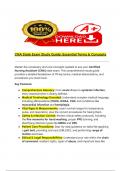
CNA State Exam Study Guide: Essential Terms & Concepts
aster the vocabulary and core concepts needed to ace yourCertified
M
Nursing Assistant (CNA)state exam. This comprehensivestudy guide
provides a detailed breakdown of 99 key terms, medical abbreviations, and
procedures you must know.
Key Features:
● C omprehensive Glossary:Fromacuteillness tosystemicinfection,
every essential term is clearly defined.
● Medical Terminology Decoded:Understand complex medicallanguage,
including abbreviations (OSHA, HIPAA, CVA) and conditionslike
myocardial infarctionandhemiplegia.
● Vital Signs & Measurements:Learn normal ranges fortemperature,
pulse, and respiration, plus the correct procedures for taking them.
● Safety & Infection Control:Review critical safetyprotocols, including
thefive moments for hand washing, properPPEdonning,and
identifying infection types likeMRSAandVRE.
● Patient Care Procedures:Step-by-step guidance ontasks like applying
agait belt, providing oral care (DBLOSC), and performingrange of
motionexercises.
● Ethical & Legal Responsibilities:Understand your role within thechain
of command, resident rights, types ofabuse, and important laws like
, BRA.
O
End-of-Life Care:Key terms related to hospice,palliativecare, and the
●
five stages of grieving(D
ABDA).
CNA State Exam: Key Terms and Definitions
1 . acute:a current illness that has severe symptoms and may be as a
result of sudden onset
. chain of command:the line of authority in the facility which addresses
2
to whom each employee/department reports
. culture change:a philosophy that focuses on providing
3
"person-centered" care to residents and creating a positive work
environment for healthcare workers
. Health Insurance Portability and Accountability Act:law that
4
requires health information to be kept secure and private
. interdisciplinary team:professionals from each discipline within the
5
nursing facility who meet to discuss and plan the care of the resident
. Long term care:care for persons who require 24 hour care and
6
assistance
. ombudsman:resident advocate who investigates complaints and
7
assists to achieve agreement between parties, often defending the rights
of residents
. palliative care:care that focuses on the comfort and dignity of the
8
person rather than curing him or her
9. projection:seeing feelings in others that are really your own
10. regression:going back to an old immature behavior
11. repression:blocking painful thoughts or feelings from the mind
aster the vocabulary and core concepts needed to ace yourCertified
M
Nursing Assistant (CNA)state exam. This comprehensivestudy guide
provides a detailed breakdown of 99 key terms, medical abbreviations, and
procedures you must know.
Key Features:
● C omprehensive Glossary:Fromacuteillness tosystemicinfection,
every essential term is clearly defined.
● Medical Terminology Decoded:Understand complex medicallanguage,
including abbreviations (OSHA, HIPAA, CVA) and conditionslike
myocardial infarctionandhemiplegia.
● Vital Signs & Measurements:Learn normal ranges fortemperature,
pulse, and respiration, plus the correct procedures for taking them.
● Safety & Infection Control:Review critical safetyprotocols, including
thefive moments for hand washing, properPPEdonning,and
identifying infection types likeMRSAandVRE.
● Patient Care Procedures:Step-by-step guidance ontasks like applying
agait belt, providing oral care (DBLOSC), and performingrange of
motionexercises.
● Ethical & Legal Responsibilities:Understand your role within thechain
of command, resident rights, types ofabuse, and important laws like
, BRA.
O
End-of-Life Care:Key terms related to hospice,palliativecare, and the
●
five stages of grieving(D
ABDA).
CNA State Exam: Key Terms and Definitions
1 . acute:a current illness that has severe symptoms and may be as a
result of sudden onset
. chain of command:the line of authority in the facility which addresses
2
to whom each employee/department reports
. culture change:a philosophy that focuses on providing
3
"person-centered" care to residents and creating a positive work
environment for healthcare workers
. Health Insurance Portability and Accountability Act:law that
4
requires health information to be kept secure and private
. interdisciplinary team:professionals from each discipline within the
5
nursing facility who meet to discuss and plan the care of the resident
. Long term care:care for persons who require 24 hour care and
6
assistance
. ombudsman:resident advocate who investigates complaints and
7
assists to achieve agreement between parties, often defending the rights
of residents
. palliative care:care that focuses on the comfort and dignity of the
8
person rather than curing him or her
9. projection:seeing feelings in others that are really your own
10. regression:going back to an old immature behavior
11. repression:blocking painful thoughts or feelings from the mind