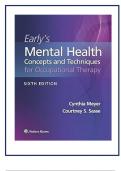
,2025 PRACTICE QUESTION BOOK: OT
MENTAL HEALTH FOUNDATIONS &
INTERVENTIONS
Comprehensive Review with NCLEX®-Style
Questions & Rationales – Cynthia Meyer &
Courtney Sasse, 6th Edition
• 23-Chapter Full Coverage | 20 MCQs Per
Chapter
• Verified Answers & Evidence-Based
Rationales
• Designed for OT/OTA Certification
Success
• Pass with Confidence – Ideal for
Coursework, Licensure & Board
,SECTION ONE: Principles of Occupational Therapy in Mental Health
Unit 1: History and Foundations
Chapter 1: History and Foundational Concepts
Chapter 2: Medical and Psychological Theories, Frames of Reference, and Models of Mental Health
and Mental Illness
Chapter 3: Occupational Therapy Frames of Reference and Practice Models
SECTION TWO: Mental Illness
Chapter 4: Understanding Psychiatric Diagnoses
SECTION THREE: Service Provision
Chapter 5: Human Occupation and Mental Health Throughout the Life Span With Those We Serve
SECTION THREE: Service Provision
Chapter 6: Methods and Models of Interaction and Intervention
Chapter 7: Service Areas, Environments, and Focuses
SECTION FOUR: Professional Practice Considerations
Chapter 8: Medications, Medical-Based Treatments, Complementary Practices, and Detoxification
Chapter 9: Safety Considerations and Techniques
Chapter 10: Using Evidence
Chapter 11: Professional Issues: Supervision, Teams, Roles, and Self-Management
Chapter 12: Evaluation and Data Collection
Chapter 13: Determining Type and Approach to Intervention
,Chapter 14: Matching Occupational Demands to Intervention Types
Chapter 15: Therapeutic Use of Self
Chapter 16: Group Concepts and Techniques in OT
Chapter 17: Facilitating Recovery Using Biopsychosocial Models
Chapter 18: Anxiety and Occupational Engagement
Chapter 20: Hallucinations, Delusions, and Paranoia
Chapter 22: Anger, Hostility, and Aggression
Chapter 23: Substance-Related and Addictive Disorders
,Chapter 1
Introduction (3 Questions)
1. Occupational therapy in mental health primarily
emphasizes:
A. Remediation of physical impairments
B. Engagement in meaningful activities
C. Diagnosis of psychiatric disorders
D. Medication management
Correct: B
Rationale: OT in mental health focuses on helping clients
engage in meaningful occupations to promote wellness;
diagnosis and medication are outside the OT’s primary
scope.
2. The foundational goal of occupational therapy is to:
A. Eliminate all symptoms of mental illness
B. Restore clients to pre-morbid functioning only
C. Enable participation in life roles
D. Provide lifelong custodial care
Correct: C
Rationale: OT aims to enable clients’ participation in
valued roles and routines; custodial care or symptom
elimination alone is not the central aim.
3. Early’s model of mental health OT highlights:
A. A strictly biomedical approach
B. Restriction of all non-essential activities
C. Adaptation of activities to client strengths
, D. The use of psychoanalysis only
Correct: C
Rationale: Early’s model advocates adapting activities to fit
client abilities, rather than solely biomedical or
psychoanalytic techniques.
Mental Health and Mental Illness (3 Questions)
4. Which best describes mental health according to Early?
A. Absence of any psychiatric diagnosis
B. A state of well-being enabling productive living
C. Permanent freedom from distress
D. Solely an individual characteristic
Correct: B
Rationale: Mental health is a dynamic state of well-being
and functioning, not simply absence of illness or individual
trait.
5. The term “mental illness” in OT context most properly
refers to:
A. Any temporary emotional upset
B. Diagnosable disorders affecting thinking or mood
C. Moral failings in character
D. Lifestyle choices
Correct: B
Rationale: It refers to diagnosable behavioral or
psychological syndromes; moral or lifestyle attributions
are outdated.
, 6. Early emphasizes that mental health and mental illness:
A. Exist on a continuum
B. Are mutually exclusive categories
C. Can’t co-occur
D. Are unchanging over time
Correct: A
Rationale: He describes them as points on a wellness–
illness continuum, with movement possible in either
direction.
Relation of Occupation to Mental Health (3 Questions)
7. Which statement best reflects occupation’s role in mental
health?
A. Occupations are merely tasks clients must complete
B. Occupations shape identity and well-being
C. Occupations should be avoided to reduce stress
D. Occupations have no therapeutic value
Correct: B
Rationale: Meaningful occupations contribute to self-
identity and well-being; avoidance contradicts OT
principles.
8. A client with anxiety benefits from structured leisure
activities because:
A. They distract from therapy
B. They provide mastery and routine
C. They replace all self-care tasks
, D. They strictly increase social status
Correct: B
Rationale: Structured activities offer mastery,
predictability, and routine, which can reduce anxiety
symptoms.
9. In Early’s framework, “doing” refers to:
A. Passive observation of tasks
B. Direct engagement in activities
C. Solely cognitive rehearsal
D. Only physical exercise
Correct: B
Rationale: “Doing” denotes active participation in
meaningful tasks, not passive or restricted to exercise.
A Few Words About Language (3 Questions)
10. Early cautions clinicians to avoid saying “crazy”
because it:
A. Is a precise diagnostic term
B. Reinforces stigma
C. Encourages client autonomy
D. Is endorsed by professional bodies
Correct: B
Rationale: “Crazy” is pejorative and perpetuates stigma; it
is neither precise nor professional.
, 11. Using “person-first” language (e.g., “person with
schizophrenia”) emphasizes:
A. The disorder over the individual
B. The individual’s humanity first
C. Medicalization of experience
D. A neutral stance on identity
Correct: B
Rationale: Person-first language foregrounds the individual
before the diagnosis, reducing dehumanization.
12. The phrase “behavioral health” is preferred because
it:
A. Excludes substance-related disorders
B. Broadens focus to behaviors, thoughts, and emotions
C. Implies only inpatient care
D. Is synonymous with physical health
Correct: B
Rationale: It captures the full spectrum of mental and
behavioral functioning, beyond symptom labels.
Thoughts About Terminology (3 Questions)
13. Early distinguishes “impairment” from “disability” by
noting that impairment is:
A. A social disadvantage
B. A loss or abnormality of function
C. Entirely environmental
D. Always permanent
, Correct: B
Rationale: Impairment refers to a bodily or mental
function loss; disability arises from interaction with
environment.
14. The term “occupational dysfunction” refers to:
A. Inability to engage in meaningful occupations
B. Financial hardship
C. Complete absence of all activity
D. A purely cognitive deficit
Correct: A
Rationale: It denotes disrupted occupational performance,
not economic or strictly cognitive issues.
15. Using “challenges” instead of “problems” when
discussing symptoms helps:
A. Minimize the client’s experience
B. Encourage a strengths-based perspective
C. Deny the existence of pathology
D. Focus only on medication
Correct: B
Rationale: “Challenges” frames difficulties in a less
pathologizing, more empowering way.
Historical Understanding (3 Questions)
16. The earliest occupational therapists were influenced
by:
MENTAL HEALTH FOUNDATIONS &
INTERVENTIONS
Comprehensive Review with NCLEX®-Style
Questions & Rationales – Cynthia Meyer &
Courtney Sasse, 6th Edition
• 23-Chapter Full Coverage | 20 MCQs Per
Chapter
• Verified Answers & Evidence-Based
Rationales
• Designed for OT/OTA Certification
Success
• Pass with Confidence – Ideal for
Coursework, Licensure & Board
,SECTION ONE: Principles of Occupational Therapy in Mental Health
Unit 1: History and Foundations
Chapter 1: History and Foundational Concepts
Chapter 2: Medical and Psychological Theories, Frames of Reference, and Models of Mental Health
and Mental Illness
Chapter 3: Occupational Therapy Frames of Reference and Practice Models
SECTION TWO: Mental Illness
Chapter 4: Understanding Psychiatric Diagnoses
SECTION THREE: Service Provision
Chapter 5: Human Occupation and Mental Health Throughout the Life Span With Those We Serve
SECTION THREE: Service Provision
Chapter 6: Methods and Models of Interaction and Intervention
Chapter 7: Service Areas, Environments, and Focuses
SECTION FOUR: Professional Practice Considerations
Chapter 8: Medications, Medical-Based Treatments, Complementary Practices, and Detoxification
Chapter 9: Safety Considerations and Techniques
Chapter 10: Using Evidence
Chapter 11: Professional Issues: Supervision, Teams, Roles, and Self-Management
Chapter 12: Evaluation and Data Collection
Chapter 13: Determining Type and Approach to Intervention
,Chapter 14: Matching Occupational Demands to Intervention Types
Chapter 15: Therapeutic Use of Self
Chapter 16: Group Concepts and Techniques in OT
Chapter 17: Facilitating Recovery Using Biopsychosocial Models
Chapter 18: Anxiety and Occupational Engagement
Chapter 20: Hallucinations, Delusions, and Paranoia
Chapter 22: Anger, Hostility, and Aggression
Chapter 23: Substance-Related and Addictive Disorders
,Chapter 1
Introduction (3 Questions)
1. Occupational therapy in mental health primarily
emphasizes:
A. Remediation of physical impairments
B. Engagement in meaningful activities
C. Diagnosis of psychiatric disorders
D. Medication management
Correct: B
Rationale: OT in mental health focuses on helping clients
engage in meaningful occupations to promote wellness;
diagnosis and medication are outside the OT’s primary
scope.
2. The foundational goal of occupational therapy is to:
A. Eliminate all symptoms of mental illness
B. Restore clients to pre-morbid functioning only
C. Enable participation in life roles
D. Provide lifelong custodial care
Correct: C
Rationale: OT aims to enable clients’ participation in
valued roles and routines; custodial care or symptom
elimination alone is not the central aim.
3. Early’s model of mental health OT highlights:
A. A strictly biomedical approach
B. Restriction of all non-essential activities
C. Adaptation of activities to client strengths
, D. The use of psychoanalysis only
Correct: C
Rationale: Early’s model advocates adapting activities to fit
client abilities, rather than solely biomedical or
psychoanalytic techniques.
Mental Health and Mental Illness (3 Questions)
4. Which best describes mental health according to Early?
A. Absence of any psychiatric diagnosis
B. A state of well-being enabling productive living
C. Permanent freedom from distress
D. Solely an individual characteristic
Correct: B
Rationale: Mental health is a dynamic state of well-being
and functioning, not simply absence of illness or individual
trait.
5. The term “mental illness” in OT context most properly
refers to:
A. Any temporary emotional upset
B. Diagnosable disorders affecting thinking or mood
C. Moral failings in character
D. Lifestyle choices
Correct: B
Rationale: It refers to diagnosable behavioral or
psychological syndromes; moral or lifestyle attributions
are outdated.
, 6. Early emphasizes that mental health and mental illness:
A. Exist on a continuum
B. Are mutually exclusive categories
C. Can’t co-occur
D. Are unchanging over time
Correct: A
Rationale: He describes them as points on a wellness–
illness continuum, with movement possible in either
direction.
Relation of Occupation to Mental Health (3 Questions)
7. Which statement best reflects occupation’s role in mental
health?
A. Occupations are merely tasks clients must complete
B. Occupations shape identity and well-being
C. Occupations should be avoided to reduce stress
D. Occupations have no therapeutic value
Correct: B
Rationale: Meaningful occupations contribute to self-
identity and well-being; avoidance contradicts OT
principles.
8. A client with anxiety benefits from structured leisure
activities because:
A. They distract from therapy
B. They provide mastery and routine
C. They replace all self-care tasks
, D. They strictly increase social status
Correct: B
Rationale: Structured activities offer mastery,
predictability, and routine, which can reduce anxiety
symptoms.
9. In Early’s framework, “doing” refers to:
A. Passive observation of tasks
B. Direct engagement in activities
C. Solely cognitive rehearsal
D. Only physical exercise
Correct: B
Rationale: “Doing” denotes active participation in
meaningful tasks, not passive or restricted to exercise.
A Few Words About Language (3 Questions)
10. Early cautions clinicians to avoid saying “crazy”
because it:
A. Is a precise diagnostic term
B. Reinforces stigma
C. Encourages client autonomy
D. Is endorsed by professional bodies
Correct: B
Rationale: “Crazy” is pejorative and perpetuates stigma; it
is neither precise nor professional.
, 11. Using “person-first” language (e.g., “person with
schizophrenia”) emphasizes:
A. The disorder over the individual
B. The individual’s humanity first
C. Medicalization of experience
D. A neutral stance on identity
Correct: B
Rationale: Person-first language foregrounds the individual
before the diagnosis, reducing dehumanization.
12. The phrase “behavioral health” is preferred because
it:
A. Excludes substance-related disorders
B. Broadens focus to behaviors, thoughts, and emotions
C. Implies only inpatient care
D. Is synonymous with physical health
Correct: B
Rationale: It captures the full spectrum of mental and
behavioral functioning, beyond symptom labels.
Thoughts About Terminology (3 Questions)
13. Early distinguishes “impairment” from “disability” by
noting that impairment is:
A. A social disadvantage
B. A loss or abnormality of function
C. Entirely environmental
D. Always permanent
, Correct: B
Rationale: Impairment refers to a bodily or mental
function loss; disability arises from interaction with
environment.
14. The term “occupational dysfunction” refers to:
A. Inability to engage in meaningful occupations
B. Financial hardship
C. Complete absence of all activity
D. A purely cognitive deficit
Correct: A
Rationale: It denotes disrupted occupational performance,
not economic or strictly cognitive issues.
15. Using “challenges” instead of “problems” when
discussing symptoms helps:
A. Minimize the client’s experience
B. Encourage a strengths-based perspective
C. Deny the existence of pathology
D. Focus only on medication
Correct: B
Rationale: “Challenges” frames difficulties in a less
pathologizing, more empowering way.
Historical Understanding (3 Questions)
16. The earliest occupational therapists were influenced
by: