Evaluating the Conscience
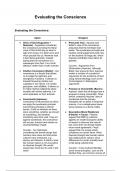
Evaluating the Conscience:
Agree Disagree
● Voice of God (Augustine + ● Presumes God - Aquinas and
Newman) - Augustine considered Butler’s view of the conscience
the conscience as being the literal presumes that the Christian God
voice of God informing us what is exists. The synderesis principle and
right and wrong. It is God’s love and intuitive moral judgements both rely
virtue poured into us. Newman took on the doctrine of imago dei, which
a less literal approach, instead Aquinas and Butler have taken for
saying that the conscience is a granted.
messenger from God. It is a truth
detector, rather than a truth inventor. Counter : Arguments from
Observation (Aquinas), although
● Intuitive Conscience (Butler) - Our Butler may presume God, Aquinas
conscience is a faculty that allows makes a number of a posteriori
us to judge the rightness and arguments for the existence of God
wrongness of actions. It directs us using natural theology such as the
towards favouring caritas over Cosmological or Teleological
cupiditas in our nature. It is innate, arguments
god-given, and infallible. It allows us
to make intuitive judgments about ● Purpose is Unscientific (Bacon) -
morality with divine authority. It is Aquinas’ claim that all things have a
what separates us from animals. purpose is being unscientific. Telos
(which underpins Aquinas’ idea of
● Conscientia (Aquinas) - synderesis and the primary
Conscience is the process by which precepts) has no place in empirical
we apply the synderesis principle science, it is a metaphysical issue
and primary precepts to ethical since purpose is a divine matter.
issues. It tells us whether we have
done something, whether we should ● Descriptive Moral Relativism
do something, and whether (Fletcher + Freud) - Fletcher
something was done well. If we act argued that DMR is evidence
against synderesis, the conscience against an innate God-given ability
will accuse, torment and rebuke us of reason to discover the natural
causing feelings of guilt. law, since then we should expect
more moral agreement. Freud
Counter : Too Optimistic, argued that it is society which
considering the terrible things that conditions our moral views. What
humans have done and that entire Aquinas thought was human nature
cultures have embraced, e.g. was really just his culture, since
slavery and Nazism, it starts to look differences in human morality tend
like human nature is not as positive to fall along cultural lines.
as Aquinas thought. We would
expect less moral evil to exist in the Counter : Cross-Cultural Morality,
world some moral principles, such as the
Golden Rule, are common across all
Evaluating the Conscience:
Agree Disagree
● Voice of God (Augustine + ● Presumes God - Aquinas and
Newman) - Augustine considered Butler’s view of the conscience
the conscience as being the literal presumes that the Christian God
voice of God informing us what is exists. The synderesis principle and
right and wrong. It is God’s love and intuitive moral judgements both rely
virtue poured into us. Newman took on the doctrine of imago dei, which
a less literal approach, instead Aquinas and Butler have taken for
saying that the conscience is a granted.
messenger from God. It is a truth
detector, rather than a truth inventor. Counter : Arguments from
Observation (Aquinas), although
● Intuitive Conscience (Butler) - Our Butler may presume God, Aquinas
conscience is a faculty that allows makes a number of a posteriori
us to judge the rightness and arguments for the existence of God
wrongness of actions. It directs us using natural theology such as the
towards favouring caritas over Cosmological or Teleological
cupiditas in our nature. It is innate, arguments
god-given, and infallible. It allows us
to make intuitive judgments about ● Purpose is Unscientific (Bacon) -
morality with divine authority. It is Aquinas’ claim that all things have a
what separates us from animals. purpose is being unscientific. Telos
(which underpins Aquinas’ idea of
● Conscientia (Aquinas) - synderesis and the primary
Conscience is the process by which precepts) has no place in empirical
we apply the synderesis principle science, it is a metaphysical issue
and primary precepts to ethical since purpose is a divine matter.
issues. It tells us whether we have
done something, whether we should ● Descriptive Moral Relativism
do something, and whether (Fletcher + Freud) - Fletcher
something was done well. If we act argued that DMR is evidence
against synderesis, the conscience against an innate God-given ability
will accuse, torment and rebuke us of reason to discover the natural
causing feelings of guilt. law, since then we should expect
more moral agreement. Freud
Counter : Too Optimistic, argued that it is society which
considering the terrible things that conditions our moral views. What
humans have done and that entire Aquinas thought was human nature
cultures have embraced, e.g. was really just his culture, since
slavery and Nazism, it starts to look differences in human morality tend
like human nature is not as positive to fall along cultural lines.
as Aquinas thought. We would
expect less moral evil to exist in the Counter : Cross-Cultural Morality,
world some moral principles, such as the
Golden Rule, are common across all