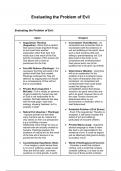
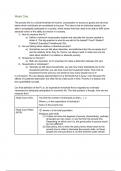
Evaluating the Problem of Evil
Evaluating the Problem of Evil:
Agree Disagree
● Augustinian Theodicy ● Inconsistent Triad (Mackie) - An
(Augustine) - Since God is perfect, omnipotent and omniscient God is
God cannot create imperfect things, inconsistent with the existence of
so evil must have another evil and suffering in the world, since
explanation other than God. Evil such a God would be able and
exists due to the result of the Fall, willing to prevent/destroy evil. Evil
and the corruption of the human will. does exist in the world, so an
God allows evil to exist as omnipotent and omnibenevolent
punishment for the Fall. God cannot exist; one of the
qualities has to be given up entirely.
● Free Will Defence (Plantinga) - It is
necessary that free will exists in the ● Determinism (Mackie) - Using free
perfect world that God created. will as an explanation for the
Plantinga continued his ‘free will problem of evil is incoherent since
defence’ by arguing that evil results the notion of libertarian free will is
as a consequence of free will but incoherent. An omnipotent and
that is unavoidable. omnibenevolent God could easily
create free beings (in the
● Privatio Boni (Augustine + compatibilist sense) that always
McCabe) - Evil is simply an absence choose to do good since they only
of good created by human free will, will to do good, however this is not
so God is not responsible for its the case. Human choices are
creation. McCabe defends this idea determined either by our
with the bad grape / bad chair environment or character, which is
analogy, showing ‘badness’ isn't a itself determined.
property in itself
● Evidential Problem of Evil (Hume)
● Natural Evil (Aquinas + Plantinga) - Even if the Augustinian Theodicy is
- Aquinas pointed out that what accepted, it still doesn't explain the
many humans see as ‘natural evil’ extent of evil and suffering,
only seems so from our perspective particularly of innocent children.
e.g a cat killing a mouse.
Additionally many things we see as ● Privatio Malus (Jung) - Augustine
natural evils are actually created by abuses language to make it seem
humans. Plantinga explains the like God is not responsible for the
existence of natural evil as the result existence of evil. It could be argued
of the free will of demons or as just as effectively that good is simply
punishment for the Fall a privation of evil.
● Counterfactual Hypothesis (Hick) ● World of Nothingness (O’Connor)
- If we imagine a world where there - Consider a world that contains
is no evil or suffering, people would nothing, and a world that contains
‘float and drift at ease’, and there constant suffering. It is clear to see
would be no moral growth. A world that one of those worlds contains
Evaluating the Problem of Evil:
Agree Disagree
● Augustinian Theodicy ● Inconsistent Triad (Mackie) - An
(Augustine) - Since God is perfect, omnipotent and omniscient God is
God cannot create imperfect things, inconsistent with the existence of
so evil must have another evil and suffering in the world, since
explanation other than God. Evil such a God would be able and
exists due to the result of the Fall, willing to prevent/destroy evil. Evil
and the corruption of the human will. does exist in the world, so an
God allows evil to exist as omnipotent and omnibenevolent
punishment for the Fall. God cannot exist; one of the
qualities has to be given up entirely.
● Free Will Defence (Plantinga) - It is
necessary that free will exists in the ● Determinism (Mackie) - Using free
perfect world that God created. will as an explanation for the
Plantinga continued his ‘free will problem of evil is incoherent since
defence’ by arguing that evil results the notion of libertarian free will is
as a consequence of free will but incoherent. An omnipotent and
that is unavoidable. omnibenevolent God could easily
create free beings (in the
● Privatio Boni (Augustine + compatibilist sense) that always
McCabe) - Evil is simply an absence choose to do good since they only
of good created by human free will, will to do good, however this is not
so God is not responsible for its the case. Human choices are
creation. McCabe defends this idea determined either by our
with the bad grape / bad chair environment or character, which is
analogy, showing ‘badness’ isn't a itself determined.
property in itself
● Evidential Problem of Evil (Hume)
● Natural Evil (Aquinas + Plantinga) - Even if the Augustinian Theodicy is
- Aquinas pointed out that what accepted, it still doesn't explain the
many humans see as ‘natural evil’ extent of evil and suffering,
only seems so from our perspective particularly of innocent children.
e.g a cat killing a mouse.
Additionally many things we see as ● Privatio Malus (Jung) - Augustine
natural evils are actually created by abuses language to make it seem
humans. Plantinga explains the like God is not responsible for the
existence of natural evil as the result existence of evil. It could be argued
of the free will of demons or as just as effectively that good is simply
punishment for the Fall a privation of evil.
● Counterfactual Hypothesis (Hick) ● World of Nothingness (O’Connor)
- If we imagine a world where there - Consider a world that contains
is no evil or suffering, people would nothing, and a world that contains
‘float and drift at ease’, and there constant suffering. It is clear to see
would be no moral growth. A world that one of those worlds contains