6/21/25, 9:02 PM NLN Nursing Entrance Exam (NEX) Science Review
NLN NURSING ENTRANCE (NEX ) SCIENCE REVIEW EXAM
2025\2026 ACTUAL EXAM COMPLETE QUESTIONS AND CORRECT
DETAILED ANSWERS (VERIFIED ANSWERS)
|ALREADY GRADED A+
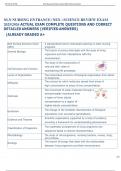
NLN Nursing Entrance Exam A standardized test for individuals planning to enter nursing
(NEX) programs.
The branch of science that deals with the study of living
General Biology
organisms and their interactions with the
environment.
The study of the components of
cells and their roles in
Cell Structure and Function
maintaining life processes.
Levels of Organization The hierarchical structure of biological organization from atoms
to biospheres.
The process by which molecules spread from areas of
Diffusion
high concentration to areas of low concentration.
The movement of water molecules through a
semipermeable membrane from
Osmosis
a region of lower solute
concentration to a region of
higher solute concentration.
The change in the heritable characteristics of biological
Evolution
populations over successive generations.
Scientific explanations supported by a body of evidence,
Evidence and Theories
providing a framework for understanding phenomena.
The systematic arrangement of living organisms into
Classification of Organisms
categories based on shared characteristics.
Microbiology The study of microorganisms, including bacteria, viruses, fungi,
and protozoa.
The branch of biology that deals with the relationships
Ecology
between living organisms and their environment.
… 1/38
,6/21/25, 9:02 PM NLN Nursing Entrance Exam (NEX) Science Review
The process by which green plants and some
other organisms use sunlight to
Photosynthesis
synthesize foods with the help
of chlorophyll.
Genetics The study of heredity and the variation of inherited
characteristics.
Dominance A genetic phenomenon where one allele masks the expression of
another allele.
Segregation The separation of alleles during gamete formation.
The principle stating that genes for different traits are
Independent Assortment
inherited independently of each other.
Deoxyribonucleic acid, the
molecule that carries the
DNA
genetic instructions for life.
Gastrointestinal System The organ system responsible for the digestion and absorption of
food.
The system that circulates blood and lymph
through the body, consisting of
Circulatory System
the heart, blood vessels, and
blood.
A part of the circulatory system that helps maintain fluid
Lymphatic System
balance and plays a role in immune function.
The system responsible for the
exchange of gases (oxygen and
Respiratory System
carbon dioxide) between the
body
and the environment.
The network of nerve cells and
fibers that transmits nerve
Nervous System
impulses between parts of the
body.
The system of glands that
produce hormones to regulate
Endocrine System
various bodily functions.
The organ system that enables humans and
animals to move using the
Musculoskeletal System
muscular and skeletal systems.
… 2/38
,6/21/25, 9:02 PM NLN Nursing Entrance Exam (NEX) Science Review
A type of tissue that supports, binds together, and
Connective Tissue
protects tissues and organs of the body.
Muscles Tissues in the body that have the ability to contract and produce
movement.
Urinary System The organ system responsible for the production, storage, and
elimination of urine.
The system involved in producing offspring.
Reproductive System
The organ system that protects the body from various
Integumentary System
kinds of damage, including loss of water or abrasion.
… 3/38
, 6/21/25, 9:02 PM NLN Nursing Entrance Exam (NEX) Science Review
Senses The physiological capacities of organisms that provide data for
perception.
Sight The ability to see; the visual perception of the environment.
Hearing The ability to perceive sound.
Taste and Smell The senses that detect flavors and odors, respectively.
Touch The sense that allows perception of pressure, temperature, and
pain.
Atomic Structure The arrangement of protons, neutrons, and electrons within an
atom.
Variants of a particular chemical element that have the
Isotopes
same number of protons but different numbers of
neutrons.
Atoms or molecules that have gained or lost one or more
Ions
electrons, resulting in a net charge.
A tabular arrangement of the chemical elements,
Periodic Table
organized by their atomic number, electron
configuration, and recurring chemical properties.
Bonding The process by which atoms or molecules combine to form new
compounds.
The distinct forms that different phases of matter take
States of Matter
on, typically solid, liquid, gas, and plasma.
Mixtures A combination of two or more substances that retain their
individual properties.
Solutions Homogeneous mixtures of two or more substances.
Tinctures Alcoholic extracts of plant or animal materials.
Mixtures of two or more immiscible liquids, where one
Emulsions
liquid contains a dispersion of the other.
Processes that lead to the transformation of one set of
Chemical Reactions
chemical substances to another.
Synthesis or Combination Reactions where two or more reactants combine to form a single
Reactions product.
Single Replacement Reactions Reactions where one element replaces another in a compound.
Double Displacement Reactions where the anions and cations of two different
Reactions compounds switch places.
Meaning of Health A state of complete physical, mental, and social well-being.
Levels of Health The various stages or degrees of health, ranging from optimal to
poor.
Elements that can affect an individual's health, including
Factors That Influence Health
genetics, environment, and lifestyle.
… 4/38