3.5 - Transport in humans (1) — blood, structures
and functions
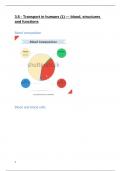
Blood composition
Blood and blood cells
● .
1
, ● Red blood cells (紅血球)
○ Red - due to large numbers of haemoglobin molecules found in
cytoplasm
○ Biconcave (雙凹) shape - large surface area to volume ratio, more
opportunities for oxygen to diffuse in/out
○ Packed with haemoglobin, help carry oxygen in blood
■ Haemoglobin is a protein, able to bind chemically to dissolved
oxygen molecules (in which the binding is easily reversed, so that
haemoglobin readily release oxygen molecules)
■ Reversible binding reaction between oxygen and haemoglobin, allows
blood carrying far more oxygen than if oxygen is simply dissolved in
plasma, and allows red blood cells to pick up dissolved oxygen in
capillaries of lungs where a lot of dissolved oxygen diffuses into
plasma from alveoli
○ Spend a very short time (about 1 second) inside a capillary whilst
loading/unloading its oxygen
○ Small & numerous - smaller cells → larger total surface area to volume
ratio in comparison to bigger cells → faster rate of diffusion; 5 million of
them per mm3, help themselves squeeze through smallest capillaries in
body
○ No nucleus - provides extra space inside cell for millions of extra
haemoglobin molecules, meaning that cell can carry extra oxygen
■ No genetic information in cell therefore only live for about a month
before dying, dead red blood cells continually replaced by fresh ones
made in bone marrow (骨髓)
2
and functions
Blood composition
Blood and blood cells
● .
1
, ● Red blood cells (紅血球)
○ Red - due to large numbers of haemoglobin molecules found in
cytoplasm
○ Biconcave (雙凹) shape - large surface area to volume ratio, more
opportunities for oxygen to diffuse in/out
○ Packed with haemoglobin, help carry oxygen in blood
■ Haemoglobin is a protein, able to bind chemically to dissolved
oxygen molecules (in which the binding is easily reversed, so that
haemoglobin readily release oxygen molecules)
■ Reversible binding reaction between oxygen and haemoglobin, allows
blood carrying far more oxygen than if oxygen is simply dissolved in
plasma, and allows red blood cells to pick up dissolved oxygen in
capillaries of lungs where a lot of dissolved oxygen diffuses into
plasma from alveoli
○ Spend a very short time (about 1 second) inside a capillary whilst
loading/unloading its oxygen
○ Small & numerous - smaller cells → larger total surface area to volume
ratio in comparison to bigger cells → faster rate of diffusion; 5 million of
them per mm3, help themselves squeeze through smallest capillaries in
body
○ No nucleus - provides extra space inside cell for millions of extra
haemoglobin molecules, meaning that cell can carry extra oxygen
■ No genetic information in cell therefore only live for about a month
before dying, dead red blood cells continually replaced by fresh ones
made in bone marrow (骨髓)
2