

1|Page
PRIMARY CARE II EXAM THREE: NEURO,
ENDO ONE, ENDO TWO
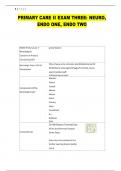
NS648 Primary Care II presentation
Neurological
Concerns in Primary
Care Spring 2024
https://www.urmc.rochester.edu/MediaLibraries/UR
Neurologic Exam: A bit of
MCMedia/ne urosurgery/images/5-minute-neuro-
Orientation
exam-handout.pdf
4 Minute Neuro Exam
Mental
Status
Cranial
Components of the
Nerves
Neurologic Exam
Motor
Exam
Sensory
Exam
Coordinati
on
Reflexes
Gait
On Old Olympus Towering Tops
A Finn and German Viewed
Cranial Nerves Some Hops
Some say marry money but my
brother says big brains matter
more
,2|Page
Confusion is not a disease
process or disease state but
rather a symptom. Confusion is
an inability to think quickly or
coherently. A confused patient
may be disoriented to time,
place, or
person and usually
demonstrates impairment of
cognitive functioning. It is
Confusion
usually demonstrated by
inappropriate reactions to
environmental stimuli, may
arise suddenly or gradually, and
may be either temporary or
irreversible.
Stressful events, lack of sleep or
food, or sensory deprivation
may precipitate confusion.
Age is not a reliable
predictor; however, older
adults are most at risk because
of polypharmacy (multiple
prescription drugs), the aging
process, preexisting dementia,
and the presence of chronic
disease.
Confusion is a key sign of neurologic disorders. The
physical examination will provide clues. One major
difficulty lies in
differentiating symptoms of delirium from dementia.
The clinician must establish whether the patient has
Confusion: Differential
Diagnosis delirium, a delirium superimposed on another
,3|Page
condition such as Alzheimer's disease (AD), or
another neurocognitive disorder apart from
delirium,
such as dementia. Once the disease has been
identified and treatment started, the symptom of
confusion may disappear. Differential diagnoses for
confusion involve almost all body systems
Dementia is a decline in
mental functioning,
affecting memory, cognition,
language, and personality.
persistent or more severe
confusion, with or without
psychomotor
hyperactivity
characterized by a
Dementia significant time span
between
symptom appearance and
death, defines dementia.
Delirium is An acute transient
disturbance in thought
process Clinically significant
confusion states in older
patients may lead the
provider to suspect
dementias such as AD; multi-
infarct dementia as a result of
CVA, or vascular dementia;
depression, which can cause
dementia; or
excessive consumption of
alcohol or drugs, which can
also cause dementia.
, 4|Page
The Diagnostic and Statistical Manual of Mental
Disorders (fifth edition; American Psychiatric
Association, 2013) 6th ed, now available. defines
dementia as significant cognitive impairment that
represents a significant decline from a previous
level of functioning.
Cognitive impairment refers to a decline in at least
one of the following cognitive domains:
Dementia: Continued Language
executive
function
Attention
perceptual-motor
function social
cognition
Learni
ng
Memo
ry
The disturbance must interfere with independence in
everyday activities and not be better accounted for
by another
neurocognitive disorder.
PRIMARY CARE II EXAM THREE: NEURO,
ENDO ONE, ENDO TWO
NS648 Primary Care II presentation
Neurological
Concerns in Primary
Care Spring 2024
https://www.urmc.rochester.edu/MediaLibraries/UR
Neurologic Exam: A bit of
MCMedia/ne urosurgery/images/5-minute-neuro-
Orientation
exam-handout.pdf
4 Minute Neuro Exam
Mental
Status
Cranial
Components of the
Nerves
Neurologic Exam
Motor
Exam
Sensory
Exam
Coordinati
on
Reflexes
Gait
On Old Olympus Towering Tops
A Finn and German Viewed
Cranial Nerves Some Hops
Some say marry money but my
brother says big brains matter
more
,2|Page
Confusion is not a disease
process or disease state but
rather a symptom. Confusion is
an inability to think quickly or
coherently. A confused patient
may be disoriented to time,
place, or
person and usually
demonstrates impairment of
cognitive functioning. It is
Confusion
usually demonstrated by
inappropriate reactions to
environmental stimuli, may
arise suddenly or gradually, and
may be either temporary or
irreversible.
Stressful events, lack of sleep or
food, or sensory deprivation
may precipitate confusion.
Age is not a reliable
predictor; however, older
adults are most at risk because
of polypharmacy (multiple
prescription drugs), the aging
process, preexisting dementia,
and the presence of chronic
disease.
Confusion is a key sign of neurologic disorders. The
physical examination will provide clues. One major
difficulty lies in
differentiating symptoms of delirium from dementia.
The clinician must establish whether the patient has
Confusion: Differential
Diagnosis delirium, a delirium superimposed on another
,3|Page
condition such as Alzheimer's disease (AD), or
another neurocognitive disorder apart from
delirium,
such as dementia. Once the disease has been
identified and treatment started, the symptom of
confusion may disappear. Differential diagnoses for
confusion involve almost all body systems
Dementia is a decline in
mental functioning,
affecting memory, cognition,
language, and personality.
persistent or more severe
confusion, with or without
psychomotor
hyperactivity
characterized by a
Dementia significant time span
between
symptom appearance and
death, defines dementia.
Delirium is An acute transient
disturbance in thought
process Clinically significant
confusion states in older
patients may lead the
provider to suspect
dementias such as AD; multi-
infarct dementia as a result of
CVA, or vascular dementia;
depression, which can cause
dementia; or
excessive consumption of
alcohol or drugs, which can
also cause dementia.
, 4|Page
The Diagnostic and Statistical Manual of Mental
Disorders (fifth edition; American Psychiatric
Association, 2013) 6th ed, now available. defines
dementia as significant cognitive impairment that
represents a significant decline from a previous
level of functioning.
Cognitive impairment refers to a decline in at least
one of the following cognitive domains:
Dementia: Continued Language
executive
function
Attention
perceptual-motor
function social
cognition
Learni
ng
Memo
ry
The disturbance must interfere with independence in
everyday activities and not be better accounted for
by another
neurocognitive disorder.

