

Module 7 Ochem 219 Portage (Final exam prep)
1. Heterocycles ans cyclic organic molecule where one or more carbon atoms
are replaced by heteroatoms
2. Heteroatoms ans Atoms in an organic compound other than carbon and
hydrogen Exans Oxygen, Nitrogen, Sulfur
3. Two main subgroups of heterocycles ans 1. aromatic
2. aliphatic (non-aromatic)
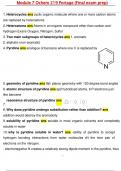
4. Pyridine ans analogue of benzene where one C is replaced by N
5. geometry of pyridine ans flat/ planar geometry with 120 degree bond angles
6. atomic structure of pyridine ans sp2 hybridized atoms, 6 P electrons just
like benzene
resonance structure of pyridine ans
7.
8. Why does pyridine undergo substitution rather than addition? ans
addition would destroy the aromaticity
9. solubility of pyridine ans soluble in most organic solvents and completely
soluble in water
10. why is pyridine soluble in water? ans -ability of pyridine to accept
hydrogen bonding interactions from water molecules d/t the lone pair of
electrons on the nitrogen.
- electronegative N creates a relatively strong dipole moment in the pyridine, thus
1/9
, Module 7 Ochem 219 Portage (Final exam prep)
making it an apolar compound overall.
11. BP of pyridine vs benzene? why? ans -pyridine has a higher BP than
benzene even though they have a similar weight
-why? dipole/dipole forces
12. Is pyridine an acid or base? ans weak base
will form pyridinium salt when reacted with strong acids
13. Two main reaction types of pyridine? ans 1. EAS- Electrophilic Aromatic
Substi- tution
2. NAS- Nucleophilic Aromatic Substitution
14. What happens in the EAS of pyridine? ans a hydrogen is replaced by an
elec- trophile
15. What conditions are needed for pyridine to undergo EAS? ans very slow
and very harsh conditions- need very hot heat and a strong acid
2/9
1. Heterocycles ans cyclic organic molecule where one or more carbon atoms
are replaced by heteroatoms
2. Heteroatoms ans Atoms in an organic compound other than carbon and
hydrogen Exans Oxygen, Nitrogen, Sulfur
3. Two main subgroups of heterocycles ans 1. aromatic
2. aliphatic (non-aromatic)
4. Pyridine ans analogue of benzene where one C is replaced by N
5. geometry of pyridine ans flat/ planar geometry with 120 degree bond angles
6. atomic structure of pyridine ans sp2 hybridized atoms, 6 P electrons just
like benzene
resonance structure of pyridine ans
7.
8. Why does pyridine undergo substitution rather than addition? ans
addition would destroy the aromaticity
9. solubility of pyridine ans soluble in most organic solvents and completely
soluble in water
10. why is pyridine soluble in water? ans -ability of pyridine to accept
hydrogen bonding interactions from water molecules d/t the lone pair of
electrons on the nitrogen.
- electronegative N creates a relatively strong dipole moment in the pyridine, thus
1/9
, Module 7 Ochem 219 Portage (Final exam prep)
making it an apolar compound overall.
11. BP of pyridine vs benzene? why? ans -pyridine has a higher BP than
benzene even though they have a similar weight
-why? dipole/dipole forces
12. Is pyridine an acid or base? ans weak base
will form pyridinium salt when reacted with strong acids
13. Two main reaction types of pyridine? ans 1. EAS- Electrophilic Aromatic
Substi- tution
2. NAS- Nucleophilic Aromatic Substitution
14. What happens in the EAS of pyridine? ans a hydrogen is replaced by an
elec- trophile
15. What conditions are needed for pyridine to undergo EAS? ans very slow
and very harsh conditions- need very hot heat and a strong acid
2/9


