100% de satisfacción garantizada Inmediatamente disponible después del pago Tanto en línea como en PDF No estas atado a nada 4,6 TrustPilot
logo-home
Examen

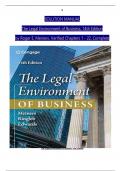
SOLUTION MANUAL The Legal Environment of Business, 14th Edition by Roger E. Meiners, Verified Chapters 1 - 22, Complete DR ERIC

Puntuación
-
Vendido
-
Páginas
164
Grado
A+
Subido en
18-06-2025
Escrito en
2024/2025

SOLUTION MANUAL The Legal Environment of Business, 14th Edition by Roger E. Meiners, Verified Chapters 1 - 22, Complete DR ERIC DR ERIC = The Legal Environment of Business, 14th Edition DR ERIC DR ERIC = The Legal Environment of Business, 14th Edition TABLE OF CONTENTS  Chapter 1. Today’s Business Environment: Law and Ethics  Chapter 2. The Court Systems  Chapter 3. Trials and Resolving Disputes  Chapter 4. The Constitution: Focus on Application to Business  Chapter 5. Criminal Law and Business  Chapter 6. Elements of Torts  Chapter 7. Business Torts and Product Liability  Chapter 8. Real and Personal Property  Chapter 9. Intellectual Property  Chapter 10. Contracts  Chapter 11. Domestic and International Sales  Chapter 12. Business Organizations  Chapter 13. Negotiable Instruments, Credit, and Bankruptcy  Chapter 14. Agency and the Employment Relationship  Chapter 15. Employment and Labor Regulations  Chapter 16. Employment Discrimination  Chapter 17. The Regulatory Process  Chapter 18. Securities Regulation  Chapter 19. Consumer Protection DR ERIC DR ERIC = The Legal Environment of Business, 14th Edition  Chapter 20. Antitrust Law  Chapter 21. Environmental Law  Chapter 22. The International Legal Environment of Business CHAPTER 1 Table of Contents Answer to Discussion Question.................................................................................................................................1 Answers to Case Questions.........................................................................................................................................1 Answers to Ethics and Social Questions.................................................................................................................3 Answer to Discussion Question Should the common law maxim “Ignorance of the law is no excuse” apply to an immigrant who speaks little English and was not educated in the United States? How about for a tourist who does not speak English? Everyone knows criminal acts are prohibited, but what about subtler rules that differ across countries and so may be misunderstood by foreigners? Answer: It is generally true that ignorance of the law is no excuse. Citizens are deemed to have constructive knowledge of the law. Yet, as well known as this rule is, it is surprising how often it is proffered as an excuse. (A Westlaw search cases finds hundreds of examples). Examples include: Deluco v. Dezi (Conn. Super) (lack of knowledge regarding the state‘s usury laws is no excuse for the inclusion of an illegal interest rate in a sales contract); and Plumlee v. Paddock (ignorance of thefact that the subject matter of the contract was illegal was not excuse). The courts have provided a small exception to the rule when it comes to people in lack of English language skills. Consider Flanery v. Kuska, (defendant did not speak English was advised by a friend that an answer to a complaint was not required); Ramon v. Dept. of Transportation, (no English and an inability to understand the law required for an excuse); Yurechko v. County of Allegheny, (Ignorance and with the fact that the municipality suffered no hardship in late lawsuit filing was an excuse). Answers to Case Questions 1. Facts from an English judge’s decision in 1884: “The crew of an English yacht.............were cast away in a storm on the high seas . . . and were compelled to put into an open boat. ........They had no supply of water and no supply of food. . . . That on the eighteenth day . . . they.........suggested that one should be sacrificed to save the rest. . . . That next day . . . they . . . went to the boy............put a knife into his throat and killed him . . . the three men fed upon the body.......of the boy for four days; [then] DR ERIC DR ERIC = The Legal Environment of Business, 14th Edition the boat was picked up by a passing vessel, and [they] were rescued. . . . and committed for trial. . . . if the men had not fed upon the body of the boy they would probably not have survived to be sopicked up and rescued, but would....have died of famine. The boy, being in a much weaker condition, was likely to have died before them ........ The real question in this case [is] whether killing under the conditions set forth....... be or be not murder.” Do you consider the acts to be immoral? [Regina v. Dudley and Stephens, 14 Queens Bench Division 273 (1884)] Answer: This points out that the legal system has limits. Its acceptability is dictated by legal culture--which determines whether law will be enforced, obeyed, avoided, or abused. It is limited by the informal rules of the society--its customs and values. One limit is the extent to which society will allow the formal rules to be imposed when a crime is committed in odd circumstances. Here there was an intentional murder. Does the motive for the murder, the effort to save several lives by sacrificing one DR ERIC DR ERIC = The Legal Environment of Business, 14th Edition life, make it a crime that should be punished? Not all crimes are treated the same. It also raises questions about the desirability of not giving judges flexibility in sentencing. There was a precedent for a light sentence in this case in U.S. law: U.S. v. Holmes, 20 F. Cas. 360 (No. 15383) (C.C.E.D. Pa. 1842). The case involved a sinking ocean liner. Several passengers madeit to the only lifeboat, which was far too overcrowded. The captain decided to save the women and children and threw several men overboard. The lifeboat was rescued. The grand jury refused to indict the captain from murder, only for manslaughter. He got a six month sentence. The British judge in the case here imposed the death penalty upon the person who survived. The judge found it difficult to rule that every man on board had the right to make law by his own hand.The Crown reduced the sentence to six months. 2. Smoking is a serious health hazard. Cigarettes are legal. Should cigarette manufacturers be liable for the serious illnesses and untimely deaths caused by their unavoidably dangerous products, even though they post a warning on the package and consumers voluntarily assume the health risks by smoking? [Cipollone v. Liggett Group, Inc., 505 U.S. 504 (1992)] Answer: The general rule that exists now is that since the government has ordered the posting of warning labels on cigarettes, and since the dangers of smoking are well known, consumers have been warned and are not due compensation if they kill themselves by smoking. The Cippoline case, since reviewed by the Supreme Court, appears to be of limited impact since the victim was adjudged to have become addicted to cigarettes before the warning label was ordered in 1964. If cigarette makers were held responsible for all health problems associated with cigarettes, then, like alcohol and other dangerous products, the damages would likely be so high it would effectively ban the products. Presumably, in a free society if adults are clearly informed of the risks of products that cannot be made safe, they accept the risk. Tobacco and alcohol producers cannot take the dangers out of the products except at the margin by encouraging responsible drinking and the like. Are drugs like cocaine different? 3. Two eight-year-old boys were seriously injured when riding Honda mini-trail bikes. The boys were riding on public streets, ran a stop sign, and were hit by a truck. The bikes had clear warning labels on the front stating they were only for off-road use. The manual stated the bikes were not to be usedon public streets. The parents sued Honda. The supreme court of Washington said one basic issue existed: “Is a manufacturer liable when children are injured while riding one of its mini-trail bikes on apublic road in violation of manufacturer and parental warnings?” Is it unethical to make products like mini-trail bikes children will use when we know accidents like this will happen? [Baughn v. Honda Motor Co., 727 P.2d 655 Sup. Ct, Wash., (1986)] Answer: The court found no liability for the manufacturers. There was no defect; the product was safe for intended use. Safety instructions were clear; the parents let the boys ride the bikes. Anything can be dangerous--baseballs are dangerous when they hit the head, swings are dangerous when kids jump out of them; there is only so much that can be done to make the government the ―national nanny‖ asthe Washington Post once said about excessive consumer protection. Parents must accept a high degree of responsible for their own children. 4. Johnson Controls adopted a “fetal protection policy” that women of childbearing age could not work in the battery-making division of the company. Exposure to lead in the battery operation could causeharm to unborn babies. The company was concerned about possible legal liability for injury sufferedby babies of mothers who had worked in the battery division. The Supreme Court held the

Mostrar más Leer menos
Institución
DRGGGGERIC
Grado
DRGGGGERIC

Vista previa del contenido

DR ERIC
=


SOLUTION MANUAL

The Legal Environment of Business, 14th Edition

by Roger E. Meiners, Verified Chapters 1 - 22, Complete


The Legal Environment of Business, 14th Edition

DR ERIC

, DR ERIC
=


The Legal Environment of Business, 14th Edition

DR ERIC

, DR ERIC
=


TABLE OF CONTENTS
 Chapter 1. Today’s Business Environment: Law and Ethics

 Chapter 2. The Court Systems

 Chapter 3. Trials and Resolving Disputes

 Chapter 4. The Constitution: Focus on Application to Business

 Chapter 5. Criminal Law and Business

 Chapter 6. Elements of Torts

 Chapter 7. Business Torts and Product Liability

 Chapter 8. Real and Personal Property

 Chapter 9. Intellectual Property

 Chapter 10. Contracts

 Chapter 11. Domestic and International Sales

 Chapter 12. Business Organizations

 Chapter 13. Negotiable Instruments, Credit, and Bankruptcy

 Chapter 14. Agency and the Employment Relationship

 Chapter 15. Employment and Labor Regulations

 Chapter 16. Employment Discrimination

 Chapter 17. The Regulatory Process

 Chapter 18. Securities Regulation

 Chapter 19. Consumer Protection


The Legal Environment of Business, 14th Edition

DR ERIC

, DR ERIC
=

 Chapter 20. Antitrust Law

 Chapter 21. Environmental Law

 Chapter 22. The International Legal Environment of Business


CHAPTER 1

Table of Contents
Answer to Discussion Question ................................................................................................................................. 1
Answers to Case Questions ......................................................................................................................................... 1
Answers to Ethics and Social Questions ................................................................................................................. 3


Answer to Discussion Question
Should the common law maxim “Ignorance of the law is no excuse” apply to an immigrant who speaks
little English and was not educated in the United States? How about for a tourist who does not speak
English? Everyone knows criminal acts are prohibited, but what about subtler rules that differ across
countries and so may be misunderstood by foreigners?
Answer: It is generally true that ignorance of the law is no excuse. Citizens are deemed to have
constructive knowledge of the law. Yet, as well known as this rule is, it is surprising how often it is
proffered as an excuse. (A Westlaw search cases finds hundreds of examples). Examples include:
Deluco v. Dezi (Conn. Super) (lack of knowledge regarding the state‘s usury laws is no excuse for the
inclusion of an illegal interest rate in a sales contract); and Plumlee v. Paddock (ignorance of the fact
that the subject matter of the contract was illegal was not excuse). The courts have provided a small
exception to the rule when it comes to people in lack of English language skills. Consider Flanery v.
Kuska, (defendant did not speak English was advised by a friend that an answer to a complaint was
not required); Ramon v. Dept. of Transportation, (no English and an inability to understand the law
required for an excuse); Yurechko v. County of Allegheny, (Ignorance and with the fact that the
municipality suffered no hardship in late lawsuit filing was an excuse).


Answers to Case Questions
1. Facts from an English judge’s decision in 1884: “The crew of an English yacht............. were cast away in
a storm on the high seas . . . and were compelled to put into an open boat. ........ They had no supply
of water and no supply of food. . . . That on the eighteenth day . . . they ......... suggested that one
should be sacrificed to save the rest. . . . That next day . . . they . . . went to the boy ............ put a knife
into his throat and killed him . . . the three men fed upon the body....... of the boy for four days; [then]

The Legal Environment of Business, 14th Edition

DR ERIC
Escuela, estudio y materia

Institución
DRGGGGERIC
Grado
DRGGGGERIC

Información del documento

Subido en
18 de junio de 2025
Número de páginas
164
Escrito en
2024/2025
Tipo
Examen
Contiene
Preguntas y respuestas

Temas

$10.49
Accede al documento completo:

100% de satisfacción garantizada
Inmediatamente disponible después del pago
Tanto en línea como en PDF
No estas atado a nada

Conoce al vendedor

Seller avatar
Los indicadores de reputación están sujetos a la cantidad de artículos vendidos por una tarifa y las reseñas que ha recibido por esos documentos. Hay tres niveles: Bronce, Plata y Oro. Cuanto mayor reputación, más podrás confiar en la calidad del trabajo del vendedor.
DRERIC University Of Washington
Ver perfil
Seguir Necesitas iniciar sesión para seguir a otros usuarios o asignaturas
Vendido
18
Miembro desde
1 año
Número de seguidores
1
Documentos
1186
Última venta
21 horas hace
NURSING BUSINESS AND ENGINEERING

Assignments, Case Studies, Research, Essay writing service, Questions and Answers, Discussions etc. for students who want to see results twice as fast. I have done papers of various topics and complexities. I am punctual and always submit work on-deadline. I write engaging and informative content on all subjects. Send me your research papers, case studies, psychology papers, etc, and I’ll do them to the best of my abilities. Writing is my passion when it comes to academic work. I’ve got a good sense of structure and enjoy finding interesting ways to deliver information in any given paper. I love impressing clients with my work, and I am very punctual about deadlines. Send me your assignment and I’ll take it to the next level. I strive for my content to be of the highest quality. Your wishes come first— send me your requirements and I’ll make a piece of work with fresh ideas, consistent structure, and following the academic formatting rules. For every student you refer to me with an order that is completed and paid transparently, I will do one assignment for you, free of charge!!!!!!!!!!!! WELCOME TO MY STORE .I APPRECIATE YOU BEING HERE TO FIND THE QUALITY TEST BANKS AND EXAMS YOU NEED FOR THAT I SAY THANK YOU. EVERYTHING HERE IS QUALITY , WELL RESEARCHED AND VERIFIED WITH THE PROPER PRCING . BE ASSURED TO 100% PASS YOUR EXAMS . REMEBER YOU CAN RATE MY DOCUMENTS .THANK YOU AGAIN FOR BEING HERE

Lee mas Leer menos
3.5

4 reseñas

5
2
4
0
3
1
2
0
1
1

Recientemente visto por ti

Por qué los estudiantes eligen Stuvia

Creado por compañeros estudiantes, verificado por reseñas

Calidad en la que puedes confiar: escrito por estudiantes que aprobaron y evaluado por otros que han usado estos resúmenes.

¿No estás satisfecho? Elige otro documento

¡No te preocupes! Puedes elegir directamente otro documento que se ajuste mejor a lo que buscas.

Paga como quieras, empieza a estudiar al instante

Sin suscripción, sin compromisos. Paga como estés acostumbrado con tarjeta de crédito y descarga tu documento PDF inmediatamente.

Student with book image

“Comprado, descargado y aprobado. Así de fácil puede ser.”

Alisha Student

Preguntas frecuentes