

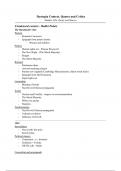
Dystopia Context, Quotes and Critics
Maddie, Ella, Roshy and Mariya
Condensed context - Bullet Points
The Handmaid's Tale
Women
- Romania Ceausescu
- Epigraph from potato famine
- Women and children
Politics
- Human rights act - Eleanor Roosevelt
- The New Right - (The Moral Majority)
- Reagan
- The Moral Majority
Religion
- Puritanism ideas
- Atwood studying religion
- Puritan new england (Cambridge Massachusetts, Salem witch trials)
- Epigraph from Old Testament
- Equal rights act
Censorship
- Burning of books
- Nazi/Soviet/Chinese propaganda
WWII
- Nuclear and Fertility - impact on environmentalism
- The Moral Majority
- White rose group
- Eugenics
Totalitarianism
- Nazi/Soviet/Chinese propaganda
- Cultural revolution
- Influence of Orwell
1984
Surveillance
- Nazi youth/ the spies
- Secret police
Political stances
- Communist - i.e. dictators
- Goldstein = Trotsky
- NKVD cells - Stalin
Censorship and propaganda
, - Spanish civil war
- Cult of personality
- Cold war - American propaganda
- Burning of books - Fahrenheit 451
Condensed Wider reading themes
The Time Machine by H. G. Wells (1895)
- Political commentary of late Victorian England - Wells was a socialist
- (Marxist) Criticism of Victorian decadence: simple, ambitionless Elois descend from
ruling elite + smart but monstrous morlocks descend from poor factory workers-
satirises negative perceptions of working class
- Novel starts as a deceptive communist utopia that is ultimately revealed to be an
exaggerated future vision of capitalist dystopia
- Bleak depiction of the future - no hope. Futility in him not returning.
Brave New World by Aldous Huxley (1932)
- Consumerism above all else
- Hierarchy: Cast system based of genetics, advanced Alphas and Betas at the top,
epsilons who have had their growth stunted at the bottom
- —> also seen in THT and 1984
- Technology and scientific development as a means of control
- Genetic engineering and eugenics
- Use of ‘soma’ drug
- Suppression of individuality
- In Brave new world, totalitarianism is more subtle. Less fear and violence, more
convincing the public to adore their slavery
- ‘Freedom is slavery’ love of big brother
- Cult of personality around Henry Ford
Animal Farm by Orwell (1945)
- Corruption of Government and manipulation of ideology (USSR)
- Inevitability of class structure
- Repression of the working class (USSR)
- Manipulation of language "all animals are equal, but some animals are more equal
than others."
- Novel is an allegory for the Russian Revolution as Old Major (Lenin/Marx) is
overthrown by Napoleon (Stalin) and Old Major's ideology is manipulated.
Fahrenheit 451 by Ray Bradbury (1951)
, - Stance against censorship + defence of literature as vital to civilization - McCarthy
era threat of book burning in the US + dangers of mass media
- Firefighter turned rebel - movement beyond ignorance
- Theme of willful ignorance + books as symbol of power
- Nazi book burnings + Stalin's great purge
- Heavy surveillance + devaluation of intelligence - means of complacency
A Clockwork Orange by Anthony Burgess (1962)
- Inspired by the rising threat of totalitarianism
- Addresses issues of human nature, morality, and importance of free will
- Repressive + Totalitarian super state → violent youth culture → encouraged by
Burgess’ visit to Leningrad in 1961
- Illusion of freedom
The Drowned World by J. G. Ballard (1962)
- New wave science fiction - rejection of linear + formulaic plotlines of Golden Age
sci-fi
- Global warming causes majority of earth to become uninhabitable
- Centres on regression, or devolution of human condition to primitive state
- Power of nature - proleptic for climate change before this was a common conception
Memoirs of a Survivor by Doris Lessing (1974)
- Takes place in a near future Britain where society has broken down due to an
unspecified disaster referred to as ‘The Crisis’
- Meaningless violence of the gangs made up of children who have overrun the city
- Transitional generation - the narrator notices society deteriorating, but passively
watches rather than leaving with the gangs moving through the city - cowardice
(offred?)
The Children of Men by P. D. James (1992)
- Infertility and human extinction - baby as a symbol of hope
- Authoritarianism and Oppression
- Loss of Individual Rights
- Dehumanization and Disregard for the Elderly
- Violence and Exploitation
- Spiritual and Moral Decay
- Nationalism of Thatcher’s rule
- The scapegoating of immigrants (fugees)
The Parable of the Sower by Octavia Butler (1993)
- Climate Catastrophe & Resource Scarcity
- Economic Collapse & Widening Inequality
- Breakdown of Law & Order Corporate Domination & Neo-Slavery
- Religious Extremism & New Belief Systems - Earthseed, God is Change.
, - Hyper-Violence & Social Decay - The drug "Pyro"
- Isolation & Fortress Communities
- Loss of Government Legitimacy
The Road by Cormac McCarthy (2006)
- Survival in a Post-Apocalyptic World
- Breakdown of Civilization & Lawlessness
- Loss of Morality & Cannibalism -
- Parental Love & Duty in a Hopeless World -
- Isolation & Loneliness -
- Environmental Destruction & Resource Scarcity
- Hopelessness vs. Hope
- Fear & Paranoia
Context
Contextual examples
Literary examples
Critics
Literary
The Handmaid’s Tale
General
Written in 1984 (Orwell influence) while Atwood was living in West Berlin. Published in
1985.
The second quotation of the epigraph is from Jonathan Swift's A Modest Proposal (1729), a
desperate plea for improving conditions in Ireland in the 1720s recommending cannibalism
and the treatment of women and children as cattle. In using it, Atwood signals at the very
opening of the book her thematic and satiric intentions.
Set in Cambridge, Massachusetts - the location of one of the earliest puritan settlements.
- Like the commanders the puritans created a society that rigidly adheres to a set of
religious beliefs with dissent punished.
Cambridge is also near salem the location of the witch trials
- Salvagings and Particicution have similarities to the mass hysteria of the witch trials
- In the 1600s, accusing someone of witchcraft quickly became a common occurrence.
Mass hysteria and paranoia combined with a rudimentary legal system meant that
anyone could be convicted of being a witch—and sentenced to death because of it.
- Links with Arthur Miller’s The Crucible: the Salvagings and the Particicution have
similarities with the hysteria of the witch trials in Salem (which Cambridge is near)
- Dedication to Atwood’s ancestor, the witch Mary Webster who was hung but
survived. Republic of Gilead is eerily reminiscent of the extreme religious intolerance
Maddie, Ella, Roshy and Mariya
Condensed context - Bullet Points
The Handmaid's Tale
Women
- Romania Ceausescu
- Epigraph from potato famine
- Women and children
Politics
- Human rights act - Eleanor Roosevelt
- The New Right - (The Moral Majority)
- Reagan
- The Moral Majority
Religion
- Puritanism ideas
- Atwood studying religion
- Puritan new england (Cambridge Massachusetts, Salem witch trials)
- Epigraph from Old Testament
- Equal rights act
Censorship
- Burning of books
- Nazi/Soviet/Chinese propaganda
WWII
- Nuclear and Fertility - impact on environmentalism
- The Moral Majority
- White rose group
- Eugenics
Totalitarianism
- Nazi/Soviet/Chinese propaganda
- Cultural revolution
- Influence of Orwell
1984
Surveillance
- Nazi youth/ the spies
- Secret police
Political stances
- Communist - i.e. dictators
- Goldstein = Trotsky
- NKVD cells - Stalin
Censorship and propaganda
, - Spanish civil war
- Cult of personality
- Cold war - American propaganda
- Burning of books - Fahrenheit 451
Condensed Wider reading themes
The Time Machine by H. G. Wells (1895)
- Political commentary of late Victorian England - Wells was a socialist
- (Marxist) Criticism of Victorian decadence: simple, ambitionless Elois descend from
ruling elite + smart but monstrous morlocks descend from poor factory workers-
satirises negative perceptions of working class
- Novel starts as a deceptive communist utopia that is ultimately revealed to be an
exaggerated future vision of capitalist dystopia
- Bleak depiction of the future - no hope. Futility in him not returning.
Brave New World by Aldous Huxley (1932)
- Consumerism above all else
- Hierarchy: Cast system based of genetics, advanced Alphas and Betas at the top,
epsilons who have had their growth stunted at the bottom
- —> also seen in THT and 1984
- Technology and scientific development as a means of control
- Genetic engineering and eugenics
- Use of ‘soma’ drug
- Suppression of individuality
- In Brave new world, totalitarianism is more subtle. Less fear and violence, more
convincing the public to adore their slavery
- ‘Freedom is slavery’ love of big brother
- Cult of personality around Henry Ford
Animal Farm by Orwell (1945)
- Corruption of Government and manipulation of ideology (USSR)
- Inevitability of class structure
- Repression of the working class (USSR)
- Manipulation of language "all animals are equal, but some animals are more equal
than others."
- Novel is an allegory for the Russian Revolution as Old Major (Lenin/Marx) is
overthrown by Napoleon (Stalin) and Old Major's ideology is manipulated.
Fahrenheit 451 by Ray Bradbury (1951)
, - Stance against censorship + defence of literature as vital to civilization - McCarthy
era threat of book burning in the US + dangers of mass media
- Firefighter turned rebel - movement beyond ignorance
- Theme of willful ignorance + books as symbol of power
- Nazi book burnings + Stalin's great purge
- Heavy surveillance + devaluation of intelligence - means of complacency
A Clockwork Orange by Anthony Burgess (1962)
- Inspired by the rising threat of totalitarianism
- Addresses issues of human nature, morality, and importance of free will
- Repressive + Totalitarian super state → violent youth culture → encouraged by
Burgess’ visit to Leningrad in 1961
- Illusion of freedom
The Drowned World by J. G. Ballard (1962)
- New wave science fiction - rejection of linear + formulaic plotlines of Golden Age
sci-fi
- Global warming causes majority of earth to become uninhabitable
- Centres on regression, or devolution of human condition to primitive state
- Power of nature - proleptic for climate change before this was a common conception
Memoirs of a Survivor by Doris Lessing (1974)
- Takes place in a near future Britain where society has broken down due to an
unspecified disaster referred to as ‘The Crisis’
- Meaningless violence of the gangs made up of children who have overrun the city
- Transitional generation - the narrator notices society deteriorating, but passively
watches rather than leaving with the gangs moving through the city - cowardice
(offred?)
The Children of Men by P. D. James (1992)
- Infertility and human extinction - baby as a symbol of hope
- Authoritarianism and Oppression
- Loss of Individual Rights
- Dehumanization and Disregard for the Elderly
- Violence and Exploitation
- Spiritual and Moral Decay
- Nationalism of Thatcher’s rule
- The scapegoating of immigrants (fugees)
The Parable of the Sower by Octavia Butler (1993)
- Climate Catastrophe & Resource Scarcity
- Economic Collapse & Widening Inequality
- Breakdown of Law & Order Corporate Domination & Neo-Slavery
- Religious Extremism & New Belief Systems - Earthseed, God is Change.
, - Hyper-Violence & Social Decay - The drug "Pyro"
- Isolation & Fortress Communities
- Loss of Government Legitimacy
The Road by Cormac McCarthy (2006)
- Survival in a Post-Apocalyptic World
- Breakdown of Civilization & Lawlessness
- Loss of Morality & Cannibalism -
- Parental Love & Duty in a Hopeless World -
- Isolation & Loneliness -
- Environmental Destruction & Resource Scarcity
- Hopelessness vs. Hope
- Fear & Paranoia
Context
Contextual examples
Literary examples
Critics
Literary
The Handmaid’s Tale
General
Written in 1984 (Orwell influence) while Atwood was living in West Berlin. Published in
1985.
The second quotation of the epigraph is from Jonathan Swift's A Modest Proposal (1729), a
desperate plea for improving conditions in Ireland in the 1720s recommending cannibalism
and the treatment of women and children as cattle. In using it, Atwood signals at the very
opening of the book her thematic and satiric intentions.
Set in Cambridge, Massachusetts - the location of one of the earliest puritan settlements.
- Like the commanders the puritans created a society that rigidly adheres to a set of
religious beliefs with dissent punished.
Cambridge is also near salem the location of the witch trials
- Salvagings and Particicution have similarities to the mass hysteria of the witch trials
- In the 1600s, accusing someone of witchcraft quickly became a common occurrence.
Mass hysteria and paranoia combined with a rudimentary legal system meant that
anyone could be convicted of being a witch—and sentenced to death because of it.
- Links with Arthur Miller’s The Crucible: the Salvagings and the Particicution have
similarities with the hysteria of the witch trials in Salem (which Cambridge is near)
- Dedication to Atwood’s ancestor, the witch Mary Webster who was hung but
survived. Republic of Gilead is eerily reminiscent of the extreme religious intolerance


