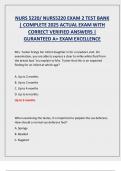
NURS 5220/ NURS5220 EXAM 2 TEST BANK
| COMPLETE 2025 ACTUAL EXAM WITH
CORRECT VERIFIED ANSWERS |
GURANTEED A+ EXAM EXCELLENCE
Mrs. Tucker brings her infant daughter in for a newborn visit. On
examination, you are able to express a clear to milky white fluid from
the breast bud. You explain to Mrs. Tucker that this is an expected
finding for an infant at which age?
A. Up to 2 months
B. Up to 3 months
C. Up to 4 months
D. Up to 6 months
Up to 3 months
When examining the testes, it is important to palpate the vas deferens.
How should a normal vas deferens feel?
A. Spongy
B. Beaded
C. Rugated
,D. Smooth
D. Smooth
Mrs. Venin brings her 18-year-old son in for a follow-up examination.
You have examined him before due to his enlarged breast tissue, which
has not resolved spontaneously. Which action is most appropriate?
A. Refer him to a surgeon for removal.
B. Explain that it may still resolve spontaneously.
C. Ask about history of sexual activity.
D. Ask about illicit or prescription drug use.
Ask about illicit or prescription drug use.
Mr. Mills, a 38-year-old patient, presents with severe rectal pain and
fever. Which condition might be the cause of the symptoms?
A. An imperforate anus
B. A perianal abscess
C. Benign prostatic hypertrophy
D. An anorectal fistula
B. A perianal abscess
,Mr. Taper is a 50-year-old man who presents to your clinic with a deep
ulceration with rolled edges on his penis. What do you suspect is
occurring in this patient?
A. Epididymitis
B. Herpes simplex virus infection
C. Penile carcinoma
D. Hydrocele
C. Penile carcinoma
Mrs. Yates is a 58-year-old patient who presents to your office for her
yearly physical examination. She asks you how often a mammogram is
recommended. The best response by the examiner is:
A. "every year."
B. "every 3 years."
C. "every 5 years."
D. "every year if you have a family history of cancer."
"every year."
, Mrs. Harold is a 37-year-old patient who presents for her yearly
physical examination. Which statement made by Mrs. Harold would
make the examiner suspect fibrocystic changes?
A. "I have a lump in my breast that is not tender."
B. "My right breast is larger than the left breast."
C. "My nipples are darker than before my baby was born."
D. "I feel lumps before my period."
"I feel lumps before my period."
Mrs. Black brings her 12-year-old daughter in with a complaint of a
breast mass. On examination, you note unilateral breast enlargement
with associated tenderness but no mass. Which action do you take?
A. Refer for mammogram.
B. Refer for biopsy.
C. Ask the mother about her own breast development.
D. Explain that this is an expected finding.
Explain that this is an expected finding.
| COMPLETE 2025 ACTUAL EXAM WITH
CORRECT VERIFIED ANSWERS |
GURANTEED A+ EXAM EXCELLENCE
Mrs. Tucker brings her infant daughter in for a newborn visit. On
examination, you are able to express a clear to milky white fluid from
the breast bud. You explain to Mrs. Tucker that this is an expected
finding for an infant at which age?
A. Up to 2 months
B. Up to 3 months
C. Up to 4 months
D. Up to 6 months
Up to 3 months
When examining the testes, it is important to palpate the vas deferens.
How should a normal vas deferens feel?
A. Spongy
B. Beaded
C. Rugated
,D. Smooth
D. Smooth
Mrs. Venin brings her 18-year-old son in for a follow-up examination.
You have examined him before due to his enlarged breast tissue, which
has not resolved spontaneously. Which action is most appropriate?
A. Refer him to a surgeon for removal.
B. Explain that it may still resolve spontaneously.
C. Ask about history of sexual activity.
D. Ask about illicit or prescription drug use.
Ask about illicit or prescription drug use.
Mr. Mills, a 38-year-old patient, presents with severe rectal pain and
fever. Which condition might be the cause of the symptoms?
A. An imperforate anus
B. A perianal abscess
C. Benign prostatic hypertrophy
D. An anorectal fistula
B. A perianal abscess
,Mr. Taper is a 50-year-old man who presents to your clinic with a deep
ulceration with rolled edges on his penis. What do you suspect is
occurring in this patient?
A. Epididymitis
B. Herpes simplex virus infection
C. Penile carcinoma
D. Hydrocele
C. Penile carcinoma
Mrs. Yates is a 58-year-old patient who presents to your office for her
yearly physical examination. She asks you how often a mammogram is
recommended. The best response by the examiner is:
A. "every year."
B. "every 3 years."
C. "every 5 years."
D. "every year if you have a family history of cancer."
"every year."
, Mrs. Harold is a 37-year-old patient who presents for her yearly
physical examination. Which statement made by Mrs. Harold would
make the examiner suspect fibrocystic changes?
A. "I have a lump in my breast that is not tender."
B. "My right breast is larger than the left breast."
C. "My nipples are darker than before my baby was born."
D. "I feel lumps before my period."
"I feel lumps before my period."
Mrs. Black brings her 12-year-old daughter in with a complaint of a
breast mass. On examination, you note unilateral breast enlargement
with associated tenderness but no mass. Which action do you take?
A. Refer for mammogram.
B. Refer for biopsy.
C. Ask the mother about her own breast development.
D. Explain that this is an expected finding.
Explain that this is an expected finding.