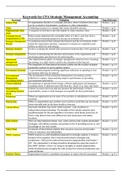
Keywords for CPA Strategic Management Accounting
Keyword Definition Page Reference
Subject Map An organisation decides on a strategic direction, where it believes that value Module 1 (p.2)
can be created for shareholders, customers or other stakeholders
Value Combining resources in a manner that creates desirable outcome Module 1 (p.2)
Organisational value A sequence of activities to provide outputs to create customer value Module 1 (p.4)
chain
Corporate Social Helps people understand the sustainable effect of a firm’s activities from a Module 1 (p.4)
Responsibility (CSR) social and environment perspective not just an economic one
Strategic Management A continuous process that evaluates the business and the environment within Module 1 (p.6)
Process which the organisation operates, evaluates/re-evaluates its competitors and
defines its objectives and strategy
Strategic Analysis: Involves scanning the internal and external environment that a firm operates in Module 1 (p.6)
Strategic management Focuses on determining the direction and structure of the organisation and Module 1 (p.6)
developing plans and objectives for achieving this
Operational The implementation phase of strategic management which involves executing Module 1 (p.7)
management the strategy on a daily basis to achieve the outcomes in the long run
Globalisation The integration of international economic activity and the creation of global Module 1 (p.15)
production systems to service global markets
Government Austerity A government program involving significant reductions in spending so that Module 1 (p.18)
government debt may be reduced
Environmental The development of Environmental Management Accounting systems Module 1 (p.18)
Management (EMASs) to capture, report and help improve performance on providing
Accounting (EMA): environmental information
Cloud computing Development of internet-based storage, software applications and programs, Module 1 (p.24)
including whole IT platforms provided from the ‘cloud’ (E.g. Saas, Iaas Paas)
Responsibility Collects revenues and costs and also measure the performance of these Module 1 (p.28)
Accounting Systems responsibility centres to hold managers accountable for their performance
(RAS)
Offshoring Where an organisation moves some of its activities to subsidiaries in overseas Module 1 (p.29)
locations
Outsourcing When an organisation pays another one to perform work that was previously Module 1 (p.29)
done internally and can be done locally or overseas
Virtual Offices Any team members may never meet in person—only via phone or Module 1 (p.29)
videoconferencing technology. The benefits of this include using the best
qualified people for the job regardless of location, work being carried out 24
hours a day (due to time zone differences) and using lower-cost labour
locations.
Joint Venture They can help implement faster, less- costly and less-risky market penetration Module 1 (p.29)
strategies, with alliance partners and parties to the JV providing access to, and
knowledge of, the new market.
Value Chain A network of interrelated activities that consume resources and provides Module 1 (p.32)
value to customers and stakeholders
SWOT Analysis SWOT analysis is a well-established approach to strategic analysis. It involves Module 1 (p.34)
analysis of the organisa- tion’s internal environment (strengths and
weaknesses—SW) and its external environment (opportunities and threats—
OT). The organisation’s strategy should be developed by using the results of
the SWOT analysis—that is, by using its strengths to exploit opportunities,
while simultaneously managing the risks arising from internal weaknesses and
external threats.
Portfolio Theory Organisations invest in a portfolio of products to reduce the risk associated Module 1 (p.35)
, with relying on a single product. Product life cycle analysis and the BCG matrix
are tools used to understand and manage product portfolios.
Product Life Cycle Product life cycle analysis helps managers to improve their understanding of Module 1 (p.36)
Analysis and ability to manage these product-specific risks. Product life cycle analysis is
particularly useful for understanding the dynamics of consumer-product
industries like electronics and cars, which typically have relatively short–
medium life cycles. It is less useful for commodity-based industries.
BCG Growth/Share BCG developed a 22 matrix for the analysis of product portfolios. The matrix Module 1 (p.37)
Matrix has an external (market growth) dimension and an internal (market share)
dimension, and so contributes to both the internal and external aspects of
strategic analysis.
Stars products that are sold into high-growth markets and hold a high market share. Module 1 (p.38)
Although these products generate large cash inflows, due to the pace of
growth in the market, the organisation needs to continue to invest heavily in
the product to maintain its position
Cash cows As stars enter the maturity phase of their product life cycle, the need for Module 1 (p.38)
finance slows and they become cash cows, generating large cash inflows. Cash
cows are products that hold a high market share in a low-growth market. Due
to the low market growth, the organisation does not need to continue
investing in the product, and the cash flows it produces support the
development of other products
Question marks Products that hold a low market share in a high growth market. Due to the Module 1 (p.38)
low market share, the organisation may need to continue a high level of
investment in the product to maintain or increase its market share and cash
inflows. The organisation needs to decide whether ‘question mark’ products
are worth continuing (in the hope that they will make the transition to stars)
or should be withdrawn from the market.
Dogs Products that hold a low market share in a low-growth market, producing low Module 1 (p.38)
cash inflows. The organisation should probably eliminate these products from
its portfolio, as dogs are unlikely to generate enough cash to support
investment in other products.
External Analysis Strategic management accounting has a strongly external focus that identifies Module 1 (p.38)
and captures information from outside the organisation. Organisations need
to understand where they are situated within their industry. For example, a
profit- making organisation must be aware of its competitors’ strengths and
weaknesses so as to identify threats to its own position, and opportunities for
growth and profitability.
Porters 5 Forces According to Porter (1985, 2006), the strategic environment of an industry is Module 1 (p.39)
Model shaped by 5 forces: New Entrants, Alternative or substitute products,
Customers, Suppliers and Existing Competitors
New entrants The emergence of a new entrant in an industry may result in significant Module 1 (p.39)
realignment of the competitive positions of existing organisations.
Alternative or An alternative product is one that performs a similar function to that Module 1 (p.40)
substitute products produced by the organisation. The presence of alternatives reduces the
demand for an organisation’s products and drives down prices.
Customers When an organisation has powerful customers, its strategic position is Module 1 (p.40)
weakened. Alternatively, when the organisation has power over its customers,
this is a source of strategic advantage. A customer may have some power over
the prices at which sales are made
Suppliers Supplier power is the opposite side of customer power. Powerful suppliers Module 1 (p.40)
have a strong effect on an organisation’s sustainable competitive advantage
, because they can drive up the price of business inputs.
Existing Competitors The type of business strategy an organisation adopts must be developed in Module 1 (p.40)
relation to the competitive strategies adopted by rivals. Understanding a
competitor’s strategies has critical implications for the design of the
organisation’s value chain activities, such as product design, quality, pricing
and advertising. Knowledge of competitors’ product/market portfolios assists
managers to predict the reaction of a competitor to their own strategic
moves.
PEST Analysis PEST analysis offers a tool for examination of these additional factors. PEST Module 1 (p.40)
stands for political, economic, social and technological.
Corporate Social Corporate social responsibility is a type of international private business self- Module 1 (p.40)
Responsibility (CSR) regulation that aims to contribute to societal goals of a philanthropic, activist,
or charitable nature by engaging in or supporting volunteering or ethically-
oriented practices.
Global Reporting A reporting structure that provides a great deal of economic, environmental Module 2 (p.49)
Initiative (GRI) and social information not usually found in annual reports
Stakeholder Grid Essentially, the stakeholder grid analysis is used to: Module 2 (p.50)
Review and evaluate particular stakeholders and assign them to a
quadrant in the matrix as a result of their interest in the matter being
considered and their power or influence on the matter under
consideration, in order to,
Determine the appropriate effort to be allocated to managing like-
classified stakeholders.
Transaction Processing Creates and records the routine primary activities or business functions (E.g. Module 2 (p.57)
System (TPS) sales or service) and may perform support functions (E.g. Procurement,
payroll)
Management Its 1st role is to identify, analyse, classify and record accounting transactions Module 2 (p.57)
Accounting Systems and the 2nd role is to provide a source of information for stakeholders to
(MAS) support decision-making
Customer Relationship Refers to the practices, strategies and technologies used to manage and Module 2 (p.58)
Management (CRM) analyse customer interactions and data throughout the customer lifecycle
Enterprise Resource Take a whole-of-business approach which help to integrate data flow and Module 2 (p.59)
Planning (ERP) access to information across the whole range of business activities. They
systems typically capture transaction data for accounting purposes together with other
data ‘modules’ such as customer, supplier, production and distribution data
and made available in custom designed reports
Decision support Possess an interactive capability and are able to answer ad hoc questions. They Module 2 (p.59)
systems (DSS) can incorporate statistical modelling and spreadsheet capabilities. Importantly,
DSSs can access not only data from within the ERP (or equivalent) system, but
also external databases containing economic or industry data
Knowledge Enables the acquisition, capture, distribution and application of knowledge Module 2 (p.59)
Management Systems and expertise gained by an organisation and can be referred to as ‘corporate
(KMSs) memory’. They assist with the retention of vital knowledge from key
employees and often contain information about lessons learned.
Validity (Accuracy) How well information describes what it is meant to describe Module 2 (p.64)
Comparability Examines how two or more pieces of information resemble each other. For Module 2 (p.65)
example, the information may be from different years (to identify trends) or
from another company (to juxtapose performance).
Any use of similar information should be checked to ensure that the
accounting methods are similar—e.g. they use the same depreciation method.
Verifiability Refers to independent observers reaching consensus (but not necessarily Module 2 (p.65)
, 100%) without simplifying the information.
2 methods of verification are used:
1. direct observation—e.g. stocktake
2. indirect checking of models, formulas or techniques—e.g. checking the
input quantities and costs for inventory.
Timeliness The degree to which older information ceases to be relevant. This encourages Module 2 (p.65)
efficient capture/collection and preparation. Decisions should be based on up-
to-date information but what is meant by the latest information is dependent
upon the specific task. Some information is timely long after the period in
which it is reported. For example, information about seasonal trends can be
useful despite the current weather pattern being an anomaly because the
trend information allows this judgment to be made.
Understandibility Refers to the interpretation of the information by a proficient user: that is, Module 2 (p.65)
someone who has reasonable knowledge of business and economic activities.
Understandability begins with classifying, characterising and presenting
information clearly and concisely. Excluding information to make it less
complex may potentially mislead.
Data warehousing Refers to both the system to analyse historical data derived from transactional Module 2 (p.69)
sources and the data model that stores data
Big Data a large dataset that can comprise both structured (e.g. spreadsheet Module 2 (p.69)
information) and unstructured data (e.g. a collection of web pages).
3V model He began with ‘volume’ to refer to the amount of data that arrives via a TPS, Module 2 (p.69)
but then added ‘variety’, because there are different types of data (e.g. text,
html, images, audio, video), and ‘velocity’, which refers to the rate at which
data arrives and which therefore implies a processing speed
Business Intelligence Is a combination of the strategies and technologies used by organisations to Module 2 (p.70)
(BI) analyse their information to improve their operational and strategic decision-
making
Executive information An EIS facilitates and supports senior executive information and decision- Module 2 (p.70)
systems (EIS) making needs by its orientation to defined organisational goals and to
combine internal and external information and present it in an easy-to-use,
convenient format.
Strategic Information It is forward looking and assists the organisation with planning (3-5 years) and Module 2 (p.72)
this information is gathered to identify and improve the organisation’s
competitive advantage
Tactical Information Focused on short-term operations whilst aiming to assist management with Module 2 (p.73)
effective execution of the strategic plan
Operational Occurs during the day-to-day transactions of an organisation Module 2 (p.74)
information
Vision An aspirational description of where an organisation wants to be in the future Module 2 (p.74)
Mission Declaration of an organisation’s core purpose and focus Module 2 (p.74)
Financial strategic involves framing budgets that extend down through the organisation and Module 2 (p.77)
approach include lower-level organisational units and their sub-units
Performance Considers the allocated resources and achievements of organisational units Module 2 (p.77)
management strategic against non-financial standards and outcomes and encompasses Continuous
approach Improvement (CI) of current processes and the accomplishment of
transformational breakthroughs
Continuous The ongoing effort to improve service effectiveness or process efficiencies to Module 2 (p.77)
Improvement (CI) achieve either best practice or benchmarks (E.g. Process improvements
measured as faster delivery of services or less resource utilisation)
Custodian of Concerned with ensuring that any technology deployed to automate Module 2 (p.79)
, information business processes and maximise productivity creates the required
accounting information and non-financial performance management
information
Data steward Responsible for the information content, context and application of business Module 2 (p.79)
rules and can achieve this through good systems design that validates input
data and provides output for verification
Data custodians Responsible for the authorised access and acceptable integrity of the stored Module 2 (p.79)
data, including its transport or communication
Preliminary A discovery (or rediscovery) of the current information needs of the business, Module 2 (p.83)
Assessment the systems and processes that underlie the business model, and the relevant
policies of the business and how those policies operate
Data Flow Diagram Highlights processes and visually illustrates what data is the input to and Module 2 (p.85)
(DFD) output from a particular system or process – Used to map process after
preliminary assessment is conducted
Heuristic Any approach to problem solving or self-discovery that employs a practical Module 2 (p.86)
method, not guaranteed to be optimal, perfect, or rational, but instead
sufficient for reaching an immediate goal
Systems Development Identifies a sequence of phases beginning with the need for a new system and Module 2 (p.89)
Lifecycle (SDL) ending with the commissioning and operation of that new system
Total Quality Advocated making holistic improvements to accounting systems by promoting Module 2 (p.92)
Management (TQM) improved performance measures and considering the adequacy of
information in reports.
Strategic Planning Focuses on long-term planning and involves senior managers planning and Module 3
setting the direction for future activities to meet the organisation’s goals as (p.101)
set out in its strategy.
Strategy helps organisations to think about where they are now, where they want to Module 3
go, and how they are going to get there. (p.101)
Operational plans The mechanism that an organisation uses to address the short-term Module 3
objectives of the strategic plan (p.101)
Master Budget A comprehensive initial plan of what the whole organisation intends to Module 3
accomplish in the budget period (p.102)
Operating Budget Associated with the operating activities or income-producing activities of an Module 3
organisation and always precedes the financial budget (p.102)
Financial Budget A set of budgeted financial statements, providing forecasts about the Module 3
organisation’s income statement, balance sheet and cash budget for the next (p.102)
financial year
Rolling or Continuous This is made possible by continually adding a month or a quarter to the period Module 3
Budget that just ended so that the business always has a 12-month period budget. (p.102)
Budgeting Process The procedures and activities that are undertaken to develop the budget Module 3
(p.103)
Responsibility Budgets are usually developed using a framework of responsibility centres. Module 3
accounting (p.105)
Responsibility Centre A unit in an organisation (e.g. a department or a division) where the manager Module 3
‘has the authority to make the day-to-day decisions’ about their unit’s (p.105)
activities and performance.
Revenue Centre The manager is only responsible for activities generating revenue (E.g. sales). Module 3
(p.106)
Cost Centre Costs and expenses are incurred but the centre does not directly generate Module 3
revenue (p.106)
Profit Centre In addition to incurring costs and expenses, a profit centre generates Module 3
Keyword Definition Page Reference
Subject Map An organisation decides on a strategic direction, where it believes that value Module 1 (p.2)
can be created for shareholders, customers or other stakeholders
Value Combining resources in a manner that creates desirable outcome Module 1 (p.2)
Organisational value A sequence of activities to provide outputs to create customer value Module 1 (p.4)
chain
Corporate Social Helps people understand the sustainable effect of a firm’s activities from a Module 1 (p.4)
Responsibility (CSR) social and environment perspective not just an economic one
Strategic Management A continuous process that evaluates the business and the environment within Module 1 (p.6)
Process which the organisation operates, evaluates/re-evaluates its competitors and
defines its objectives and strategy
Strategic Analysis: Involves scanning the internal and external environment that a firm operates in Module 1 (p.6)
Strategic management Focuses on determining the direction and structure of the organisation and Module 1 (p.6)
developing plans and objectives for achieving this
Operational The implementation phase of strategic management which involves executing Module 1 (p.7)
management the strategy on a daily basis to achieve the outcomes in the long run
Globalisation The integration of international economic activity and the creation of global Module 1 (p.15)
production systems to service global markets
Government Austerity A government program involving significant reductions in spending so that Module 1 (p.18)
government debt may be reduced
Environmental The development of Environmental Management Accounting systems Module 1 (p.18)
Management (EMASs) to capture, report and help improve performance on providing
Accounting (EMA): environmental information
Cloud computing Development of internet-based storage, software applications and programs, Module 1 (p.24)
including whole IT platforms provided from the ‘cloud’ (E.g. Saas, Iaas Paas)
Responsibility Collects revenues and costs and also measure the performance of these Module 1 (p.28)
Accounting Systems responsibility centres to hold managers accountable for their performance
(RAS)
Offshoring Where an organisation moves some of its activities to subsidiaries in overseas Module 1 (p.29)
locations
Outsourcing When an organisation pays another one to perform work that was previously Module 1 (p.29)
done internally and can be done locally or overseas
Virtual Offices Any team members may never meet in person—only via phone or Module 1 (p.29)
videoconferencing technology. The benefits of this include using the best
qualified people for the job regardless of location, work being carried out 24
hours a day (due to time zone differences) and using lower-cost labour
locations.
Joint Venture They can help implement faster, less- costly and less-risky market penetration Module 1 (p.29)
strategies, with alliance partners and parties to the JV providing access to, and
knowledge of, the new market.
Value Chain A network of interrelated activities that consume resources and provides Module 1 (p.32)
value to customers and stakeholders
SWOT Analysis SWOT analysis is a well-established approach to strategic analysis. It involves Module 1 (p.34)
analysis of the organisa- tion’s internal environment (strengths and
weaknesses—SW) and its external environment (opportunities and threats—
OT). The organisation’s strategy should be developed by using the results of
the SWOT analysis—that is, by using its strengths to exploit opportunities,
while simultaneously managing the risks arising from internal weaknesses and
external threats.
Portfolio Theory Organisations invest in a portfolio of products to reduce the risk associated Module 1 (p.35)
, with relying on a single product. Product life cycle analysis and the BCG matrix
are tools used to understand and manage product portfolios.
Product Life Cycle Product life cycle analysis helps managers to improve their understanding of Module 1 (p.36)
Analysis and ability to manage these product-specific risks. Product life cycle analysis is
particularly useful for understanding the dynamics of consumer-product
industries like electronics and cars, which typically have relatively short–
medium life cycles. It is less useful for commodity-based industries.
BCG Growth/Share BCG developed a 22 matrix for the analysis of product portfolios. The matrix Module 1 (p.37)
Matrix has an external (market growth) dimension and an internal (market share)
dimension, and so contributes to both the internal and external aspects of
strategic analysis.
Stars products that are sold into high-growth markets and hold a high market share. Module 1 (p.38)
Although these products generate large cash inflows, due to the pace of
growth in the market, the organisation needs to continue to invest heavily in
the product to maintain its position
Cash cows As stars enter the maturity phase of their product life cycle, the need for Module 1 (p.38)
finance slows and they become cash cows, generating large cash inflows. Cash
cows are products that hold a high market share in a low-growth market. Due
to the low market growth, the organisation does not need to continue
investing in the product, and the cash flows it produces support the
development of other products
Question marks Products that hold a low market share in a high growth market. Due to the Module 1 (p.38)
low market share, the organisation may need to continue a high level of
investment in the product to maintain or increase its market share and cash
inflows. The organisation needs to decide whether ‘question mark’ products
are worth continuing (in the hope that they will make the transition to stars)
or should be withdrawn from the market.
Dogs Products that hold a low market share in a low-growth market, producing low Module 1 (p.38)
cash inflows. The organisation should probably eliminate these products from
its portfolio, as dogs are unlikely to generate enough cash to support
investment in other products.
External Analysis Strategic management accounting has a strongly external focus that identifies Module 1 (p.38)
and captures information from outside the organisation. Organisations need
to understand where they are situated within their industry. For example, a
profit- making organisation must be aware of its competitors’ strengths and
weaknesses so as to identify threats to its own position, and opportunities for
growth and profitability.
Porters 5 Forces According to Porter (1985, 2006), the strategic environment of an industry is Module 1 (p.39)
Model shaped by 5 forces: New Entrants, Alternative or substitute products,
Customers, Suppliers and Existing Competitors
New entrants The emergence of a new entrant in an industry may result in significant Module 1 (p.39)
realignment of the competitive positions of existing organisations.
Alternative or An alternative product is one that performs a similar function to that Module 1 (p.40)
substitute products produced by the organisation. The presence of alternatives reduces the
demand for an organisation’s products and drives down prices.
Customers When an organisation has powerful customers, its strategic position is Module 1 (p.40)
weakened. Alternatively, when the organisation has power over its customers,
this is a source of strategic advantage. A customer may have some power over
the prices at which sales are made
Suppliers Supplier power is the opposite side of customer power. Powerful suppliers Module 1 (p.40)
have a strong effect on an organisation’s sustainable competitive advantage
, because they can drive up the price of business inputs.
Existing Competitors The type of business strategy an organisation adopts must be developed in Module 1 (p.40)
relation to the competitive strategies adopted by rivals. Understanding a
competitor’s strategies has critical implications for the design of the
organisation’s value chain activities, such as product design, quality, pricing
and advertising. Knowledge of competitors’ product/market portfolios assists
managers to predict the reaction of a competitor to their own strategic
moves.
PEST Analysis PEST analysis offers a tool for examination of these additional factors. PEST Module 1 (p.40)
stands for political, economic, social and technological.
Corporate Social Corporate social responsibility is a type of international private business self- Module 1 (p.40)
Responsibility (CSR) regulation that aims to contribute to societal goals of a philanthropic, activist,
or charitable nature by engaging in or supporting volunteering or ethically-
oriented practices.
Global Reporting A reporting structure that provides a great deal of economic, environmental Module 2 (p.49)
Initiative (GRI) and social information not usually found in annual reports
Stakeholder Grid Essentially, the stakeholder grid analysis is used to: Module 2 (p.50)
Review and evaluate particular stakeholders and assign them to a
quadrant in the matrix as a result of their interest in the matter being
considered and their power or influence on the matter under
consideration, in order to,
Determine the appropriate effort to be allocated to managing like-
classified stakeholders.
Transaction Processing Creates and records the routine primary activities or business functions (E.g. Module 2 (p.57)
System (TPS) sales or service) and may perform support functions (E.g. Procurement,
payroll)
Management Its 1st role is to identify, analyse, classify and record accounting transactions Module 2 (p.57)
Accounting Systems and the 2nd role is to provide a source of information for stakeholders to
(MAS) support decision-making
Customer Relationship Refers to the practices, strategies and technologies used to manage and Module 2 (p.58)
Management (CRM) analyse customer interactions and data throughout the customer lifecycle
Enterprise Resource Take a whole-of-business approach which help to integrate data flow and Module 2 (p.59)
Planning (ERP) access to information across the whole range of business activities. They
systems typically capture transaction data for accounting purposes together with other
data ‘modules’ such as customer, supplier, production and distribution data
and made available in custom designed reports
Decision support Possess an interactive capability and are able to answer ad hoc questions. They Module 2 (p.59)
systems (DSS) can incorporate statistical modelling and spreadsheet capabilities. Importantly,
DSSs can access not only data from within the ERP (or equivalent) system, but
also external databases containing economic or industry data
Knowledge Enables the acquisition, capture, distribution and application of knowledge Module 2 (p.59)
Management Systems and expertise gained by an organisation and can be referred to as ‘corporate
(KMSs) memory’. They assist with the retention of vital knowledge from key
employees and often contain information about lessons learned.
Validity (Accuracy) How well information describes what it is meant to describe Module 2 (p.64)
Comparability Examines how two or more pieces of information resemble each other. For Module 2 (p.65)
example, the information may be from different years (to identify trends) or
from another company (to juxtapose performance).
Any use of similar information should be checked to ensure that the
accounting methods are similar—e.g. they use the same depreciation method.
Verifiability Refers to independent observers reaching consensus (but not necessarily Module 2 (p.65)
, 100%) without simplifying the information.
2 methods of verification are used:
1. direct observation—e.g. stocktake
2. indirect checking of models, formulas or techniques—e.g. checking the
input quantities and costs for inventory.
Timeliness The degree to which older information ceases to be relevant. This encourages Module 2 (p.65)
efficient capture/collection and preparation. Decisions should be based on up-
to-date information but what is meant by the latest information is dependent
upon the specific task. Some information is timely long after the period in
which it is reported. For example, information about seasonal trends can be
useful despite the current weather pattern being an anomaly because the
trend information allows this judgment to be made.
Understandibility Refers to the interpretation of the information by a proficient user: that is, Module 2 (p.65)
someone who has reasonable knowledge of business and economic activities.
Understandability begins with classifying, characterising and presenting
information clearly and concisely. Excluding information to make it less
complex may potentially mislead.
Data warehousing Refers to both the system to analyse historical data derived from transactional Module 2 (p.69)
sources and the data model that stores data
Big Data a large dataset that can comprise both structured (e.g. spreadsheet Module 2 (p.69)
information) and unstructured data (e.g. a collection of web pages).
3V model He began with ‘volume’ to refer to the amount of data that arrives via a TPS, Module 2 (p.69)
but then added ‘variety’, because there are different types of data (e.g. text,
html, images, audio, video), and ‘velocity’, which refers to the rate at which
data arrives and which therefore implies a processing speed
Business Intelligence Is a combination of the strategies and technologies used by organisations to Module 2 (p.70)
(BI) analyse their information to improve their operational and strategic decision-
making
Executive information An EIS facilitates and supports senior executive information and decision- Module 2 (p.70)
systems (EIS) making needs by its orientation to defined organisational goals and to
combine internal and external information and present it in an easy-to-use,
convenient format.
Strategic Information It is forward looking and assists the organisation with planning (3-5 years) and Module 2 (p.72)
this information is gathered to identify and improve the organisation’s
competitive advantage
Tactical Information Focused on short-term operations whilst aiming to assist management with Module 2 (p.73)
effective execution of the strategic plan
Operational Occurs during the day-to-day transactions of an organisation Module 2 (p.74)
information
Vision An aspirational description of where an organisation wants to be in the future Module 2 (p.74)
Mission Declaration of an organisation’s core purpose and focus Module 2 (p.74)
Financial strategic involves framing budgets that extend down through the organisation and Module 2 (p.77)
approach include lower-level organisational units and their sub-units
Performance Considers the allocated resources and achievements of organisational units Module 2 (p.77)
management strategic against non-financial standards and outcomes and encompasses Continuous
approach Improvement (CI) of current processes and the accomplishment of
transformational breakthroughs
Continuous The ongoing effort to improve service effectiveness or process efficiencies to Module 2 (p.77)
Improvement (CI) achieve either best practice or benchmarks (E.g. Process improvements
measured as faster delivery of services or less resource utilisation)
Custodian of Concerned with ensuring that any technology deployed to automate Module 2 (p.79)
, information business processes and maximise productivity creates the required
accounting information and non-financial performance management
information
Data steward Responsible for the information content, context and application of business Module 2 (p.79)
rules and can achieve this through good systems design that validates input
data and provides output for verification
Data custodians Responsible for the authorised access and acceptable integrity of the stored Module 2 (p.79)
data, including its transport or communication
Preliminary A discovery (or rediscovery) of the current information needs of the business, Module 2 (p.83)
Assessment the systems and processes that underlie the business model, and the relevant
policies of the business and how those policies operate
Data Flow Diagram Highlights processes and visually illustrates what data is the input to and Module 2 (p.85)
(DFD) output from a particular system or process – Used to map process after
preliminary assessment is conducted
Heuristic Any approach to problem solving or self-discovery that employs a practical Module 2 (p.86)
method, not guaranteed to be optimal, perfect, or rational, but instead
sufficient for reaching an immediate goal
Systems Development Identifies a sequence of phases beginning with the need for a new system and Module 2 (p.89)
Lifecycle (SDL) ending with the commissioning and operation of that new system
Total Quality Advocated making holistic improvements to accounting systems by promoting Module 2 (p.92)
Management (TQM) improved performance measures and considering the adequacy of
information in reports.
Strategic Planning Focuses on long-term planning and involves senior managers planning and Module 3
setting the direction for future activities to meet the organisation’s goals as (p.101)
set out in its strategy.
Strategy helps organisations to think about where they are now, where they want to Module 3
go, and how they are going to get there. (p.101)
Operational plans The mechanism that an organisation uses to address the short-term Module 3
objectives of the strategic plan (p.101)
Master Budget A comprehensive initial plan of what the whole organisation intends to Module 3
accomplish in the budget period (p.102)
Operating Budget Associated with the operating activities or income-producing activities of an Module 3
organisation and always precedes the financial budget (p.102)
Financial Budget A set of budgeted financial statements, providing forecasts about the Module 3
organisation’s income statement, balance sheet and cash budget for the next (p.102)
financial year
Rolling or Continuous This is made possible by continually adding a month or a quarter to the period Module 3
Budget that just ended so that the business always has a 12-month period budget. (p.102)
Budgeting Process The procedures and activities that are undertaken to develop the budget Module 3
(p.103)
Responsibility Budgets are usually developed using a framework of responsibility centres. Module 3
accounting (p.105)
Responsibility Centre A unit in an organisation (e.g. a department or a division) where the manager Module 3
‘has the authority to make the day-to-day decisions’ about their unit’s (p.105)
activities and performance.
Revenue Centre The manager is only responsible for activities generating revenue (E.g. sales). Module 3
(p.106)
Cost Centre Costs and expenses are incurred but the centre does not directly generate Module 3
revenue (p.106)
Profit Centre In addition to incurring costs and expenses, a profit centre generates Module 3