Localisation of Function in the Brain
Localisation of function in the brain refers to the principle that specific functions
(language, memory, hearing etc.) have specific locations within the brain.
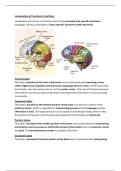
Frontal Lobes
This lobe is located at the front of the brain and is associated with reasoning, motor
skills, higher level cognition and expressive language (Broca’s area). At the back of the
frontal lobe, near the central sulcus, lies the motor cortex. This area of the brain receives
information from various lobes of the brain and utilises this information to carry out body
movements.
Temporal Lobes
This lobe is located on the bottom section of the brain. It is also the location of the
auditory cortex, which is important for interpreting sounds and the language we hear
(Wernicke’s area). The hippocampus is also located in the temporal lobe, which is why
this portion of the brain is also heavily associated with the formation of memories.
Parietal Lobes
This lobe is located in the middle section of the brain and is associated with processing
information such as pressure and tactile sensory information such as pressure, touch
and pain. The somatosensory cortex is located in this lobe.
Occipital Lobes
This lobe is located at the back portion of the brain and is associated with interpreting
, visual stimuli and information. The visual cortex, which receives and interprets
information from the retinas, is located here.
Motor Cortex
The motor cortex is located in the frontal lobe (in both hemispheres).
The motor cortex is responsible for voluntary motor movements by sending signals to the
muscles in the body. Both hemispheres of the brain have a motor cortex, and they control
the opposite side of the body. Different parts of the motor cortex control different parts of
the body. They are ordered logically e.g. the region that controls the foot is next to the
region that controls the leg etc.
Somatosensory Cortex
The somatosensory cortex is located in the parietal lobe (in both hemispheres).
Receives incoming sensory information from the skin to produce sensations related to
touch, pressure, pain and temperature. Both hemispheres of the brain have a
somatosensory cortex, with the cortex on one side of the brain receiving sensory
information from the opposite side of the body.
Visual Cortex
The visual cortex is located at the back of the brain, in the occipital lobe (in both
hemispheres).
Receives and processes visual information directly from the eyes. The visual area
contains different parts that process different types of information including colour, shape
or movement. The visual cortex spans both hemispheres, with the right hemisphere
receiving its input from the left-hand side of the visual field, while the visual cortex in the
left hemisphere receives its input from the right-hand side of the visual field.
Auditory Cortex
The auditory centre in the brain is located in the temporal lobes (in both hemispheres).
The auditory centre is responsible for analysing and processing acoustic information
(sound). The auditory centre contains different parts, and the primary auditory area is
involved in processing simple features of sound including volume, tempo and pitch.
Broca’s Area
Broca’s area is located in the left frontal lobe.
Responsible for speech production. This area is named after the neurosurgeon Paul
Broca. Broca studied patient ‘Tan’ who could understand spoken language but was
unable to speak, nor express his thoughts in writing (Broca’s aphasia). The only word he
could say was ‘Tan’. Broca studied 8 other patients, all of whom had similar language
deficits and post-mortem examinations showed they had lesions in their left frontal lobe.
Localisation of function in the brain refers to the principle that specific functions
(language, memory, hearing etc.) have specific locations within the brain.
Frontal Lobes
This lobe is located at the front of the brain and is associated with reasoning, motor
skills, higher level cognition and expressive language (Broca’s area). At the back of the
frontal lobe, near the central sulcus, lies the motor cortex. This area of the brain receives
information from various lobes of the brain and utilises this information to carry out body
movements.
Temporal Lobes
This lobe is located on the bottom section of the brain. It is also the location of the
auditory cortex, which is important for interpreting sounds and the language we hear
(Wernicke’s area). The hippocampus is also located in the temporal lobe, which is why
this portion of the brain is also heavily associated with the formation of memories.
Parietal Lobes
This lobe is located in the middle section of the brain and is associated with processing
information such as pressure and tactile sensory information such as pressure, touch
and pain. The somatosensory cortex is located in this lobe.
Occipital Lobes
This lobe is located at the back portion of the brain and is associated with interpreting
, visual stimuli and information. The visual cortex, which receives and interprets
information from the retinas, is located here.
Motor Cortex
The motor cortex is located in the frontal lobe (in both hemispheres).
The motor cortex is responsible for voluntary motor movements by sending signals to the
muscles in the body. Both hemispheres of the brain have a motor cortex, and they control
the opposite side of the body. Different parts of the motor cortex control different parts of
the body. They are ordered logically e.g. the region that controls the foot is next to the
region that controls the leg etc.
Somatosensory Cortex
The somatosensory cortex is located in the parietal lobe (in both hemispheres).
Receives incoming sensory information from the skin to produce sensations related to
touch, pressure, pain and temperature. Both hemispheres of the brain have a
somatosensory cortex, with the cortex on one side of the brain receiving sensory
information from the opposite side of the body.
Visual Cortex
The visual cortex is located at the back of the brain, in the occipital lobe (in both
hemispheres).
Receives and processes visual information directly from the eyes. The visual area
contains different parts that process different types of information including colour, shape
or movement. The visual cortex spans both hemispheres, with the right hemisphere
receiving its input from the left-hand side of the visual field, while the visual cortex in the
left hemisphere receives its input from the right-hand side of the visual field.
Auditory Cortex
The auditory centre in the brain is located in the temporal lobes (in both hemispheres).
The auditory centre is responsible for analysing and processing acoustic information
(sound). The auditory centre contains different parts, and the primary auditory area is
involved in processing simple features of sound including volume, tempo and pitch.
Broca’s Area
Broca’s area is located in the left frontal lobe.
Responsible for speech production. This area is named after the neurosurgeon Paul
Broca. Broca studied patient ‘Tan’ who could understand spoken language but was
unable to speak, nor express his thoughts in writing (Broca’s aphasia). The only word he
could say was ‘Tan’. Broca studied 8 other patients, all of whom had similar language
deficits and post-mortem examinations showed they had lesions in their left frontal lobe.