Learners and Learning Science (Western Governors
University) D664 Full Key Learning Theories Study
Guide.
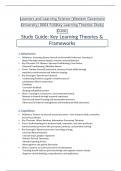
Study Guide: Key Learning Theories &
Frameworks
1. Behaviorism
• Definition: A learning theory focused on observable behaviors. Learning is
shaped through external stimuli, rewards, and punishments.
• Key Theorists: B.F. Skinner (Operant Conditioning), Ivan Pavlov
(Classical Conditioning), Madeline Hunter
• Focus: Teacher-directed instruction, mastery of basic skills through
repetition, reinforcement and behavior shaping
• Key Strategies: Operant and classical
conditioning Positive/negative reinforcement S
punishment Direct instruction
Chunking
Corrective feedback
Shaping and guided practice
• Notes: Learning is a response to environmental stimuli.
Memory is formed through repeated experience.
Best for task-based learning and measurable outcomes.
Often used in behavior management and foundational skill instruction.
2. Cognitivism
• Definition: Focuses on internal mental processes—how learners think, remember,
and solve problems.
• Key Theorists: Albert Bandura, Information Processing Theorists
• Focus: Understanding how learners think, remember, and solve problems;
internal mental processes like perception, memory, and problem-solving
• Key Strategies: Memory processes (encoding, storage,
retrieval) Mental schemas
Concept maps, graphic organizers
Bloom’s Revised Taxonomy
Attention-getting devices
Metacognition and guided discussion
• Notes: Learners are active processors of information.
Teaching should build on prior knowledge and organize content clearly.
Supports critical thinking, comprehension, and application.
University) D664 Full Key Learning Theories Study
Guide.
Study Guide: Key Learning Theories &
Frameworks
1. Behaviorism
• Definition: A learning theory focused on observable behaviors. Learning is
shaped through external stimuli, rewards, and punishments.
• Key Theorists: B.F. Skinner (Operant Conditioning), Ivan Pavlov
(Classical Conditioning), Madeline Hunter
• Focus: Teacher-directed instruction, mastery of basic skills through
repetition, reinforcement and behavior shaping
• Key Strategies: Operant and classical
conditioning Positive/negative reinforcement S
punishment Direct instruction
Chunking
Corrective feedback
Shaping and guided practice
• Notes: Learning is a response to environmental stimuli.
Memory is formed through repeated experience.
Best for task-based learning and measurable outcomes.
Often used in behavior management and foundational skill instruction.
2. Cognitivism
• Definition: Focuses on internal mental processes—how learners think, remember,
and solve problems.
• Key Theorists: Albert Bandura, Information Processing Theorists
• Focus: Understanding how learners think, remember, and solve problems;
internal mental processes like perception, memory, and problem-solving
• Key Strategies: Memory processes (encoding, storage,
retrieval) Mental schemas
Concept maps, graphic organizers
Bloom’s Revised Taxonomy
Attention-getting devices
Metacognition and guided discussion
• Notes: Learners are active processors of information.
Teaching should build on prior knowledge and organize content clearly.
Supports critical thinking, comprehension, and application.