

10/15/24, 9:38 PM Week 2: Pediatric Assessment: Primary Care of the Childbearing and Childrearing Family Practicum-BAILEY
Week 2
Pediatric Assessment
Pediatric Health History and Interview
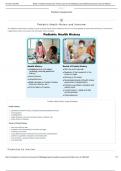
The pediatric health history includes a social or family history and is collected at the first visit and updated at routine well-child exams. Examine the
image below to learn more about the information that is included.
Pediatric Health History Image Description
Health History
gestational and birth history (including maternal gestational history)
immunizations
hospitalizations
major illnesses or trauma (includes fractures, stitches, etc.)
family history of disease
Social of Family History
who the child lives with
members of the household in the home and ages
smoking in the home
social determinants of health (home environment, transportation)
parents or guardians’ education and reading level
current school – grade and after school activities
risky behaviors
Conducting the Interview
https://chamberlain.instructure.com/courses/131088/pages/week-2-pediatric-assessment?module_item_id=18914653 1/17
,10/15/24, 9:38 PM Week 2: Pediatric Assessment: Primary Care of the Childbearing and Childrearing Family Practicum-BAILEY
Interviewing children separately or with their parents varies according to the child and family. Providers may consider talking to children privately if
they are older or adolescent, have a history of parent-child disagreements, have peer issues, or have a history of abuse. Establishing an early and
ongoing rapport with the child is key to optimizing outcomes. For example, at age 10, talk to the child about privacy and confidentiality. Then at age 11
or 12, ask if they would like to talk alone. Over 75% of parents feel alone time with a provider is important to their adolescent’s health (Ross et al.,
2020).
Learn by Applying
Apply what you have learned to the clinical scenario below.
The Okoro family presents for well-child visits and a sports physical. Darius and Michaela need well-child checks and Ariah needs a sports physical
for school. Their parents, Hakim and Nila, have questions and concerns about their children’s health they want to address.
Okoros Family Image Description
Ariah: 16-year-old daughter
Hakim: Father
Nila: Mother
Darius: 8-year-old son
Michaela: 4-month-old daughter
Hakim reports that Darius has had behavioral issues at school. Since Michaela was born, their home life has been chaotic. Hakim works many long
hours. He regards himself as a strict parent and believes Darius is spending too much time playing violent video games and is acting out because of
the stress at home.
The FNP asks to speak to Darius alone; the parents agree. Click each section below to work through the scenario.
Part One
Complete the activity below to determine why Darius is reluctant to speak with the FNP.
Darius will not talk despite the use of different approaches and questions. Which of the following
are possible reasons that Darius is reluctant to talk with the FNP? Select all that apply.
Part One Transcript
Darius will not talk despite the use of different approaches and questions. Which of the following are possible reasons that Darius is reluctant to
talk with the FNP? Select all that apply.
https://chamberlain.instructure.com/courses/131088/pages/week-2-pediatric-assessment?module_item_id=18914653 2/17
, 10/15/24, 9:38 PM Week 2: Pediatric Assessment: Primary Care of the Childbearing and Childrearing Family Practicum-BAILEY
embarrassment
anxiety (Correct answer)
anger (Correct answer)
developmental delays (Correct answer)
mental illness (Correct answer)
distraction
Rationale: Darius may be anxious or angry, have a developmental delay, or have a mental illness like depression (Youngstrom et al., 2020).
Distraction and embarrassment often yield some verbal or non-verbal interaction.
Part Two
The FNP initiated a conversation with Darius about his love of gaming. After several minutes, he started to respond and confirmed that he loves to
play video games but denies playing violent ones. The FNP then asked him how things were going at home and school. Darius responded that
everything at home is great and he loves his baby sister. He said school is hard because kids make fun of him. One girl, in particular, calls him
names for sitting in the front row. He explained that he has to sit in the front row to see the whiteboard; if he moves to the back of the room, he is
not able to read it. The other day he got angry and threw a book at the girl. The school called his parents.
To understand behaviors, it is important to establish the context, experience, thoughts, and emotional response.
Click each plus (+) sign in the activity below to see how the FNP applied the information to the conversation with Darius.
Understanding Behaviors Transcript
Darius said school is hard because kids make fun of him. (context)
One girl, in particular, calls him names for sitting in the front row. (experience)
He has to sit in the front row to see the whiteboard; if he moves to the back of the room, he is not able to read it. (thought or rationale)
The other day he got angry (emotional response) and threw a book at the girl (behavior). The school called his parents.
A child’s version of a story may not match a parent’s version. Identified problems or concerns are often influenced by many factors, as seen in the
image below.
Matching Stories Image Description
Parent
Personality
Marital relationship
Relationship with own parents
Psychosocial background
https://chamberlain.instructure.com/courses/131088/pages/week-2-pediatric-assessment?module_item_id=18914653 3/17
Week 2
Pediatric Assessment
Pediatric Health History and Interview
The pediatric health history includes a social or family history and is collected at the first visit and updated at routine well-child exams. Examine the
image below to learn more about the information that is included.
Pediatric Health History Image Description
Health History
gestational and birth history (including maternal gestational history)
immunizations
hospitalizations
major illnesses or trauma (includes fractures, stitches, etc.)
family history of disease
Social of Family History
who the child lives with
members of the household in the home and ages
smoking in the home
social determinants of health (home environment, transportation)
parents or guardians’ education and reading level
current school – grade and after school activities
risky behaviors
Conducting the Interview
https://chamberlain.instructure.com/courses/131088/pages/week-2-pediatric-assessment?module_item_id=18914653 1/17
,10/15/24, 9:38 PM Week 2: Pediatric Assessment: Primary Care of the Childbearing and Childrearing Family Practicum-BAILEY
Interviewing children separately or with their parents varies according to the child and family. Providers may consider talking to children privately if
they are older or adolescent, have a history of parent-child disagreements, have peer issues, or have a history of abuse. Establishing an early and
ongoing rapport with the child is key to optimizing outcomes. For example, at age 10, talk to the child about privacy and confidentiality. Then at age 11
or 12, ask if they would like to talk alone. Over 75% of parents feel alone time with a provider is important to their adolescent’s health (Ross et al.,
2020).
Learn by Applying
Apply what you have learned to the clinical scenario below.
The Okoro family presents for well-child visits and a sports physical. Darius and Michaela need well-child checks and Ariah needs a sports physical
for school. Their parents, Hakim and Nila, have questions and concerns about their children’s health they want to address.
Okoros Family Image Description
Ariah: 16-year-old daughter
Hakim: Father
Nila: Mother
Darius: 8-year-old son
Michaela: 4-month-old daughter
Hakim reports that Darius has had behavioral issues at school. Since Michaela was born, their home life has been chaotic. Hakim works many long
hours. He regards himself as a strict parent and believes Darius is spending too much time playing violent video games and is acting out because of
the stress at home.
The FNP asks to speak to Darius alone; the parents agree. Click each section below to work through the scenario.
Part One
Complete the activity below to determine why Darius is reluctant to speak with the FNP.
Darius will not talk despite the use of different approaches and questions. Which of the following
are possible reasons that Darius is reluctant to talk with the FNP? Select all that apply.
Part One Transcript
Darius will not talk despite the use of different approaches and questions. Which of the following are possible reasons that Darius is reluctant to
talk with the FNP? Select all that apply.
https://chamberlain.instructure.com/courses/131088/pages/week-2-pediatric-assessment?module_item_id=18914653 2/17
, 10/15/24, 9:38 PM Week 2: Pediatric Assessment: Primary Care of the Childbearing and Childrearing Family Practicum-BAILEY
embarrassment
anxiety (Correct answer)
anger (Correct answer)
developmental delays (Correct answer)
mental illness (Correct answer)
distraction
Rationale: Darius may be anxious or angry, have a developmental delay, or have a mental illness like depression (Youngstrom et al., 2020).
Distraction and embarrassment often yield some verbal or non-verbal interaction.
Part Two
The FNP initiated a conversation with Darius about his love of gaming. After several minutes, he started to respond and confirmed that he loves to
play video games but denies playing violent ones. The FNP then asked him how things were going at home and school. Darius responded that
everything at home is great and he loves his baby sister. He said school is hard because kids make fun of him. One girl, in particular, calls him
names for sitting in the front row. He explained that he has to sit in the front row to see the whiteboard; if he moves to the back of the room, he is
not able to read it. The other day he got angry and threw a book at the girl. The school called his parents.
To understand behaviors, it is important to establish the context, experience, thoughts, and emotional response.
Click each plus (+) sign in the activity below to see how the FNP applied the information to the conversation with Darius.
Understanding Behaviors Transcript
Darius said school is hard because kids make fun of him. (context)
One girl, in particular, calls him names for sitting in the front row. (experience)
He has to sit in the front row to see the whiteboard; if he moves to the back of the room, he is not able to read it. (thought or rationale)
The other day he got angry (emotional response) and threw a book at the girl (behavior). The school called his parents.
A child’s version of a story may not match a parent’s version. Identified problems or concerns are often influenced by many factors, as seen in the
image below.
Matching Stories Image Description
Parent
Personality
Marital relationship
Relationship with own parents
Psychosocial background
https://chamberlain.instructure.com/courses/131088/pages/week-2-pediatric-assessment?module_item_id=18914653 3/17

