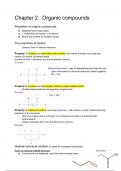
Chapter 2 : Organic compounds
Properties of organic compounds
■ Obtained from living nature
■ 1 molecules can contain 1 mil atoms
■ Atoms are bonded by covalent bonds
The properties of carbon
- Carbons have 4 valance electrons
Property 1: C-atoms can bond with more c-atoms, this means that they can make big
chains of c-atoms covalently linked
(covalent bonds = electrons are shared between atoms)
Example
Structural formula (= way of representing the molecule and
gives information on how the atoms are linked together)
CH3 - CH3
Property 2: C-atoms can form single, double or triple covalent bonds
- Double/ triple bonds are stronger than single bonds
Example
CH2 = CH2
Property 3: Chains of C-atoms can have branches (: side chains or more C-atoms forming
branches in the structure)
- Only one C-atom and one H-atom in a compound is called a branched-chain
hydrocarbons
- Larger molecules with more branches form isomers
Example
Skeletal structural notation (= used for complex structures)
Rules for drawing skeletal structure : Examples
■ C-atoms are not displayed, only the bonds between them
Properties of organic compounds
■ Obtained from living nature
■ 1 molecules can contain 1 mil atoms
■ Atoms are bonded by covalent bonds
The properties of carbon
- Carbons have 4 valance electrons
Property 1: C-atoms can bond with more c-atoms, this means that they can make big
chains of c-atoms covalently linked
(covalent bonds = electrons are shared between atoms)
Example
Structural formula (= way of representing the molecule and
gives information on how the atoms are linked together)
CH3 - CH3
Property 2: C-atoms can form single, double or triple covalent bonds
- Double/ triple bonds are stronger than single bonds
Example
CH2 = CH2
Property 3: Chains of C-atoms can have branches (: side chains or more C-atoms forming
branches in the structure)
- Only one C-atom and one H-atom in a compound is called a branched-chain
hydrocarbons
- Larger molecules with more branches form isomers
Example
Skeletal structural notation (= used for complex structures)
Rules for drawing skeletal structure : Examples
■ C-atoms are not displayed, only the bonds between them