

GNRS 5669 UTMB FNP 1 Exam 3 Questions With Complete
Solutions
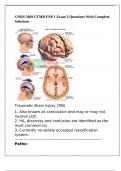
Traumatic Brain Injury (TBI)
1. Also known as concussion and may or may not
involve LOC.
2. HA, dizziness and confusion are identified as the
most common c/c.
3. Currently no widely accepted classification
system.
------------------------------------------------------------------
Patho:
,Identifiable metabolic alterations in
intra-/extracellular K+, Ca+ and glutamate
w/subsequent neuron dysfxn. Micro-tearing of
cerebral blood vessels and a relative decrease in
cerebral blood flow also occurs. An increased
requirement for glucose by the brain, coupled
w/decreased blood flow, may result in cellular
dysfxn and increased susceptibility to subsequent
brain injury.
------------------------------------------------------------------
Risk factors:
Falls: Most common cause for pts age > 65. Up to
1/3 of all sport-related injuries may go unreported
or undiagnosed.
Contact Sports: football, basketball, hockey, soccer
(college males), skiing and snowboarding.
TBI: Clinical Presentation and Return to play
,Confusion.
Post-traumatic amnesia (PTA).
Retrograde amnesia.
LOC
Disorientation, feeling "in a fog" or zoned out.
Inability to focus (work or school).
Delayed verbal and motor responses.
Excessive drowsiness and slurred/incoherent
speech.
------------------------------------------------------------------
HA
Fatigue
Disequilibrium and/or dizziness.
Visual disturbances.
Phonophobia (fear of loud sounds)
Nausea
Emotional lability
Irritability
Personality changes
Sleep disturbances
------------------------------------------------------------------
Protocol takes place over 6 days.
, Migraine: Preventive Meds
AED's: Depakote 500-1000 mg/day and Topamax
25-100 mg BID.
------------------------------------------------------------------
TCA's: Amitriptyline and nortriptyline 10-15
mg/day. SE: drowsiness, urinary retention and wt
gain.
------------------------------------------------------------------
BBs: Propranolol 80-240 mg and Timolol 10-30
mg/day. Helps w/panic attacks.
------------------------------------------------------------------
CCBs: Verapamil 240-320 mg/day
precaution: CV dx or hypotension.
------------------------------------------------------------------
Feverfew: Herbal supplement. Limited clinical
Solutions
Traumatic Brain Injury (TBI)
1. Also known as concussion and may or may not
involve LOC.
2. HA, dizziness and confusion are identified as the
most common c/c.
3. Currently no widely accepted classification
system.
------------------------------------------------------------------
Patho:
,Identifiable metabolic alterations in
intra-/extracellular K+, Ca+ and glutamate
w/subsequent neuron dysfxn. Micro-tearing of
cerebral blood vessels and a relative decrease in
cerebral blood flow also occurs. An increased
requirement for glucose by the brain, coupled
w/decreased blood flow, may result in cellular
dysfxn and increased susceptibility to subsequent
brain injury.
------------------------------------------------------------------
Risk factors:
Falls: Most common cause for pts age > 65. Up to
1/3 of all sport-related injuries may go unreported
or undiagnosed.
Contact Sports: football, basketball, hockey, soccer
(college males), skiing and snowboarding.
TBI: Clinical Presentation and Return to play
,Confusion.
Post-traumatic amnesia (PTA).
Retrograde amnesia.
LOC
Disorientation, feeling "in a fog" or zoned out.
Inability to focus (work or school).
Delayed verbal and motor responses.
Excessive drowsiness and slurred/incoherent
speech.
------------------------------------------------------------------
HA
Fatigue
Disequilibrium and/or dizziness.
Visual disturbances.
Phonophobia (fear of loud sounds)
Nausea
Emotional lability
Irritability
Personality changes
Sleep disturbances
------------------------------------------------------------------
Protocol takes place over 6 days.
, Migraine: Preventive Meds
AED's: Depakote 500-1000 mg/day and Topamax
25-100 mg BID.
------------------------------------------------------------------
TCA's: Amitriptyline and nortriptyline 10-15
mg/day. SE: drowsiness, urinary retention and wt
gain.
------------------------------------------------------------------
BBs: Propranolol 80-240 mg and Timolol 10-30
mg/day. Helps w/panic attacks.
------------------------------------------------------------------
CCBs: Verapamil 240-320 mg/day
precaution: CV dx or hypotension.
------------------------------------------------------------------
Feverfew: Herbal supplement. Limited clinical

