

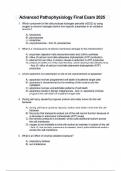
Advanced Pathophysiology Final Exam 2025
1. Which component of the cell produces hydrogen peroxide (H2O2) by using oxygen to remove hydrogen atoms from specific substrates in an oxidative reaction? A) lysosomes B) peroxisomes C) ribosomes D) oxyhydrosomes - Ans: B- peroxisomes 2. What is a consequence of plasma membrane damage to the mitochondria? A) enzymatic digestion halts deoxyribonucleic acid (DNA) synthese B) influx of calcium ions halts adenosine triphosphate (ATP) production C) edema from an influx in sodium causes a reduction in ATP production D) potassium shifts out of the mitochondria, which destroys the infrastructure - Ans: B- influx of calcium ions halts adenosine triphosphate (ATP) production 3. Which statement is a description of one of the characteristics of apoptosis? A) apoptosis involves programmed cell death of scattered singel cells B) apoptosis is characterized by the swelling of the nucleus and the cytoplasm C) apoptosis involves unpredictable patterns of cell death D) apoptosis results in benign malignancies - Ans: A- apoptosis involves programmed cell death of scattered singel cells 4. During cell injury caused by hypoxia, sodium and water move into the cell because: A) during cell injury cause by hypoxia, sodium and water move into the cell because: B) the pump that transports sodium out of the cell cannot function because of a decrease in adenosine triphosphate (ATP) levels C) the osmotic pressure is increased, which pulls additional sodium across the cell membrane D) oxygen is not available to bind with sodium to maintain it outside of the cell - Ans: C- the osmotic pressure is increased, which pulls additional sodium across the cell membrane 5. What is an effect of ionizing radiation exposure? A) respiratory distress B) sun intolerance C) deoxyribonucleic acid (DNA) abberations D) death - Ans: C- deoxyribonucleic acid (DNA) abberations 6. Obesity creates a greater risk for dehydration in people because: A) adipose cells contain little water because fat is water repelling B) the metabolic rates of obese adults are slower than those of lean adults C) the rates of urine output of obese adults are higher than thos of lean adults D) the thirst receptors of the hypothalamus do not function effectively - Ans: A- adipose cells contain little water because fat is water repelling 7. In addition to osmosis, what force is involved in the movement of water between the plasma and interstitial fluid spaces? A) oncotic pressure B) buffering C) net filtration D) hydrostatic pressure - Ans: D- hydrostatic pressure 8. Venous obstruction is a cause of edema because of an increase in which pressure? A) capillary hydrostatic B) interstitial hydrostatic C) capillary oncotic D) interstitial oncotic - Ans: A- capillary hydrostatic 9. At the arterial end of capillaries, fluid moves from the intravascular space into the interstitial space because: A) the interstitial hydrostatic pressure is higher than the capillary hydrostatic pressure B) the capillary hydrostatic pressure is higher than then capillary oncotic pressure C) the interstitial oncotic pressure is higher than the interstitial hydrostatic pressure D) the capillary oncotic pressure is lower than the interstitial hydrostatic pressure - Ans: B- the capillary hydrostatic pressure is higher than then capillary oncotic pressure 10. It is true that natriuretic peptides: A) decrease blood pressure and increase sodium and water excretion B) increase blood pressure and decrease sodium and water excretion C) increase the heart rate and decrease potassium excretion D) decrease the heart rate and increase the potassium excretion - Ans: A- decrease blood pressure and increase sodium and water excretion 11. What causes the clinical manifestations of confusion, convulsions, cerebral hemorrhage, and coma in hypernatremia? A) high sodium in the blood vessels pulls water out of the brain cells into the blood vessels, causing brain cells to shrink B) high sodium in the brain cells pulls water out of the blood vessels into the brain cells, causing them to swell C) high sodium in the blood vessels pulls potassium out of the brain cells, which slows the synapses in the brain D) high sodium in the blood vessels draws chloride into the brain cells followed by water, causing the brain cells to swell - Ans: A- high sodium in the blood vessels pulls water out of the brain cells into the blood vessels, causing brain cells to shrink 12. A major determinant of the resting membrane potential necessary for the transmission of nercve impulses is the ratio between: A) intracellular and extracellular Na+ B) intracellular and extracellular K+ C) instracellular Na+ and extracellular K+ D) intracellular K+ and extracellular Na+ - Ans: B- intracellular and extracellular K+ 13. In hyperkalemia what change occurs to the cells resting membrane potential? A) hypopolarization B) hyperexcitability C) depolarization D) repolarization - Ans: A- hypopolarization 14. Physiologic pH is maintained around 7.4 because carbonic acid (H2CO3) and bicarbonate (HCO3) exist in a ratio of: A) 20:1 B) 1:20 C) 10:2 D) 10:5 - Ans: A- 20:1 15. Increased capillary hydrostatic pressure results in edema because of: A) losses or diminished production of plasma albumin B) inflammation resulting from an immune response C) blockage within the lymphatic channel system D) sodium and water retention - Ans: C- blockage within the lymphatic channel system 16. Hyopmethylation and the resulting effect on oncogenes result in: A) a decrease in the activity fo the oncogene, thuse suppressing cancer development B) deactivation of MLH1 to halt deoxyribonucleic acid (DNA) repair C) an incrase in tumor progression from benign to malignant D) overexpression of micro-ribonucleic acid (miRNA), resulting in tumorigenesis - Ans: C- an increase in tumor progression from benign to malignant 17. The functions of the major histocompatibility complex (MHC) and CD1 molecules are alike because both: A) are antigen-presenting molecules B) bind antigens to antibodies C) secrete interleukins (ILs) during the immune process D) are capable of activating cytotoxic T lymphocytes - Ans: A- are antigen- presenting molecules 18. The B-cell receptor (BCR) complex functions uniquely by: A) communicating information about the anitgen to the helper T (Th) cell B) secreting chemical signals to help cells communicate C) recognizing the anitgen on the surface of the B lymphocyte D) communicating information about the antigen to the cell nucleus - Ans: D- communicating information about the antigen to the cell nucleus 19. The generation of clonal diversity includes a process that: A) involves antigens that selet lymphocytes with compatible receptors B) allows the differentiation of cells into antibody-secreting plasma cells or mature T cells C) takes place in the primary (central) lymphoid organs D) causes antigens to expand and diversify their population - Ans: C- takes place in the primary (central) lymphoid organs 20. Vacinations are able to provide protection against certain microorganisms because of the: A) strong response from immunoglobulin M (IgM) B) level of protection provided by immunoglobulin G (IgG) C) memory cells for immunoglobulin E (IgE)
Información del documento
- Subido en
- 4 de junio de 2025
- Número de páginas
- 11
- Escrito en
- 2024/2025
- Tipo
- Examen
- Contiene
- Preguntas y respuestas

