

Test Bank for Fundamentals of Nursing, 11th Edition
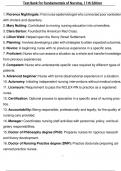
1. Florence Nightingale: First nurse epidemiologist who connected poor sanitation
with cholera and dysentery.
2. Mary Nutting: Contributed to moving nursing education into universities.
3. Clara Barton: Founded the American Red Cross.
4. Lillian Wald: Helped open the Henry Street Settlement.
5. Planning: Involves developing a plan with strategies to attain expected outcomes.
6. Novice: A beginning nurse with no previous experience in a specific area.
7. Proficient: Nurse who can assess a situation as a whole and transfer knowledge
from previous experiences.
8. Competent: Nurse who understands specific care required by different types of
patients.
9. Advanced beginner: Nurse with some observational experience in a situation.
10. Autonomy: Initiating independent nursing interventions without medical orders.
11. Licensure: Requirement to pass the NCLEX-RN to practice as a registered
nurse.
12. Certification: Optional process to specialize in a specific area of nursing prac-
tice.
13. Accountability: Being responsible, professionally and legally, for the quality of
nursing care provided.
14. Manager: Coordinates nursing staff activities with personnel, policy, and bud-
getary responsibilities.
15. Doctor of Philosophy degree (PhD): Prepares nurses for rigorous research
and theory development.
16. Doctor of Nursing Practice degree (DNP): Practice doctorate preparing ad-
vanced practice nurses.
1/6
, Test Bank for Fundamentals of Nursing, 11th Edition
17. Continuing education: Formal educational programs offered post-baccalaure-
ate by various institutions.
18. Quality improvement: Identifying gaps between local and best practices.
19. Safety: One of the Quality and Safety Education for Nurses (QSEN) competen-
cies.
20. Patient-centered care: Focusing on individual patient needs and preferences.
21. Educator: Explains health concepts, demonstrates procedures, and evaluates
patient progress.
22. Advocate: Protects patient rights and provides assistance in asserting these
rights.
23. Caregiver: Helps patients maintain health, manage disease, and attain inde-
pendence.
24. Inservice education: Instruction or training provided by a health care facility or
institution.
2/6
1. Florence Nightingale: First nurse epidemiologist who connected poor sanitation
with cholera and dysentery.
2. Mary Nutting: Contributed to moving nursing education into universities.
3. Clara Barton: Founded the American Red Cross.
4. Lillian Wald: Helped open the Henry Street Settlement.
5. Planning: Involves developing a plan with strategies to attain expected outcomes.
6. Novice: A beginning nurse with no previous experience in a specific area.
7. Proficient: Nurse who can assess a situation as a whole and transfer knowledge
from previous experiences.
8. Competent: Nurse who understands specific care required by different types of
patients.
9. Advanced beginner: Nurse with some observational experience in a situation.
10. Autonomy: Initiating independent nursing interventions without medical orders.
11. Licensure: Requirement to pass the NCLEX-RN to practice as a registered
nurse.
12. Certification: Optional process to specialize in a specific area of nursing prac-
tice.
13. Accountability: Being responsible, professionally and legally, for the quality of
nursing care provided.
14. Manager: Coordinates nursing staff activities with personnel, policy, and bud-
getary responsibilities.
15. Doctor of Philosophy degree (PhD): Prepares nurses for rigorous research
and theory development.
16. Doctor of Nursing Practice degree (DNP): Practice doctorate preparing ad-
vanced practice nurses.
1/6
, Test Bank for Fundamentals of Nursing, 11th Edition
17. Continuing education: Formal educational programs offered post-baccalaure-
ate by various institutions.
18. Quality improvement: Identifying gaps between local and best practices.
19. Safety: One of the Quality and Safety Education for Nurses (QSEN) competen-
cies.
20. Patient-centered care: Focusing on individual patient needs and preferences.
21. Educator: Explains health concepts, demonstrates procedures, and evaluates
patient progress.
22. Advocate: Protects patient rights and provides assistance in asserting these
rights.
23. Caregiver: Helps patients maintain health, manage disease, and attain inde-
pendence.
24. Inservice education: Instruction or training provided by a health care facility or
institution.
2/6


