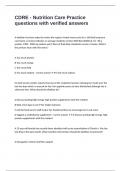
CDRE - Nutrition Care Practice
questions with verified answers
A dietitian has been asked to review the regular 4-week menu cycle for a 160-bed long term
care home. A review indicates on average residents receive 2000 Kals (8400 kJ), 65 - 80 g
protein, 2300 - 3000 mg sodium and 2 liters of fluid daily. Residents receive 2 snacks. What is
the primary issue with this menu?
A Too much protein
B Too much energy
C Too much fluid
D Too much sodium - correct answer ✔✔D Too much sodium
he food service worker reports that one of the residents has been refusing her meals over the
last few days which is unusual for her. Her appetite seems to have diminished although she is
otherwise fine. What should the dietitian do?
A Discuss starting high energy, high protein supplements with the resident
B Wait a few days to see if her intake improves
C Ask the food service staff to give her double portions to encourage her to eat more
D Suggest a multivitamin supplement - correct answer ✔✔A Discuss starting high energy, high
protein supplements with the resident
A 23 year-old female has recently been admitted with acute exacerbation of Chrohn's. She has
lost 8 kg in the past month. What nutrition intervention should the dietitian recommend?
A Nasogastric enteral nutrition support
, B Nasojejunal enteral nutrition support
C Parenteral nutrition support
D Clear fluids with low residue - correct answer ✔✔C Parenteral nutrition support
The dietitian suspects the patient may be at risk of refeeding syndrome due to the patient's
weight loss and underlying chronic health issue. What should the dietitian do next?
A Initiate feeding slowly
B Supplement with a high protein/high energy nourishment
C Begin full volume feeds immediately
D Monitor the patient periodically - correct answer ✔✔A Initiate feeding slowly
Since the patient is at risk for refeeding syndrome, which electrolytes abnormalities should the
dietitian monitor?
A Hypokalemia, hypophosphatemia and hypomagnesemia
B Hyperkalemia, hyponatremia and hypermagnesemia
C Hypokalemia, hypernatremia and hypermagnesemia
D Hyperkalemia, hypernatremia and hypomagnesemia - correct answer ✔✔A Hypokalemia,
hypophosphatemia and hypomagnesemia
The patient currently weighs 55 kg. The daily energy needs for this patient have been assessed
as 2200 kCals (9240 KJ) with protein at 82g and carbohydrates at 320g. What should her
nutrition support regimen provide on the first day?
A 2200 kCals, 60g protein and 160g carbohydrate
B 1100 KCals, 82g protein and 160g carbohydrate
C 2200 kCals, 60 g protein and 320g carbohydrate
questions with verified answers
A dietitian has been asked to review the regular 4-week menu cycle for a 160-bed long term
care home. A review indicates on average residents receive 2000 Kals (8400 kJ), 65 - 80 g
protein, 2300 - 3000 mg sodium and 2 liters of fluid daily. Residents receive 2 snacks. What is
the primary issue with this menu?
A Too much protein
B Too much energy
C Too much fluid
D Too much sodium - correct answer ✔✔D Too much sodium
he food service worker reports that one of the residents has been refusing her meals over the
last few days which is unusual for her. Her appetite seems to have diminished although she is
otherwise fine. What should the dietitian do?
A Discuss starting high energy, high protein supplements with the resident
B Wait a few days to see if her intake improves
C Ask the food service staff to give her double portions to encourage her to eat more
D Suggest a multivitamin supplement - correct answer ✔✔A Discuss starting high energy, high
protein supplements with the resident
A 23 year-old female has recently been admitted with acute exacerbation of Chrohn's. She has
lost 8 kg in the past month. What nutrition intervention should the dietitian recommend?
A Nasogastric enteral nutrition support
, B Nasojejunal enteral nutrition support
C Parenteral nutrition support
D Clear fluids with low residue - correct answer ✔✔C Parenteral nutrition support
The dietitian suspects the patient may be at risk of refeeding syndrome due to the patient's
weight loss and underlying chronic health issue. What should the dietitian do next?
A Initiate feeding slowly
B Supplement with a high protein/high energy nourishment
C Begin full volume feeds immediately
D Monitor the patient periodically - correct answer ✔✔A Initiate feeding slowly
Since the patient is at risk for refeeding syndrome, which electrolytes abnormalities should the
dietitian monitor?
A Hypokalemia, hypophosphatemia and hypomagnesemia
B Hyperkalemia, hyponatremia and hypermagnesemia
C Hypokalemia, hypernatremia and hypermagnesemia
D Hyperkalemia, hypernatremia and hypomagnesemia - correct answer ✔✔A Hypokalemia,
hypophosphatemia and hypomagnesemia
The patient currently weighs 55 kg. The daily energy needs for this patient have been assessed
as 2200 kCals (9240 KJ) with protein at 82g and carbohydrates at 320g. What should her
nutrition support regimen provide on the first day?
A 2200 kCals, 60g protein and 160g carbohydrate
B 1100 KCals, 82g protein and 160g carbohydrate
C 2200 kCals, 60 g protein and 320g carbohydrate