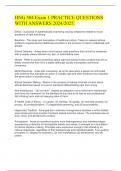
HNG 504 Exam 1 PRACTICE QUESTIONS
WITH ANSWERS 2024/2025.
Ethics - a process of systematically examining varying viewpoints related to moral
questions of right and wrong
Bioethics - The study and formulation of healthcare ethics. Takes on relevant ethical
problems experienced by healthcare providers in the provision of care to individuals and
groups.
Ethical Dilemma - Arises when moral issues raise questions that cannot be answered
with a simple, clearly defined rule, fact, or authoritative view
Morals - Refer to social conventions about right and wrong human conduct that are so
widely shared that they form a stable (although usually incomplete) communal
consensus
Moral Dilemmas - Arise with uncertainty, as is the case when a person is confronted
with evidence that indicates an action is morally right and other evidence that indicates
the same action is morally wrong.
Ethical Decision Making - Refers to the process of making informed choices about
ethical dilemmas based on a set of standards differentiating right from wrong.
Non-maleficence - "do not harm". Asserts an obligation not to inflict harm intentionally
and forms the framework for the standard of due care to be met by any professional.
Not inflicting harm and not imposing risks of harm.
E-Health Code of Ethics - (1) candor, (2) honesty, (3) quality, (4) informed consent, (5)
privacy, (6) professionalism, (7) responsible partnering, and (8) accountability.
Hippocratic Tradition - Emerged from relatively homogeneous societies in which beliefs
were similar and most societal members shared common values. The emphasis was on
duty, virtue, and gentlemanly conduct.
Principalsim - Arose as societies became more heterogeneous and members began
experiencing a diversity of incompatible beliefs and values; it emerged as a foundation
for ethical decision-making. Principles were expansive enough to be shared by all
rational individuals, regardless of their backgrounds and individual beliefs. Four guiding
principles: (1) respect for autonomy, (2) non-maleficence, (3) beneficence, and (4)
justice.
, Autonomy - refers to an individual's freedom from controlling interferences by others
and from personal limitations that prevent meaningful choices, such as inadequate
understanding. Two conditions are essential:
liberty, meaning independence from controlling influences, and an individual's capacity
for intentional action.
Negligence - A departure from the standard of due care toward others. Includes
intentionally imposing risks that are unreasonable and unintentionally but carelessly
imposing risks.
Beneficence - Refers to actions performed that contribute to the welfare of others. Two
principles underlie: positive requires the provision of benefits, and utility requires that
benefits and drawbacks be balanced. One must avoid negative, which occurs when
constraints are placed on activities that, even though they might not be unjust, could in
some situations cause detriment or harm to others.
Justice - Refers to fair, equitable, and appropriate treatment in light of what is due or
owed to a person.
Distributive Justice - refers to fair, equitable, and appropriate distribution in society as
determined by justified norms that structure the terms of social cooperation.
Substantive Rules - Rules of truth telling, confidentiality, privacy, and fidelity and those
pertaining to the allocation and rationing of health care, omitting treatment, physician-
assisted suicide, and informed consent
Authority Rules - Indicate who may and should perform actions.
Procedural rules - establish the procedures to be followed.
Casuist Approach/ Casuistry - Case-based ethical reasoning method that analyzes the
facts of a case in a sound, logical, ordered, and structured manner
The Husted Bioethical Decision-Making Model - Decision-making model centers on the
healthcare professional's implicit agreement with the patient or client (Husted & Husted,
1995). It is based on six contemporary bioethical standards: (1) autonomy, (2) freedom,
(3) veracity, (4) privacy, (5) beneficence, and (6) fidelity.
Virtue Ethics Approach - Emphasizes the virtuous character of individuals who make the
choices. Emphasize the ideal situation and attempt to identify and define ideals. A
person acts immorally because the individual does not know what is really good for him
or her. Four cardinal virtues: (1) wisdom, (2) courage, (3) self-control, and (4) justice.
Nicomachean Ethics - virtues are connected to will and motive because the intention is
what determines whether one is or is not acting virtuously.
WITH ANSWERS 2024/2025.
Ethics - a process of systematically examining varying viewpoints related to moral
questions of right and wrong
Bioethics - The study and formulation of healthcare ethics. Takes on relevant ethical
problems experienced by healthcare providers in the provision of care to individuals and
groups.
Ethical Dilemma - Arises when moral issues raise questions that cannot be answered
with a simple, clearly defined rule, fact, or authoritative view
Morals - Refer to social conventions about right and wrong human conduct that are so
widely shared that they form a stable (although usually incomplete) communal
consensus
Moral Dilemmas - Arise with uncertainty, as is the case when a person is confronted
with evidence that indicates an action is morally right and other evidence that indicates
the same action is morally wrong.
Ethical Decision Making - Refers to the process of making informed choices about
ethical dilemmas based on a set of standards differentiating right from wrong.
Non-maleficence - "do not harm". Asserts an obligation not to inflict harm intentionally
and forms the framework for the standard of due care to be met by any professional.
Not inflicting harm and not imposing risks of harm.
E-Health Code of Ethics - (1) candor, (2) honesty, (3) quality, (4) informed consent, (5)
privacy, (6) professionalism, (7) responsible partnering, and (8) accountability.
Hippocratic Tradition - Emerged from relatively homogeneous societies in which beliefs
were similar and most societal members shared common values. The emphasis was on
duty, virtue, and gentlemanly conduct.
Principalsim - Arose as societies became more heterogeneous and members began
experiencing a diversity of incompatible beliefs and values; it emerged as a foundation
for ethical decision-making. Principles were expansive enough to be shared by all
rational individuals, regardless of their backgrounds and individual beliefs. Four guiding
principles: (1) respect for autonomy, (2) non-maleficence, (3) beneficence, and (4)
justice.
, Autonomy - refers to an individual's freedom from controlling interferences by others
and from personal limitations that prevent meaningful choices, such as inadequate
understanding. Two conditions are essential:
liberty, meaning independence from controlling influences, and an individual's capacity
for intentional action.
Negligence - A departure from the standard of due care toward others. Includes
intentionally imposing risks that are unreasonable and unintentionally but carelessly
imposing risks.
Beneficence - Refers to actions performed that contribute to the welfare of others. Two
principles underlie: positive requires the provision of benefits, and utility requires that
benefits and drawbacks be balanced. One must avoid negative, which occurs when
constraints are placed on activities that, even though they might not be unjust, could in
some situations cause detriment or harm to others.
Justice - Refers to fair, equitable, and appropriate treatment in light of what is due or
owed to a person.
Distributive Justice - refers to fair, equitable, and appropriate distribution in society as
determined by justified norms that structure the terms of social cooperation.
Substantive Rules - Rules of truth telling, confidentiality, privacy, and fidelity and those
pertaining to the allocation and rationing of health care, omitting treatment, physician-
assisted suicide, and informed consent
Authority Rules - Indicate who may and should perform actions.
Procedural rules - establish the procedures to be followed.
Casuist Approach/ Casuistry - Case-based ethical reasoning method that analyzes the
facts of a case in a sound, logical, ordered, and structured manner
The Husted Bioethical Decision-Making Model - Decision-making model centers on the
healthcare professional's implicit agreement with the patient or client (Husted & Husted,
1995). It is based on six contemporary bioethical standards: (1) autonomy, (2) freedom,
(3) veracity, (4) privacy, (5) beneficence, and (6) fidelity.
Virtue Ethics Approach - Emphasizes the virtuous character of individuals who make the
choices. Emphasize the ideal situation and attempt to identify and define ideals. A
person acts immorally because the individual does not know what is really good for him
or her. Four cardinal virtues: (1) wisdom, (2) courage, (3) self-control, and (4) justice.
Nicomachean Ethics - virtues are connected to will and motive because the intention is
what determines whether one is or is not acting virtuously.