

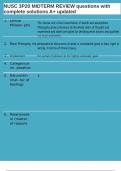
NUSC 3P20 MIDTERM REVIEW questions with
complete solutions A+ updated
1. Ethical
The intense and critical examination of beliefs and assumptions.
Philoso- phy
Philosophy gives coherence to the whole realm of thought and
experience and otters principles for deciding what actions and qualities
are most worthwhile.
2. Moral Philosophy the philosophical discussion of what is considered good or bad, right or
wrong, in terms of moral issues.
3. Hedonism the pursuit of pleasure to the highest achievable good
4. Categorical
im- perative
5. Naturalism 7.
(mat- ter of
feeling)
6. Relationalis
m (matter
of reason)
1/
24
,NUSC 3P20 MIDTERM REVIEW questions with
complete solutions A+ updated
decisions based on principle What is best in this case?
in a way that is universal
and able to applied in all There are absolute truths not dependent on human nature All people
similar cases have unique feelings and perceptions
Ethical values have an independent origin in the nature of the universe
Ethics is and can become known to humans through the process of reasoning
dependent Truths about the world are universal and superior to what we receive
on human from our senses and experiences
nature and For example, the sky may be perceived as blue, but the actual colour may be
psychology ditterent, or seen as ditterent by some
Ditterences Our sympathy/ empathy is dependent on the person suttering
in moral Moral/ ethical rules originate from a higher source and are always
codes are a true What is right always?
result of
social
conditions
All people have similar
underlying psychological
tendencies, suggesting
universal- ity in moral
judgment
All people
have tendency
to make
similar ethical
decisions
Sympathy/empa
thy is a
motivating
factor in moral
decision making
2/
24
, NUSC 3P20 MIDTERM REVIEW questions with
complete solutions A+ updated
Utilitarian- (basis in naturalism)Action is judged as good or bad in relation to the
ism/Consequen conse- quence, outcome, or end
- tialism Right action is that which has the greatest utility or usefulness (no action is in
itself good or bad, always depends on the end derived from them)
Forward looking
Epicurus felt pleasure was good and pain was evil, humans control their
destiny Bentham felt actions are right when they increase happiness and
diminish misery, wrong if they have the opposite ettect. Hedonism: the
pursuit of pleasure to the highest achievable good.
Mill's theory led to: "The end justifies the means"
8. Deontology/ (basis in rationalism)Based on writings of Immanuel Kant
Kan- tianism Ethical rules are universal and humans can derive consistent principles to
guide action
Awareness of moral rules is product of pure reason vs. experience
Moral rules apply to all people, for all times, in all situations
Categorical imperative: decisions based on principle in a way that is
universal and able to applied in all similar cases
Domination of one person over another is morally wrong
We must fulfill certain duties owed to others while keeping their needs
foremost. Treat others as an end vs. a means and make their needs,
agenda, or desires something you will work toward with them (e.g. health,
recovery, end of suttering) We must all act as members of a community
of equal and autonomous individuals, and each member must treat all
others as moral beings. Each person should have regard for the desires
of others and allow for freedom of decision. All rational people are
equal and equally competent to make autonomous, universal
decisions.
Backward looking- what is driving us? Motivating us?
Most professional codes of ethics are based upon Kantian principles.
Nurses' codes of
3/
24
complete solutions A+ updated
1. Ethical
The intense and critical examination of beliefs and assumptions.
Philoso- phy
Philosophy gives coherence to the whole realm of thought and
experience and otters principles for deciding what actions and qualities
are most worthwhile.
2. Moral Philosophy the philosophical discussion of what is considered good or bad, right or
wrong, in terms of moral issues.
3. Hedonism the pursuit of pleasure to the highest achievable good
4. Categorical
im- perative
5. Naturalism 7.
(mat- ter of
feeling)
6. Relationalis
m (matter
of reason)
1/
24
,NUSC 3P20 MIDTERM REVIEW questions with
complete solutions A+ updated
decisions based on principle What is best in this case?
in a way that is universal
and able to applied in all There are absolute truths not dependent on human nature All people
similar cases have unique feelings and perceptions
Ethical values have an independent origin in the nature of the universe
Ethics is and can become known to humans through the process of reasoning
dependent Truths about the world are universal and superior to what we receive
on human from our senses and experiences
nature and For example, the sky may be perceived as blue, but the actual colour may be
psychology ditterent, or seen as ditterent by some
Ditterences Our sympathy/ empathy is dependent on the person suttering
in moral Moral/ ethical rules originate from a higher source and are always
codes are a true What is right always?
result of
social
conditions
All people have similar
underlying psychological
tendencies, suggesting
universal- ity in moral
judgment
All people
have tendency
to make
similar ethical
decisions
Sympathy/empa
thy is a
motivating
factor in moral
decision making
2/
24
, NUSC 3P20 MIDTERM REVIEW questions with
complete solutions A+ updated
Utilitarian- (basis in naturalism)Action is judged as good or bad in relation to the
ism/Consequen conse- quence, outcome, or end
- tialism Right action is that which has the greatest utility or usefulness (no action is in
itself good or bad, always depends on the end derived from them)
Forward looking
Epicurus felt pleasure was good and pain was evil, humans control their
destiny Bentham felt actions are right when they increase happiness and
diminish misery, wrong if they have the opposite ettect. Hedonism: the
pursuit of pleasure to the highest achievable good.
Mill's theory led to: "The end justifies the means"
8. Deontology/ (basis in rationalism)Based on writings of Immanuel Kant
Kan- tianism Ethical rules are universal and humans can derive consistent principles to
guide action
Awareness of moral rules is product of pure reason vs. experience
Moral rules apply to all people, for all times, in all situations
Categorical imperative: decisions based on principle in a way that is
universal and able to applied in all similar cases
Domination of one person over another is morally wrong
We must fulfill certain duties owed to others while keeping their needs
foremost. Treat others as an end vs. a means and make their needs,
agenda, or desires something you will work toward with them (e.g. health,
recovery, end of suttering) We must all act as members of a community
of equal and autonomous individuals, and each member must treat all
others as moral beings. Each person should have regard for the desires
of others and allow for freedom of decision. All rational people are
equal and equally competent to make autonomous, universal
decisions.
Backward looking- what is driving us? Motivating us?
Most professional codes of ethics are based upon Kantian principles.
Nurses' codes of
3/
24


