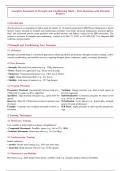
Complete Essentials of Strength and Conditioning Q&A – Real Questions with Detailed
Answers
1 Introduction
This document is a comprehensive Q&A guide for Grades 10–12 students preparing for IEB Physical Education or Sports
Science exams, focusing on strength and conditioning essentials. It provides advanced explanations, practical applica-
tions, and refactored, precise exam questions with verified answers and helpers, tailored to the IEB curriculum. The
content is exclusive to strength and conditioning, verified as of May 27, 2025, at 8:30 PM EAT. Use alongside IEB
textbooks and past papers.
2 Strength and Conditioning Core Concepts
2.1 Definition
Strength and conditioning is a structured approach to enhancing athletic performance through resistance training, cardio-
vascular conditioning, and mobility exercises, targeting strength, power, endurance, agility, and injury prevention.
2.2 Key Elements
• Strength: Maximal force production (e.g., 120kg bench press).
• Power: Rapid force application (e.g., 65cm vertical jump).
• Endurance: Sustained performance (e.g., 10km run in 45min).
• Agility: Quick directional shifts (e.g., 4.2s T-test).
• Mobility: Joint range of motion (e.g., 170° hip flexion).
2.3 Training Principles
Progressive Overload: Incrementally increase load (e.g., Variation: Change exercises (e.g., front to back squats) to
2.5kg/week to squats) to drive adaptation. prevent stagnation.
Specificity: Align training with goals (e.g., sprint drills for Individualization: Customize programs for fitness levels
speed). (e.g., novice vs. advanced).
Recovery: Allow 48–72h between sessions to optimize mus- Periodization: Cycle phases (e.g., hypertrophy, strength,
cle repair. power) for peak performance.
Example: A sprinter uses weighted sled pulls to boost ac- IEB Focus: Apply principles to sport-specific program de-
celeration. sign.
3 Training Techniques
3.1 Resistance Training
Uses weights or bodyweight to enhance strength/power:
• Compound Movements: Deadlifts, squats (e.g., 4x6 at 75% 1RM).
• Isolation Movements: Hamstring curls (e.g., 3x12 at 20kg).
3.2 Cardiovascular Training
Builds endurance:
• Aerobic: Steady-state running (e.g., 60% max heart rate).
• Anaerobic: High-intensity intervals (e.g., 6x30s sprints).
3.3 Plyometrics and Mobility
Plyometrics (e.g., depth jumps) boost power; mobility work (e.g., dynamic lunges) enhances flexibility.
1
, 3.4 IEB Focus
Understand physiological effects and sport-specific applications of each technique.
4 Program Design and Safety Protocols
4.1 Program Design
• Assessment: Measure baselines (e.g., 1RM deadlift of 100kg).
• Goals: Set targets (e.g., increase deadlift to 130kg in 12 weeks).
• Planning: Define sets/reps (e.g., 4x5 at 80% 1RM), rest (e.g., 120s), and phases (e.g., 4-week strength).
4.2 Safety Protocols
• Form: Maintain proper technique (e.g., flat back in squats).
• Warm-Up: 5–10min dynamic stretches reduce injury risk.
• Supervision: Use spotters for heavy lifts (e.g., 90% 1RM bench press).
4.3 Example
A netball player’s program includes lunges (strength), shuttle runs (agility), and static stretches (mobility), with bi-weekly
progress checks.
5 Strength vs. Conditioning Comparison
5.1 Key Differences
Aspect Strength Conditioning
Focus Force generation Endurance and stamina
Examples Squats, bench press Long runs, HIIT
Goal Build muscle strength Enhance cardiovascular capacity
Training High load, low reps Moderate load, high duration
Metrics 1RM (e.g., 140kg deadlift) VO2 max (e.g., 52 mL/kg/min)
5.2 IEB Focus
Design programs balancing strength and conditioning for sport-specific outcomes.
6 Advanced Exam Questions and Answers
6.1 Question Set 1: Core Concepts
6.1.1 Question 1.1 (5 marks) 6.1.1 Question 1.3 (7 marks)
Define strength and conditioning and analyze how variation A school’s volleyball team struggles with weak serves. Pro-
and individualization principles optimize performance for a pose a power training intervention with precise specifica-
long-distance swimmer. tions and justify its benefits.
Answer: Strength and conditioning is a structured approach Answer: Implement a 12-week plyometric program with
to improving athletic performance via resistance, cardio- medicine ball slams (3x12 with 6kg ball, 60s rest) and over-
vascular, and mobility training. **Variation** involves al- head presses (4x8 at 70% 1RM, e.g., 40kg). Slams en-
tering exercises (e.g., switching freestyle drills to pull-ups hance upper-body power, increasing serve speed by 12%
every 4 weeks), preventing plateaus and improving swim (e.g., from 50km/h to 56km/h). Presses build shoulder strength,
stroke power by 10% (e.g., 200m time from 2:10 to 2:06). supporting explosive serves. This intervention improves serve
**Individualization** tailors training to the swimmer’s level effectiveness, aligning with IEB volleyball goals.
(e.g., 3x12 squats at 50kg for a novice vs. 5x5 at 100kg for Helper: Specify exercises with metrics; justify for serving.
advanced), ensuring progressive strength gains. Both prin- See IEB past papers.
ciples enhance endurance and efficiency for swimming. Steps:
Helper: Define S&C; link principles to swimming with 1. Propose plyometrics and presses with specs.
2
Answers
1 Introduction
This document is a comprehensive Q&A guide for Grades 10–12 students preparing for IEB Physical Education or Sports
Science exams, focusing on strength and conditioning essentials. It provides advanced explanations, practical applica-
tions, and refactored, precise exam questions with verified answers and helpers, tailored to the IEB curriculum. The
content is exclusive to strength and conditioning, verified as of May 27, 2025, at 8:30 PM EAT. Use alongside IEB
textbooks and past papers.
2 Strength and Conditioning Core Concepts
2.1 Definition
Strength and conditioning is a structured approach to enhancing athletic performance through resistance training, cardio-
vascular conditioning, and mobility exercises, targeting strength, power, endurance, agility, and injury prevention.
2.2 Key Elements
• Strength: Maximal force production (e.g., 120kg bench press).
• Power: Rapid force application (e.g., 65cm vertical jump).
• Endurance: Sustained performance (e.g., 10km run in 45min).
• Agility: Quick directional shifts (e.g., 4.2s T-test).
• Mobility: Joint range of motion (e.g., 170° hip flexion).
2.3 Training Principles
Progressive Overload: Incrementally increase load (e.g., Variation: Change exercises (e.g., front to back squats) to
2.5kg/week to squats) to drive adaptation. prevent stagnation.
Specificity: Align training with goals (e.g., sprint drills for Individualization: Customize programs for fitness levels
speed). (e.g., novice vs. advanced).
Recovery: Allow 48–72h between sessions to optimize mus- Periodization: Cycle phases (e.g., hypertrophy, strength,
cle repair. power) for peak performance.
Example: A sprinter uses weighted sled pulls to boost ac- IEB Focus: Apply principles to sport-specific program de-
celeration. sign.
3 Training Techniques
3.1 Resistance Training
Uses weights or bodyweight to enhance strength/power:
• Compound Movements: Deadlifts, squats (e.g., 4x6 at 75% 1RM).
• Isolation Movements: Hamstring curls (e.g., 3x12 at 20kg).
3.2 Cardiovascular Training
Builds endurance:
• Aerobic: Steady-state running (e.g., 60% max heart rate).
• Anaerobic: High-intensity intervals (e.g., 6x30s sprints).
3.3 Plyometrics and Mobility
Plyometrics (e.g., depth jumps) boost power; mobility work (e.g., dynamic lunges) enhances flexibility.
1
, 3.4 IEB Focus
Understand physiological effects and sport-specific applications of each technique.
4 Program Design and Safety Protocols
4.1 Program Design
• Assessment: Measure baselines (e.g., 1RM deadlift of 100kg).
• Goals: Set targets (e.g., increase deadlift to 130kg in 12 weeks).
• Planning: Define sets/reps (e.g., 4x5 at 80% 1RM), rest (e.g., 120s), and phases (e.g., 4-week strength).
4.2 Safety Protocols
• Form: Maintain proper technique (e.g., flat back in squats).
• Warm-Up: 5–10min dynamic stretches reduce injury risk.
• Supervision: Use spotters for heavy lifts (e.g., 90% 1RM bench press).
4.3 Example
A netball player’s program includes lunges (strength), shuttle runs (agility), and static stretches (mobility), with bi-weekly
progress checks.
5 Strength vs. Conditioning Comparison
5.1 Key Differences
Aspect Strength Conditioning
Focus Force generation Endurance and stamina
Examples Squats, bench press Long runs, HIIT
Goal Build muscle strength Enhance cardiovascular capacity
Training High load, low reps Moderate load, high duration
Metrics 1RM (e.g., 140kg deadlift) VO2 max (e.g., 52 mL/kg/min)
5.2 IEB Focus
Design programs balancing strength and conditioning for sport-specific outcomes.
6 Advanced Exam Questions and Answers
6.1 Question Set 1: Core Concepts
6.1.1 Question 1.1 (5 marks) 6.1.1 Question 1.3 (7 marks)
Define strength and conditioning and analyze how variation A school’s volleyball team struggles with weak serves. Pro-
and individualization principles optimize performance for a pose a power training intervention with precise specifica-
long-distance swimmer. tions and justify its benefits.
Answer: Strength and conditioning is a structured approach Answer: Implement a 12-week plyometric program with
to improving athletic performance via resistance, cardio- medicine ball slams (3x12 with 6kg ball, 60s rest) and over-
vascular, and mobility training. **Variation** involves al- head presses (4x8 at 70% 1RM, e.g., 40kg). Slams en-
tering exercises (e.g., switching freestyle drills to pull-ups hance upper-body power, increasing serve speed by 12%
every 4 weeks), preventing plateaus and improving swim (e.g., from 50km/h to 56km/h). Presses build shoulder strength,
stroke power by 10% (e.g., 200m time from 2:10 to 2:06). supporting explosive serves. This intervention improves serve
**Individualization** tailors training to the swimmer’s level effectiveness, aligning with IEB volleyball goals.
(e.g., 3x12 squats at 50kg for a novice vs. 5x5 at 100kg for Helper: Specify exercises with metrics; justify for serving.
advanced), ensuring progressive strength gains. Both prin- See IEB past papers.
ciples enhance endurance and efficiency for swimming. Steps:
Helper: Define S&C; link principles to swimming with 1. Propose plyometrics and presses with specs.
2