

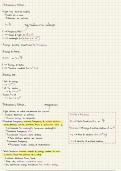
-Photoelectric Effect-
Light has particle duality
·
-
Travels as a wave
-
Interacts as particle
t= E High frequency = low
wavelength
f
-
o
Frequency (H2)-
Speedoflight -I
--------
Energy directly proportional to frequency
·
-Energy _
of Photon
-
ha
E = hf or E = X
E Energy of photon
↓ & Planck's constant (6 6 ,
.
10 J .
5)
-Electron Volt -
Unit of
·
energy
·
1 6 ,
.
1819J
eV to
·
joules
-
19
X
by 1 6
-
10
.
,
Joules to
·
eV
%9
-
-
by 1 6 ,
.
10
-PhotoelectricEffect -
* Photoelectrons #
F
Light shines on metal and electrons are ejected
----------------
- - -
7
·
Loosens electrons on surface I
E = Wo + El (max) I
I
I
-Minumum is recquired I
energy
or
I
Wo ho I
Threshold frequency Work function
frequency of incident radiation
· a
: minimum =
I
which electrons will be emmited from a particular metal at
I
I
-
Corresponds to wavelength (maximum wavelength(
El
I
(max) &
Energy of emitted electron = meV Y
-
Threshold frequency = fo I I
10
Increased intensity (more photons) :
I
me Mass of electron 19 , 1 .
kg) I
I I
↳ More electrons ejected per second
I I
Increased frequency ↓ velocityoemitted electro
I
↓ -
-
---
Increased Kinetic energy of photoelectron
↳
·
Work function : minimum amount of needed to emit
energy
an electron from the surface of a metal
-
Loosens electrons from bond
Move into surface conduction band
-
Any additional transforms to kinetic
energy energy
Light has particle duality
·
-
Travels as a wave
-
Interacts as particle
t= E High frequency = low
wavelength
f
-
o
Frequency (H2)-
Speedoflight -I
--------
Energy directly proportional to frequency
·
-Energy _
of Photon
-
ha
E = hf or E = X
E Energy of photon
↓ & Planck's constant (6 6 ,
.
10 J .
5)
-Electron Volt -
Unit of
·
energy
·
1 6 ,
.
1819J
eV to
·
joules
-
19
X
by 1 6
-
10
.
,
Joules to
·
eV
%9
-
-
by 1 6 ,
.
10
-PhotoelectricEffect -
* Photoelectrons #
F
Light shines on metal and electrons are ejected
----------------
- - -
7
·
Loosens electrons on surface I
E = Wo + El (max) I
I
I
-Minumum is recquired I
energy
or
I
Wo ho I
Threshold frequency Work function
frequency of incident radiation
· a
: minimum =
I
which electrons will be emmited from a particular metal at
I
I
-
Corresponds to wavelength (maximum wavelength(
El
I
(max) &
Energy of emitted electron = meV Y
-
Threshold frequency = fo I I
10
Increased intensity (more photons) :
I
me Mass of electron 19 , 1 .
kg) I
I I
↳ More electrons ejected per second
I I
Increased frequency ↓ velocityoemitted electro
I
↓ -
-
---
Increased Kinetic energy of photoelectron
↳
·
Work function : minimum amount of needed to emit
energy
an electron from the surface of a metal
-
Loosens electrons from bond
Move into surface conduction band
-
Any additional transforms to kinetic
energy energy



