HUMAN REPRODUCTION
MALE REPRODUCTIVE SYSTEM
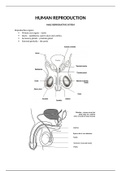
Reproductive organs:
Primary sex organs – testis
Ducts – epididymis, sperm duct and urethra
Accessory glands – prostate gland
External genitalia – the penis
, MALE ORGANS
ORGANS FUNCTION
Scrotum Acts as a temperature regulator (2-3°C), the lower temperature
is necessary for the formation of fertile sperm
In cold conditions – the testis is pulled closer to the abdomen
for warmth
Houses and protects
Testis The testis produces:
consist of many compartments or sperm by the germinal layer
lobules, which contain highly convoluted testosterone by the interstitial cells
tubules, the seminiferous tubules
germinal epithelium lines the tubules
between the tubules are groups of
endocrine cells, the interstitial cells, or
cells of Leydig
Epididymis Immature sperm enter the epididymis where they:
mature, to become motile and fertile
are sorted for several months
Sperm duct Pushes mature sperm forward by strong peristaltic waves from the
epididymis into the urethra = ejaculation
Urethra The urethra forms a common duct for the transportation of semen and
urine
Cowper’s Gland neutralizes acidic urine that may still be present in the urethra
the two are found at the base of the lubricates the urethra and external urethral opening to protect
penis sperm from mechanical damage during ejaculation
Prostate Gland Secretes fluid that aids the transport of the sperm and contains
enzymes that make sperm more active
this fluid makes up one 1/3 of the seminal fluid (semen)
Penis Deposits semen with sperm into the female’s vagina during copulation
Foreskin Loose protective skin around penis tip
Semen consists of:
sperm from the testis
seminal fluid from the sperm duct and accessory glands
Erection = stiffening of the penis the difference
Ejaculation = expulsion of the semen
PENIS:
it consists of special spongy tissue (erectile tissue)
running the length of the penis there are 3 sections of erectile tissue
2 are situated on the dorsal side, the corpus cavernosa, and one on the ventral side, the
corpus spongiosum
the primary mechanism that brings about an erection is the dilatation of dorsal and central
arteries supplying blood to the penis – this allows more blood to fill the 3 spongy erectile
tissue chambers causing the penis to lengthen = erection
the human male is the only mammal that has no erectile bone (baculum) in the penis – it
relies entirely on engorgement with blood to reach its erect state
, it not attached to the abdominal wall but hangs free. This is in contrast to most other
mammals where the penis is stored internally until erect
STRUCTURE OF A SPERM
the smallest of all human cells and consists
of a head, neck, body and tail
once ejaculated, the sperm can survive in
the female reproductive tract for about 48
hours
this is possible as it obtains nourishment
from seminal fluid and female secretions
HOW SPERM TRAVELS: testis epididymis
sperm duct prostate urethra
FEMALE REPRODUCTIVE TRACT
Organs include:
MALE REPRODUCTIVE SYSTEM
Reproductive organs:
Primary sex organs – testis
Ducts – epididymis, sperm duct and urethra
Accessory glands – prostate gland
External genitalia – the penis
, MALE ORGANS
ORGANS FUNCTION
Scrotum Acts as a temperature regulator (2-3°C), the lower temperature
is necessary for the formation of fertile sperm
In cold conditions – the testis is pulled closer to the abdomen
for warmth
Houses and protects
Testis The testis produces:
consist of many compartments or sperm by the germinal layer
lobules, which contain highly convoluted testosterone by the interstitial cells
tubules, the seminiferous tubules
germinal epithelium lines the tubules
between the tubules are groups of
endocrine cells, the interstitial cells, or
cells of Leydig
Epididymis Immature sperm enter the epididymis where they:
mature, to become motile and fertile
are sorted for several months
Sperm duct Pushes mature sperm forward by strong peristaltic waves from the
epididymis into the urethra = ejaculation
Urethra The urethra forms a common duct for the transportation of semen and
urine
Cowper’s Gland neutralizes acidic urine that may still be present in the urethra
the two are found at the base of the lubricates the urethra and external urethral opening to protect
penis sperm from mechanical damage during ejaculation
Prostate Gland Secretes fluid that aids the transport of the sperm and contains
enzymes that make sperm more active
this fluid makes up one 1/3 of the seminal fluid (semen)
Penis Deposits semen with sperm into the female’s vagina during copulation
Foreskin Loose protective skin around penis tip
Semen consists of:
sperm from the testis
seminal fluid from the sperm duct and accessory glands
Erection = stiffening of the penis the difference
Ejaculation = expulsion of the semen
PENIS:
it consists of special spongy tissue (erectile tissue)
running the length of the penis there are 3 sections of erectile tissue
2 are situated on the dorsal side, the corpus cavernosa, and one on the ventral side, the
corpus spongiosum
the primary mechanism that brings about an erection is the dilatation of dorsal and central
arteries supplying blood to the penis – this allows more blood to fill the 3 spongy erectile
tissue chambers causing the penis to lengthen = erection
the human male is the only mammal that has no erectile bone (baculum) in the penis – it
relies entirely on engorgement with blood to reach its erect state
, it not attached to the abdominal wall but hangs free. This is in contrast to most other
mammals where the penis is stored internally until erect
STRUCTURE OF A SPERM
the smallest of all human cells and consists
of a head, neck, body and tail
once ejaculated, the sperm can survive in
the female reproductive tract for about 48
hours
this is possible as it obtains nourishment
from seminal fluid and female secretions
HOW SPERM TRAVELS: testis epididymis
sperm duct prostate urethra
FEMALE REPRODUCTIVE TRACT
Organs include: