

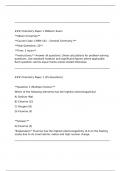
### Chemistry Paper 1 Midterm Exam
**Albion University**
**Course Code: CHEM 101 – General Chemistry I**
**Total Questions: 25**
**Time: 2 hours**
**Instructions:** Answer all questions. Show calculations for problem-solving
questions. Use standard notation and significant figures where applicable.
Each question carries equal marks unless stated otherwise.
### Chemistry Paper 1 (25 Questions)
**Question 1 (Multiple Choice):**
Which of the following elements has the highest electronegativity?
A) Sodium (Na)
B) Chlorine (Cl)
C) Oxygen (O)
D) Fluorine (F)
**Answer:**
D) Fluorine (F)
*Explanation:* Fluorine has the highest electronegativity (4.0 on the Pauling
scale) due to its small atomic radius and high nuclear charge.
, **Question 2 (Short Answer):**
Define an “isotope” and provide an example.
**Answer:**
An isotope is an atom of an element with the same number of protons but a
different number of neutrons. Example: Carbon-12 (¹²C) and Carbon-14 (¹⁴C).
**Question 3 (Problem Solving):**
Calculate the atomic mass of an element with two isotopes: Isotope A (80%
abundance, 35.0 amu) and Isotope B (20% abundance, 37.0 amu).
**Answer:**
Atomic mass = (Fraction of A × Mass of A) + (Fraction of B × Mass of B)
= (0.80 × 35.0) + (0.20 × 37.0)
= 28.0 + 7.4 = **35.4 amu**
**Question 4 (Multiple Choice):**
What is the electron configuration of a neutral sulfur atom (atomic number
16)?
A) 1s² 2s² 2p⁶ 3s² 3p⁴
B) 1s² 2s² 2p⁶ 3s² 3p⁶
C) 1s² 2s² 2p⁴ 3s² 3p²
D) 1s² 2s² 2p⁶ 3s¹ 3p⁵
**Answer:**
A) 1s² 2s² 2p⁶ 3s² 3p⁴
**Albion University**
**Course Code: CHEM 101 – General Chemistry I**
**Total Questions: 25**
**Time: 2 hours**
**Instructions:** Answer all questions. Show calculations for problem-solving
questions. Use standard notation and significant figures where applicable.
Each question carries equal marks unless stated otherwise.
### Chemistry Paper 1 (25 Questions)
**Question 1 (Multiple Choice):**
Which of the following elements has the highest electronegativity?
A) Sodium (Na)
B) Chlorine (Cl)
C) Oxygen (O)
D) Fluorine (F)
**Answer:**
D) Fluorine (F)
*Explanation:* Fluorine has the highest electronegativity (4.0 on the Pauling
scale) due to its small atomic radius and high nuclear charge.
, **Question 2 (Short Answer):**
Define an “isotope” and provide an example.
**Answer:**
An isotope is an atom of an element with the same number of protons but a
different number of neutrons. Example: Carbon-12 (¹²C) and Carbon-14 (¹⁴C).
**Question 3 (Problem Solving):**
Calculate the atomic mass of an element with two isotopes: Isotope A (80%
abundance, 35.0 amu) and Isotope B (20% abundance, 37.0 amu).
**Answer:**
Atomic mass = (Fraction of A × Mass of A) + (Fraction of B × Mass of B)
= (0.80 × 35.0) + (0.20 × 37.0)
= 28.0 + 7.4 = **35.4 amu**
**Question 4 (Multiple Choice):**
What is the electron configuration of a neutral sulfur atom (atomic number
16)?
A) 1s² 2s² 2p⁶ 3s² 3p⁴
B) 1s² 2s² 2p⁶ 3s² 3p⁶
C) 1s² 2s² 2p⁴ 3s² 3p²
D) 1s² 2s² 2p⁶ 3s¹ 3p⁵
**Answer:**
A) 1s² 2s² 2p⁶ 3s² 3p⁴


