SMQT- Survey & Certification Background
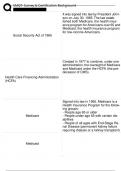
It was signed into law by President John-
son on July 30, 1965. The law estab-
lished both Medicare, the health insur-
ance program for Americans over 65 and
Medicaid, the health insurance program
for low-income Americans.
Social Security Act of 1965
Created in 1977 to combine, under one
administration, the oversight of Medicare
and Medicaid under the HCFA (the pre-
decessor of CMS).
Health Care Financing Administration
(HCFA)
Signed into law in 1965, Medicare is a
Health Insurance Program for the follow-
ing groups:
- People age 65 or older
Medicare - People under age 65 with certain dis-
abilities
- People of all ages with End-Stage Re-
nal Disease (permanent kidney failure
requiring dialysis or a kidney transplant)
Medicaid
, SMQT- Survey & Certification Background
Medicaid is a medical assistance pro-
gram jointly financed by State and Fed-
eral governments for eligible low-income
individuals. The program covers a variety
of groups, including the following:
- The needy elderly
- Blind
- Disabled individuals receiving cash as-
sistance under the Supplemental Secu-
rity Income Program
- Certain infants and low-income preg-
nant women
- At the option of the State, other low-in-
come individuals with medical bills that
qualify them as categorically or medically
needy.
Medicaid is a state program that provides
medical services to clients of the state
public assistance program and, at the
State's option, other needy individuals.
Medicaid also augments the hospital and
nursing facility (NF) services mandated
under Medicaid.
States may decide on the amount, du-
ration, and scope of additional services,
except that care in institutions primari-
ly for the care and treatment of mental
health issues, may not be included for
persons over age 21 and under age 65.
Clinical Laboratory Improvement
Amendments (CLIA)
, SMQT- Survey & Certification Background
Signed into law in 1988, CLIA regulations
include federal standards applicable to
all U.S. laboratory facilities or sites that
test human specimens for health assess-
ment or to diagnose, prevent, or treat
disease. The CDC, in partnership with
the CMS and FDA, supports the CLIA
program and clinical laboratory quality.
- The Centers for Disease Control &
Prevention is responsible for the CLIA
studies, convening the Clinical Labora-
tory Improvement Amendments Commit-
tee (CLIAC) & provides scientific & tech-
nical support to CMS.
- A laboratory is defined as any facil-
ity that performs laboratory testing on
specimens derived from humans for the
purpose of providing information for the
diagnosis, prevention, treatment of dis-
ease, or impairment of, or assessment of
health.
- CLIA covers approximately 175,000
laboratory entities.
- The Food & Drug Administration (FDA)
is responsible for test categorization.
- The Division of Laboratory Services,
within the Survey & Certification Group,
under the Center for Medicaid, CHIP and
Survey & Certification have the respon-
sibility for implementing the CLIA Pro-
gram.
- CMS is charged with the implementa-
tion of CLIA, including laboratory regis-
It was signed into law by President John-
son on July 30, 1965. The law estab-
lished both Medicare, the health insur-
ance program for Americans over 65 and
Medicaid, the health insurance program
for low-income Americans.
Social Security Act of 1965
Created in 1977 to combine, under one
administration, the oversight of Medicare
and Medicaid under the HCFA (the pre-
decessor of CMS).
Health Care Financing Administration
(HCFA)
Signed into law in 1965, Medicare is a
Health Insurance Program for the follow-
ing groups:
- People age 65 or older
Medicare - People under age 65 with certain dis-
abilities
- People of all ages with End-Stage Re-
nal Disease (permanent kidney failure
requiring dialysis or a kidney transplant)
Medicaid
, SMQT- Survey & Certification Background
Medicaid is a medical assistance pro-
gram jointly financed by State and Fed-
eral governments for eligible low-income
individuals. The program covers a variety
of groups, including the following:
- The needy elderly
- Blind
- Disabled individuals receiving cash as-
sistance under the Supplemental Secu-
rity Income Program
- Certain infants and low-income preg-
nant women
- At the option of the State, other low-in-
come individuals with medical bills that
qualify them as categorically or medically
needy.
Medicaid is a state program that provides
medical services to clients of the state
public assistance program and, at the
State's option, other needy individuals.
Medicaid also augments the hospital and
nursing facility (NF) services mandated
under Medicaid.
States may decide on the amount, du-
ration, and scope of additional services,
except that care in institutions primari-
ly for the care and treatment of mental
health issues, may not be included for
persons over age 21 and under age 65.
Clinical Laboratory Improvement
Amendments (CLIA)
, SMQT- Survey & Certification Background
Signed into law in 1988, CLIA regulations
include federal standards applicable to
all U.S. laboratory facilities or sites that
test human specimens for health assess-
ment or to diagnose, prevent, or treat
disease. The CDC, in partnership with
the CMS and FDA, supports the CLIA
program and clinical laboratory quality.
- The Centers for Disease Control &
Prevention is responsible for the CLIA
studies, convening the Clinical Labora-
tory Improvement Amendments Commit-
tee (CLIAC) & provides scientific & tech-
nical support to CMS.
- A laboratory is defined as any facil-
ity that performs laboratory testing on
specimens derived from humans for the
purpose of providing information for the
diagnosis, prevention, treatment of dis-
ease, or impairment of, or assessment of
health.
- CLIA covers approximately 175,000
laboratory entities.
- The Food & Drug Administration (FDA)
is responsible for test categorization.
- The Division of Laboratory Services,
within the Survey & Certification Group,
under the Center for Medicaid, CHIP and
Survey & Certification have the respon-
sibility for implementing the CLIA Pro-
gram.
- CMS is charged with the implementa-
tion of CLIA, including laboratory regis-