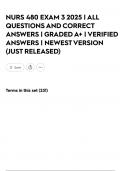
NURS 480 EXAM 3 2025 | ALL
QUESTIONS AND CORRECT
ANSWERS | GRADED A+ | VERIFIED
ANSWERS | NEWEST VERSION
(JUST RELEASED)
Save
Terms in this set (231)
,In planning for 3. Take all of the antibiotics until
discharge gone.
planning for a
client with The client should be instructed to
bacterial complete all antibiotics until they are
meningitis, the completely gone. Failure to
nurse will be complete antibiotics may lead to re-
sure to include infection and may spread causing
which endocarditis and other infections in
instruction? the body, especially if the bacteria
were from streptococci. While the
1. Keep all family client may be in isolation while in the
and visitors from hospital, family may not need to
visiting your quarantine the client when at home.
room for Some family members receive
protective prophylactic antibiotics, but will be
isolation. ordered according to the bacterial
2. Make sure you strain and health care provider
eat high protein (HCP) recommendations. It is
diet with plenty important to eat a good diet, but the
of fluids most important will be taking
3. Take all of the prescribed antibiotics. While
antibiotics until returning to exercise is important,
gone. gradual increase should be
4. Incorporate performed, and the answer
regular exercise
,with an active selection for exercise was not as
range of motion. important as prescribed antibiotics.
The nurse is 1. Supraorbital ridge pressure.
assessing the
central stimulus Central stimulus is applied to cranial
function of an nerves not peripheral nerves.
unconscious Supraorbital ridge pressure by
client in the applying pressure on the orbital rim
intensive care is indicated for central stimulus
unit. The nurse assessment. Sternal rub is usually
should plan to not indicated via best practices.
use which Pressure on the nail bed represents
technique to test testing painful stimuli for motor
the client's testing on peripheral nerves. Calling
central response out loudly is not an assessment
to stimuli? technique for central stimulus
function. There are two anatomic
1. Supraorbital locations for pain stimulus: centrally
ridge pressure. and peripherally. Central involves
2. Sternal rub. trapezious pinch or supraorbital
3. Pressure on pressure whereas peripheral stimuli
the nail bed. are applied to extremities.
4. Calling out Responses may infer damage to the
loudly close to brain or specific brain areas.
the client's ear.
, A client is 2. Perform neurological assessment
admitted for and assess pupillary response.
observation
following a The nurse needs to perform a neuro
motor vehicle assessment to determine pupillary
accident that response, ask if a headache is
occurred on the present, take vital signs, and contact
way to the the health care provider. The client
client's may be exhibiting subtle signs of
daughter's increased intracranial pressure
wedding. The which includes restlessness,
next morning, agitation, headache, and pupil
instead of asking changes.
about the
wedding, the
client tells the
nurse "I have to
leave now since
the wedding is in
a few minutes."
The client then
becomes
agitated when
the nurse re-
orients and
states the actual
QUESTIONS AND CORRECT
ANSWERS | GRADED A+ | VERIFIED
ANSWERS | NEWEST VERSION
(JUST RELEASED)
Save
Terms in this set (231)
,In planning for 3. Take all of the antibiotics until
discharge gone.
planning for a
client with The client should be instructed to
bacterial complete all antibiotics until they are
meningitis, the completely gone. Failure to
nurse will be complete antibiotics may lead to re-
sure to include infection and may spread causing
which endocarditis and other infections in
instruction? the body, especially if the bacteria
were from streptococci. While the
1. Keep all family client may be in isolation while in the
and visitors from hospital, family may not need to
visiting your quarantine the client when at home.
room for Some family members receive
protective prophylactic antibiotics, but will be
isolation. ordered according to the bacterial
2. Make sure you strain and health care provider
eat high protein (HCP) recommendations. It is
diet with plenty important to eat a good diet, but the
of fluids most important will be taking
3. Take all of the prescribed antibiotics. While
antibiotics until returning to exercise is important,
gone. gradual increase should be
4. Incorporate performed, and the answer
regular exercise
,with an active selection for exercise was not as
range of motion. important as prescribed antibiotics.
The nurse is 1. Supraorbital ridge pressure.
assessing the
central stimulus Central stimulus is applied to cranial
function of an nerves not peripheral nerves.
unconscious Supraorbital ridge pressure by
client in the applying pressure on the orbital rim
intensive care is indicated for central stimulus
unit. The nurse assessment. Sternal rub is usually
should plan to not indicated via best practices.
use which Pressure on the nail bed represents
technique to test testing painful stimuli for motor
the client's testing on peripheral nerves. Calling
central response out loudly is not an assessment
to stimuli? technique for central stimulus
function. There are two anatomic
1. Supraorbital locations for pain stimulus: centrally
ridge pressure. and peripherally. Central involves
2. Sternal rub. trapezious pinch or supraorbital
3. Pressure on pressure whereas peripheral stimuli
the nail bed. are applied to extremities.
4. Calling out Responses may infer damage to the
loudly close to brain or specific brain areas.
the client's ear.
, A client is 2. Perform neurological assessment
admitted for and assess pupillary response.
observation
following a The nurse needs to perform a neuro
motor vehicle assessment to determine pupillary
accident that response, ask if a headache is
occurred on the present, take vital signs, and contact
way to the the health care provider. The client
client's may be exhibiting subtle signs of
daughter's increased intracranial pressure
wedding. The which includes restlessness,
next morning, agitation, headache, and pupil
instead of asking changes.
about the
wedding, the
client tells the
nurse "I have to
leave now since
the wedding is in
a few minutes."
The client then
becomes
agitated when
the nurse re-
orients and
states the actual