kyle ricci chapter 10 (questions n answers) already passed
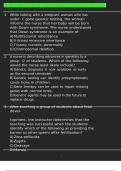
1. While talking with a pregnant woman who has
under- C gone genetic testing, the woman
informs the nurse that her baby will be born
with Down syndrome. The nurse understands
that Down syndrome is an example of:
A) Multifactorial inheritance
B) X-linked recessive inheritance
C)Trisomy numeric abnormality
D) Chromosomal deletion
2. A nurse is describing advances in genetics to a
group D of students. Which of the following
would the nurse least likely include?
A) Genetic diagnosis is now available as early
as the second trimester.
B) Genetic testing can identify presymptomatic
condi- tions in children.
C)Gene therapy can be used to repair missing
genes with normal ones.
D)Genetic agents may be used in the future to
replace drugs.
3. After teaching a group of students about fetal
devel-
A opment, the instructor determines that the
teaching was successful when the students
identify which of the following as providing the
barrier to other sperm after fertilization?
A) Zona pellucida
B) Zygote
C)Cleavage
D) Morula
1/
13
, kyle ricci chapter 10 (questions n answers) already passed
4. A nurse is teaching a class on X-linked
recessive dis-
B orders. Which of the following statements
would the nurse most likely include?
A) Males are typically carriers of the disorders.
B) No male-to-male transmission occurs.
C)Daughters are more commonly affected
with the disorder.
D) Both sons and daughters have a 50% risk of
the disorder.
5. A pregnant woman undergoes maternal serum
al-
A pha-fetoprotein (MSAFP) testing at 16 to 18
weeks' ges- tation. Which of the following
would the nurse suspect if the woman's level
is decreased?
A) Down syndrome
B) Sickle-cell anemia
C)Cardiac defects
D) Open neural tube defect
6. The nurse is developing a presentation for a
communi- B ty group of young adults
discussing fetal development and pregnancy.
The nurse would identify that the sex of
offspring is determined at the time of:
A) Meiosis
B) Fertilization
C)Formation of morula
D) Oogenesis
2/
13
1. While talking with a pregnant woman who has
under- C gone genetic testing, the woman
informs the nurse that her baby will be born
with Down syndrome. The nurse understands
that Down syndrome is an example of:
A) Multifactorial inheritance
B) X-linked recessive inheritance
C)Trisomy numeric abnormality
D) Chromosomal deletion
2. A nurse is describing advances in genetics to a
group D of students. Which of the following
would the nurse least likely include?
A) Genetic diagnosis is now available as early
as the second trimester.
B) Genetic testing can identify presymptomatic
condi- tions in children.
C)Gene therapy can be used to repair missing
genes with normal ones.
D)Genetic agents may be used in the future to
replace drugs.
3. After teaching a group of students about fetal
devel-
A opment, the instructor determines that the
teaching was successful when the students
identify which of the following as providing the
barrier to other sperm after fertilization?
A) Zona pellucida
B) Zygote
C)Cleavage
D) Morula
1/
13
, kyle ricci chapter 10 (questions n answers) already passed
4. A nurse is teaching a class on X-linked
recessive dis-
B orders. Which of the following statements
would the nurse most likely include?
A) Males are typically carriers of the disorders.
B) No male-to-male transmission occurs.
C)Daughters are more commonly affected
with the disorder.
D) Both sons and daughters have a 50% risk of
the disorder.
5. A pregnant woman undergoes maternal serum
al-
A pha-fetoprotein (MSAFP) testing at 16 to 18
weeks' ges- tation. Which of the following
would the nurse suspect if the woman's level
is decreased?
A) Down syndrome
B) Sickle-cell anemia
C)Cardiac defects
D) Open neural tube defect
6. The nurse is developing a presentation for a
communi- B ty group of young adults
discussing fetal development and pregnancy.
The nurse would identify that the sex of
offspring is determined at the time of:
A) Meiosis
B) Fertilization
C)Formation of morula
D) Oogenesis
2/
13