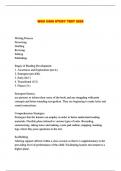
WGU C909 STUDY TEST 2025
Writing Process
Prewriting
Drafting
Revising
Editing
Publishing
Stages of Reading Development
1. Awareness and Exploration (pre-k)
2. Emergent (pre-k/K)
3. Early (K/1)
4. Transitional (1/2)
5. Fluent (3+)
Emergent literacy
use pictures to inform their sense of the book and are struggling with print
concepts and letter-sounding recognition. They are beginning to make letter and
sound connections.
Comprehension Strategies
Strategies that the learner can employ in order to better understand reading
materials. Flexible plans tailored to various types of tasks. Rereading,
summarizing, taking notes and making a note pad outline, mapping, learning
logs where they pose questions to the text.
Scaffolding
Altering support offered within a class session so that it is supplementary to the
prevailing level of performance of the child. Facilitating learner movement to a
higher plane.
, Graphic Organizer
a tool applied to organize thoughts and can be utilized to envision thoughts.
Visible presentations that reveal relationships between facts, concepts or ideas.
Anticipation Guide
collection of sentences utilized to predict and stimulate pre-existing knowledge
before reading a passage.
Reciprocal Teaching
Reading and listening comprehension teaching procedure in which learners take
turns questioning peers with questions similar to what a teacher might ask.
Phonemic Awareness
The ability to hear, identify, and use the unique sounds, phonemes, within
spoken language.
Venn Diagram
two overlapping circles that show how a text is alike and different. Facilitates
ideas comparison.
Brainstorming
generates writing ideas.
Semantic Mapping
Maps writing ideas for description. A technique that visually shows the word
relationship and allows categorizing.
Journaling
Writing down thoughts and feelings on a regular basis, offers opportunities for
reflective thinking.
One of the best predictors of word knowledge is
extensive reading.
Oral retellings are helped most when
Writing Process
Prewriting
Drafting
Revising
Editing
Publishing
Stages of Reading Development
1. Awareness and Exploration (pre-k)
2. Emergent (pre-k/K)
3. Early (K/1)
4. Transitional (1/2)
5. Fluent (3+)
Emergent literacy
use pictures to inform their sense of the book and are struggling with print
concepts and letter-sounding recognition. They are beginning to make letter and
sound connections.
Comprehension Strategies
Strategies that the learner can employ in order to better understand reading
materials. Flexible plans tailored to various types of tasks. Rereading,
summarizing, taking notes and making a note pad outline, mapping, learning
logs where they pose questions to the text.
Scaffolding
Altering support offered within a class session so that it is supplementary to the
prevailing level of performance of the child. Facilitating learner movement to a
higher plane.
, Graphic Organizer
a tool applied to organize thoughts and can be utilized to envision thoughts.
Visible presentations that reveal relationships between facts, concepts or ideas.
Anticipation Guide
collection of sentences utilized to predict and stimulate pre-existing knowledge
before reading a passage.
Reciprocal Teaching
Reading and listening comprehension teaching procedure in which learners take
turns questioning peers with questions similar to what a teacher might ask.
Phonemic Awareness
The ability to hear, identify, and use the unique sounds, phonemes, within
spoken language.
Venn Diagram
two overlapping circles that show how a text is alike and different. Facilitates
ideas comparison.
Brainstorming
generates writing ideas.
Semantic Mapping
Maps writing ideas for description. A technique that visually shows the word
relationship and allows categorizing.
Journaling
Writing down thoughts and feelings on a regular basis, offers opportunities for
reflective thinking.
One of the best predictors of word knowledge is
extensive reading.
Oral retellings are helped most when