IGCSE Physics\Current Electricity\Important Concepts
IGCSE PHYSICS
CURRENT ELECTRICITY: IMPORTANT CONCEPTS
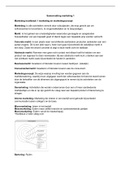
CIRCUIT SYMBOLS
d.c. supply a.c. supply Joined wires Crossing wires
Switch Bulb Earth wire Fuse
Resistor Ammeter Voltmeter Galvanometer
Rheostat Potential divider Thermistor Light-dependent resistor
Diode Light-emitting diode Bell Buzzer
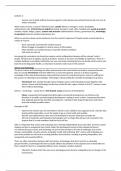
FLOW OF CHARGES, CONVENTIONAL CURRENT
Positive and negative particles (protons and electrons) in the atoms that make up
an object carry charges. The unit for charge, Q, is Coulomb (C).
Each electron carries a negative charge of 1.6 x 10⁻¹⁹ C. As electrons flow through a
conductor from the negative terminal to the positive terminal, electric current flows
from the positive terminal to the negative terminal.
Hence, current is defined as the rate of flow of electric charges:
Current, I (A) =
The unit for current, I, is amperes (A).
The magnitude of current in a circuit is measured by an ammeter connected in
series to the circuit.
_____________________________________________________________________________
Nakazawa EduServ. Created by Jackson Tik, B.Sc. (NUS). ©All rights reserved. 1
, IGCSE Physics\Current Electricity\Important Concepts
An ideal ammeter has negligible resistance; i.e. negligible amount of work is done
to drive charges through the ammeter.
A zero-centred galvanometer gives the direction of conventional current.
ELECTROMOTIVE FORCE, POTENTIAL DIFFERENCE
In a circuit, a difference in electrical potential is required to produce net movement
of charges (electrons). Electrons flow from a point of lower electrical potential
(negative terminal) to a point of higher electrical potential (positive terminal).
The potential difference required for movement of charges is provided by a cell or a
battery. When a charge moves across a cell, work is done to increase the electrical
potential energy of the charge due to the chemical reaction in the cell.
Hence, the work done in moving every unit charge across a cell around a complete
circuit is known as the electromotive force (e.m.f.) of the cell.
Electromotive force (e.m.f.), (V) =
The unit for e.m.f., , is volts (V).
When the charge flows through a load (an electrical component), its electrical
potential energy is converted into other forms of energy to power the load.
Hence, the amount of energy dissipated in moving every unit charge across a load
in a complete circuit is known as the potential difference or voltage across the load.
Potential difference/ voltage, V (V) =
The unit for potential difference or voltage, V, is volts (V).
The e.m.f. of a cell and the potential difference across a load is measured by
connecting a voltmeter in parallel to the circuit.
An ideal voltmeter has infinite resistance; i.e. the current flowing through the
voltmeter is negligibly small.
Test Yourself:
A student connected two dry cells in series, each of e.m.f. 1.5 V, to light up a bulb in
a simple circuit. He also connected an ammeter to measure the amount the current in
the circuit and a voltmeter to measure the potential difference across the bulb.
(a) In the empty space given, draw a circuit diagram to represent the setup above
such that the bulb will light up and correct readings will be obtained.
_____________________________________________________________________________
Nakazawa EduServ. Created by Jackson Tik, B.Sc. (NUS). ©All rights reserved. 2
IGCSE PHYSICS
CURRENT ELECTRICITY: IMPORTANT CONCEPTS
CIRCUIT SYMBOLS
d.c. supply a.c. supply Joined wires Crossing wires
Switch Bulb Earth wire Fuse
Resistor Ammeter Voltmeter Galvanometer
Rheostat Potential divider Thermistor Light-dependent resistor
Diode Light-emitting diode Bell Buzzer
FLOW OF CHARGES, CONVENTIONAL CURRENT
Positive and negative particles (protons and electrons) in the atoms that make up
an object carry charges. The unit for charge, Q, is Coulomb (C).
Each electron carries a negative charge of 1.6 x 10⁻¹⁹ C. As electrons flow through a
conductor from the negative terminal to the positive terminal, electric current flows
from the positive terminal to the negative terminal.
Hence, current is defined as the rate of flow of electric charges:
Current, I (A) =
The unit for current, I, is amperes (A).
The magnitude of current in a circuit is measured by an ammeter connected in
series to the circuit.
_____________________________________________________________________________
Nakazawa EduServ. Created by Jackson Tik, B.Sc. (NUS). ©All rights reserved. 1
, IGCSE Physics\Current Electricity\Important Concepts
An ideal ammeter has negligible resistance; i.e. negligible amount of work is done
to drive charges through the ammeter.
A zero-centred galvanometer gives the direction of conventional current.
ELECTROMOTIVE FORCE, POTENTIAL DIFFERENCE
In a circuit, a difference in electrical potential is required to produce net movement
of charges (electrons). Electrons flow from a point of lower electrical potential
(negative terminal) to a point of higher electrical potential (positive terminal).
The potential difference required for movement of charges is provided by a cell or a
battery. When a charge moves across a cell, work is done to increase the electrical
potential energy of the charge due to the chemical reaction in the cell.
Hence, the work done in moving every unit charge across a cell around a complete
circuit is known as the electromotive force (e.m.f.) of the cell.
Electromotive force (e.m.f.), (V) =
The unit for e.m.f., , is volts (V).
When the charge flows through a load (an electrical component), its electrical
potential energy is converted into other forms of energy to power the load.
Hence, the amount of energy dissipated in moving every unit charge across a load
in a complete circuit is known as the potential difference or voltage across the load.
Potential difference/ voltage, V (V) =
The unit for potential difference or voltage, V, is volts (V).
The e.m.f. of a cell and the potential difference across a load is measured by
connecting a voltmeter in parallel to the circuit.
An ideal voltmeter has infinite resistance; i.e. the current flowing through the
voltmeter is negligibly small.
Test Yourself:
A student connected two dry cells in series, each of e.m.f. 1.5 V, to light up a bulb in
a simple circuit. He also connected an ammeter to measure the amount the current in
the circuit and a voltmeter to measure the potential difference across the bulb.
(a) In the empty space given, draw a circuit diagram to represent the setup above
such that the bulb will light up and correct readings will be obtained.
_____________________________________________________________________________
Nakazawa EduServ. Created by Jackson Tik, B.Sc. (NUS). ©All rights reserved. 2