

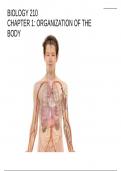
BIOLOGY 210
CHAPTER 1: ORGANIZATION OF THE
BODY
, LEARNING OUTCOMES-1
1. Define the term anatomy.
2. Give TWO examples for the application of anatomy.
3. Define the term physiology.
4. Give TWO specific examples for the application of physiology.
5. List the levels of organization in the human body starting with
the atom.
6. Give one example of each level of organization.
7. List the six functions of human life.
8. Give one example of each function of human life.
9. List the 11 body systems.
10. List the functions of EACH of the 11 body systems.
11. Describe the anatomical position. Why is having an anatomical
position important?
, LEARNING OUTCOMES-2
12. List AND define all the directional terms.
13. Apply each directional term by using them in a sentence.
14. List AND define the body planes. In your answer, use the
directional terms in question 13 to describe the planes in question
14.
15. Describe the body regions and list at least two main organs in
each region. Draw or use a picture to help.
16. Describe the body cavities and list at least two main organs in
each cavity. Draw or use a picture to help.
17. Describe how the abdomen and pelvis are divided into regions.
18. List the names of those abdominopelvic regions.
19. Describe how the abdomen and pelvis are divided into
quadrants.
, LEARNING OUTCOMES-3
20. List the names of those quadrants.
21. List the components of homeostatic mechanisms in negative
feedback loops and give a definition of each.
22. Compare and contrast negative and positive feedback loops.
CHAPTER 1: ORGANIZATION OF THE
BODY
, LEARNING OUTCOMES-1
1. Define the term anatomy.
2. Give TWO examples for the application of anatomy.
3. Define the term physiology.
4. Give TWO specific examples for the application of physiology.
5. List the levels of organization in the human body starting with
the atom.
6. Give one example of each level of organization.
7. List the six functions of human life.
8. Give one example of each function of human life.
9. List the 11 body systems.
10. List the functions of EACH of the 11 body systems.
11. Describe the anatomical position. Why is having an anatomical
position important?
, LEARNING OUTCOMES-2
12. List AND define all the directional terms.
13. Apply each directional term by using them in a sentence.
14. List AND define the body planes. In your answer, use the
directional terms in question 13 to describe the planes in question
14.
15. Describe the body regions and list at least two main organs in
each region. Draw or use a picture to help.
16. Describe the body cavities and list at least two main organs in
each cavity. Draw or use a picture to help.
17. Describe how the abdomen and pelvis are divided into regions.
18. List the names of those abdominopelvic regions.
19. Describe how the abdomen and pelvis are divided into
quadrants.
, LEARNING OUTCOMES-3
20. List the names of those quadrants.
21. List the components of homeostatic mechanisms in negative
feedback loops and give a definition of each.
22. Compare and contrast negative and positive feedback loops.


