

Advanced Med Surg Case Study-1 Complete 2025
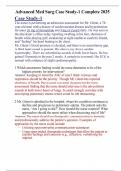
Case Study-1 The nurse is performing an admission assessment for Mr. Glenn, a 78- year-old man with a history of cardiovascular disease and hypertension. He takes 20 mg of furosemide and 5 mg of Zestril daily. He was seen in the physician’s office today reporting swelling in his feet, shortness of breath while playing golf, awakening at night unable to catch his breath, and “feeling” his heart beating in his chest. Mr. Glenn’s blood pressure is elevated, and there is no auscultatory gap. A third heart sound is present. His chest x-ray shows cardiac hypertrophy. There are adventitious sounds in both lower bases. He has gained 10 pounds in the past 2 weeks. A urinalysis is normal. His ECG is normal with evidence of slight cardiomyopathy. 1 Which assessment finding would the nurse determine to be of the highest priority for intervention? Answer: Keeping in mind the ABC of care I think Airways and respiration should be the priority. Though Mr. Glenn has reported shortness of breath, Paroxysmal nocturnal dyspnea but the most assessment finding that the nurse should intervene is the adventitious sounds in both lower bases of lungs. It could strongly correlate with developing pulmonary edema which could be life threatening. 2 Mr. Glenn is admitted to the hospital, where his condition continues to decline and progresses to pulmonary edema. The patient asks the nurse, “Am I going to die?” How should the nurse respond? What approaches should the nurse utilize when discussing end of life? Answer: The nurse should use therapeutic communication to honestly and professionally address the patient’s question. Examples of approaches by the nurse could include: • Utilizing open nonverbal communication techniques • Using open-ended, therapeutic techniques that allow the patient to express feelings and concerns (e.g., reflection, verbalizing the implied. End of life discussions, with Mr. Glenn should extend beyond a DNR. The nurse should discuss Mr. Glenn’s fears of dying and his families fear. The nurse should discuss, Mr. Glenn’s prognosis and help him to make important end of life decisions, including making sure his physical needs are met. The nurse must make sure Mr. Glenn’s wishes and values are adhered too. The Nurse can ask “What make him feel that he is going to die? “ 1 The conversation between Mr. Glenn and the nurse continues; Mr. Glenn states, “My doctor said that I only have about 2 months to live.” Should the nurse discuss advance directives with the patient? If so, what approaches should the nurse utilize when discussing his wishes? Answer: Yes, the nurse should take this opportunity to discuss advance directives, using therapeutic communication to honestly and professionally dialogue with the patient. Mr. Glenn relies on his nurse for guidance. The nurse is responsible for advocating for Mr. Glenn and supporting his decisions. The nurse should certainly discuss advance directives with Mr. Glenn, his family and the provider. Case Study #2: Mrs. Jones is a 63-year-old patient who has come to the ED after awaking this morning at 8:00 AM experiencing symptoms after eating. She has a 5-year history of hyperlipidemia, hypertension, type 2 diabetes, and osteoarthritis. She states that she had a total hysterectomy 10 years ago, and that her gallbladder was removed 2 years ago. At this time, the patient states that she has fatigue, shoulder pain, indigestion, a moderate ache in the chest that is worse on inspiration, nausea, and a headache. 1 Which portion(s) of Mrs. Jones’s health history should the nurse identify that require priority assessment? Answer: The priority assessment in this case would be that she has a moderate ache in her chest that is worse on inspiration with shoulder pain and indigestion. These symptoms could indicate a possible heart condition. Mrs. Jones should have an EKG 2. Based upon the symptoms that Mrs. Jones expressed and the nurse’s identification of priority assessment, what actions should the nurse take? Answer: The nurse priority actions with Mr. Jones should include, assesses for abnormal heart and lung sounds, to detect for heart failure. The nurse should monitor Mrs. Jone’s 1. blood pressure and pulse. 2. Mrs. Jone’s level of consciousness. 3. assess the patient’s skin tone and peripheral pulses. 4. Mrs. Jones’s oxygen saturation, airway, breathing and circulation should be assessed. If Mrs. Jones needs oxygen and if was prescribed the nurse should administer it. 5. ECG monitoring 6. Obtaining medication history 7. Obtaining orders for initial diagnostic testing 8. Asking the patient when she consumed her last meal (including what was consumed, amount, etc.)
Información del documento
- Subido en
- 30 de abril de 2025
- Número de páginas
- 6
- Escrito en
- 2024/2025
- Tipo
- Examen
- Contiene
- Preguntas y respuestas

