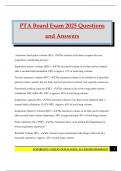
PTA Board Exam 2025 Questions
and Answers
Anatomic dead space volume (VD) - ✔✔The volume of air that occupies the non-
respiratory conducting airways
Expiratory reserve volume (ERV) - ✔✔The maximal volume of air that can be exhaled
after a normal tidal exhalation. ERV is approx. 15% of total lung volume.
Forced expiratory volume (FEV) - ✔✔The maximal volume of air exhaled in a specified
period of time: usually the 1st, 2nd, and 3rd second of a forced vital capacity maneuver.
Functional residual capacity (FRC) - ✔✔The volume of air in the lungs after normal
exhalation. FRC=ERV+RV. FRC is approx. 40% of total lung volume.
Inspiratory capacity (IC) - ✔✔The maximal volume of air that can be inspired after a
normal tidal exhalation. IC=TV+IRV. Approx. 60% of total lung volume
Inspiratory Reserve Volume (IRV) - ✔✔The maximal volume of air that can be inspired
after normal tidal volume inspiration. IRV is approximately 50% of total lung volume.
Peak expiratory flow (PEF) - ✔✔The maximum flow of air during the beginning of a
forced expiratory maneuver
Residual Volume (RV) - ✔✔the volume of gas remaining in the lungs at the end of a
maximal expiration. Approx. 25% of total lung volume.
COPYRIGHT © 2025 BY OLIVIA WEST, ALL RIGHTS RESERVED 1
,Tidal Volume (TV) - ✔✔Total volume inspired and expired with each breath during
quiet breathing. Approx. 10% of total lung volume
Total Lung Capacity (TLC) - ✔✔The volume of air in the lungs after max inspiration.
The sum of all lung volumes.
Vital Capacity (VC) - ✔✔volume change that occurs between maximal inspiration and
maximal expiration. Approx. 75% of total lung volume
Akinesia - ✔✔The inability to initiate movement; commonly seen in patients with
Parkinson's disease
Asthenia - ✔✔generalized weakness, typically secondary to cerebellar pathology
Ataxia - ✔✔inability to perform coordinated movements
Athetosis - ✔✔A condition that presents with involuntary movements combined with
instability of posture. Peripheral movements occur without central stability
Bradykinesia - ✔✔slow movement
Chorea - ✔✔movements that are sudden, random, and involuntary
Clasp-knife response - ✔✔A form of resistance seen during range of motion of a
hypertonic joint where there is greatest resistance at the initiation of range that lessens
with movement through the range of motion
Clonus - ✔✔characteristic of an upper motor neuron lesion; involuntary alternating
spasmodic contraction of a muscle precipitated by a quick stretch reflex
cogwheel rigidity - ✔✔A form of rigidity where resistance to movement has a phasic
quality to it; often seen with Parkinson's disease.
Dysdiadochokinesia - ✔✔inability to perform rapid alternating movements
COPYRIGHT © 2025 BY OLIVIA WEST, ALL RIGHTS RESERVED 2
,Dysmetria - ✔✔The inability to control the range of a movement and the force of
muscular activity.
Dystonia - ✔✔closely related to athetosis; however there is larger axial muscle
involvement rather than appendicular muscles
Fasciculation - ✔✔A muscular twitch that is caused by random discharge of a lower
motor neuron and its muscle fibers; suggests lower motor neuron disease, however, can
be benign
Hemiballism - ✔✔an involuntary and violent movement of a large body part
Kinesthesia - ✔✔Ability to perceive the direction and extent of movement of a joint or
body part
Lead pipe rigidity - ✔✔form of rigidity where there is uniform and constant resistance
to ROM, often associated with lesions of basal ganglia
rigidity - ✔✔a state of severe hypertonicity where a sustained muscle contraction does
not allow for any movement at a specified joint
Tremor - ✔✔involuntary, rhythmic, oscillatory movements secondary to a basal ganglia
lesion
Agnosia - ✔✔inability to interpret information
Agraphesthesia - ✔✔inability to recognize symbols, letters or numbers traced on the
skin
Agraphia - ✔✔inability to write due to a lesion on the brain. Normally found in combo
with aphasia
Apraxia - ✔✔inability to perform purposeful learned movements or activities even
though there is no sensory or motor impairment
COPYRIGHT © 2025 BY OLIVIA WEST, ALL RIGHTS RESERVED 3
, astereogenesis - ✔✔inability to recognize objects by sense of touch
Body schema - ✔✔having an understanding of the body as a whole and the relationship
of its parts to the whole
decerebrate rigidity - ✔✔characteristic of a corticospinal lesion at level of brainstem that
results in extension of trunk and all extremities
decorticate rigidity - ✔✔A characteristic of a corticospinal lesion at the level of the
diencephalon where the trunk and lower extremities are positioned in extension and the
upper extremities are positioned in flexion
diplopia - ✔✔double vision
Dysarthria - ✔✔slurred and impaired speech due to a motor deficit of the tongue or
other muscles essential for speech.
Dysphagia - ✔✔difficulty swallowing
homonymous hemianopsia - ✔✔The loss of the right or left half of the field of vision in
both eyes.
Perseveration - ✔✔state of repeatedly performing the same segment of a task or
repeatedly saying the same word/phrase without purpose
Synergy - ✔✔mass movement patterns that are primitive in nature and coupled with
spasticity due to brain damage
unilateral neglect - ✔✔The inability to interpret stimuli and events on the contralateral
side of a hemispheric lesion. Left-sided neglect is most common with a lesion to the
right inferior parietal or superior temporal lobes.
Complete lesion SCI - ✔✔A lesion to the spinal cord where there is no preserved motor
or sensory function below the level of the lesion
COPYRIGHT © 2025 BY OLIVIA WEST, ALL RIGHTS RESERVED 4
and Answers
Anatomic dead space volume (VD) - ✔✔The volume of air that occupies the non-
respiratory conducting airways
Expiratory reserve volume (ERV) - ✔✔The maximal volume of air that can be exhaled
after a normal tidal exhalation. ERV is approx. 15% of total lung volume.
Forced expiratory volume (FEV) - ✔✔The maximal volume of air exhaled in a specified
period of time: usually the 1st, 2nd, and 3rd second of a forced vital capacity maneuver.
Functional residual capacity (FRC) - ✔✔The volume of air in the lungs after normal
exhalation. FRC=ERV+RV. FRC is approx. 40% of total lung volume.
Inspiratory capacity (IC) - ✔✔The maximal volume of air that can be inspired after a
normal tidal exhalation. IC=TV+IRV. Approx. 60% of total lung volume
Inspiratory Reserve Volume (IRV) - ✔✔The maximal volume of air that can be inspired
after normal tidal volume inspiration. IRV is approximately 50% of total lung volume.
Peak expiratory flow (PEF) - ✔✔The maximum flow of air during the beginning of a
forced expiratory maneuver
Residual Volume (RV) - ✔✔the volume of gas remaining in the lungs at the end of a
maximal expiration. Approx. 25% of total lung volume.
COPYRIGHT © 2025 BY OLIVIA WEST, ALL RIGHTS RESERVED 1
,Tidal Volume (TV) - ✔✔Total volume inspired and expired with each breath during
quiet breathing. Approx. 10% of total lung volume
Total Lung Capacity (TLC) - ✔✔The volume of air in the lungs after max inspiration.
The sum of all lung volumes.
Vital Capacity (VC) - ✔✔volume change that occurs between maximal inspiration and
maximal expiration. Approx. 75% of total lung volume
Akinesia - ✔✔The inability to initiate movement; commonly seen in patients with
Parkinson's disease
Asthenia - ✔✔generalized weakness, typically secondary to cerebellar pathology
Ataxia - ✔✔inability to perform coordinated movements
Athetosis - ✔✔A condition that presents with involuntary movements combined with
instability of posture. Peripheral movements occur without central stability
Bradykinesia - ✔✔slow movement
Chorea - ✔✔movements that are sudden, random, and involuntary
Clasp-knife response - ✔✔A form of resistance seen during range of motion of a
hypertonic joint where there is greatest resistance at the initiation of range that lessens
with movement through the range of motion
Clonus - ✔✔characteristic of an upper motor neuron lesion; involuntary alternating
spasmodic contraction of a muscle precipitated by a quick stretch reflex
cogwheel rigidity - ✔✔A form of rigidity where resistance to movement has a phasic
quality to it; often seen with Parkinson's disease.
Dysdiadochokinesia - ✔✔inability to perform rapid alternating movements
COPYRIGHT © 2025 BY OLIVIA WEST, ALL RIGHTS RESERVED 2
,Dysmetria - ✔✔The inability to control the range of a movement and the force of
muscular activity.
Dystonia - ✔✔closely related to athetosis; however there is larger axial muscle
involvement rather than appendicular muscles
Fasciculation - ✔✔A muscular twitch that is caused by random discharge of a lower
motor neuron and its muscle fibers; suggests lower motor neuron disease, however, can
be benign
Hemiballism - ✔✔an involuntary and violent movement of a large body part
Kinesthesia - ✔✔Ability to perceive the direction and extent of movement of a joint or
body part
Lead pipe rigidity - ✔✔form of rigidity where there is uniform and constant resistance
to ROM, often associated with lesions of basal ganglia
rigidity - ✔✔a state of severe hypertonicity where a sustained muscle contraction does
not allow for any movement at a specified joint
Tremor - ✔✔involuntary, rhythmic, oscillatory movements secondary to a basal ganglia
lesion
Agnosia - ✔✔inability to interpret information
Agraphesthesia - ✔✔inability to recognize symbols, letters or numbers traced on the
skin
Agraphia - ✔✔inability to write due to a lesion on the brain. Normally found in combo
with aphasia
Apraxia - ✔✔inability to perform purposeful learned movements or activities even
though there is no sensory or motor impairment
COPYRIGHT © 2025 BY OLIVIA WEST, ALL RIGHTS RESERVED 3
, astereogenesis - ✔✔inability to recognize objects by sense of touch
Body schema - ✔✔having an understanding of the body as a whole and the relationship
of its parts to the whole
decerebrate rigidity - ✔✔characteristic of a corticospinal lesion at level of brainstem that
results in extension of trunk and all extremities
decorticate rigidity - ✔✔A characteristic of a corticospinal lesion at the level of the
diencephalon where the trunk and lower extremities are positioned in extension and the
upper extremities are positioned in flexion
diplopia - ✔✔double vision
Dysarthria - ✔✔slurred and impaired speech due to a motor deficit of the tongue or
other muscles essential for speech.
Dysphagia - ✔✔difficulty swallowing
homonymous hemianopsia - ✔✔The loss of the right or left half of the field of vision in
both eyes.
Perseveration - ✔✔state of repeatedly performing the same segment of a task or
repeatedly saying the same word/phrase without purpose
Synergy - ✔✔mass movement patterns that are primitive in nature and coupled with
spasticity due to brain damage
unilateral neglect - ✔✔The inability to interpret stimuli and events on the contralateral
side of a hemispheric lesion. Left-sided neglect is most common with a lesion to the
right inferior parietal or superior temporal lobes.
Complete lesion SCI - ✔✔A lesion to the spinal cord where there is no preserved motor
or sensory function below the level of the lesion
COPYRIGHT © 2025 BY OLIVIA WEST, ALL RIGHTS RESERVED 4