100% de satisfacción garantizada Inmediatamente disponible después del pago Tanto en línea como en PDF No estas atado a nada 4.2 TrustPilot
logo-home
Examen

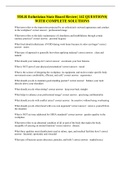
AQA PSYCHOLOGY PAPER 1 2024 QUESTIONS WITH COMPLETE SOLUTIONS GRADED A+

Puntuación
-
Vendido
-
Páginas
23
Grado
A+
Subido en
29-04-2025
Escrito en
2024/2025

AQA PSYCHOLOGY PAPER 1 2024 QUESTIONS WITH COMPLETE SOLUTIONS GRADED A+ "Evaluate Milgram's (1964) study: - CORRECT ANSWER Ethical issues - ppts were deceived. They thought that the allocation of roes was random, but it was predetermined. They also thought the shocks were real. Milgram dealt with this by debriefing participants. However, Baumrind (1964) criticised Milgram for deceiving his participants - lasting psychological consequences for ppts and researchers. Research support - findings were replicated in a French documentary (Le Jeu de la Mort) - their behaviour was almost identical to that of Milgram's ppts - nervous laughter, nail-biting and other signs of anxiety. Supports Milgram's findings about obedience to authority, and demonstrated that the findings were NOT just due to special circumstances. Low internal validity - may not have been testing what it was meant to be - Milgram said 75% of ppts said they believed the shocks were genuine/Orne and Holland (1968) argued that ppts were 'play-acting'. This suggests that ppts may have been responding to demand characteristics, trying to fulfil the aims of the study." "What are situational variables? - CORRECT ANSWER Features of the environments that may influence a person's behaviour." "Evaluate situational explanations: - CORRECT ANSWER Research support - Milgram's studies support the role of the agentic state in obedience. Most of Milgram's ppts resisted giving the shocks at some point - asked the EXPERIMENTER 'who is responsible if Mr Wallace is harmed?'. When they were told they were not responsible they continued with no objection. Explains cultural differences - many studies have shown that countries differ in the degree to which people are obedient to legitimate authority. Kilham and Mann (1974) found that only 16% of Australian women went all the way up to 450 volts in a Milgram-style study. However, David Mantell (1971) found 85% obedience in German ppts. Shows that, in some cultures, authority is more likely to be accepted as legitimate. Reflects the structure of society and how children are raised." "What are dispositional explanations? - CORRECT ANSWER Internal characteristics (e.g. personality) that influence behaviour." "What is the dispositional explanation for obedience? - CORRECT ANSWER Authoritarian Personality: a personality that is susceptible to obeying people in authority. Thought be submissive to a higher authority and dismissive of inferiors. Origins of AP: harsh parenting (conditional love) results in hostility but cannot be expressed so is displaced onto weaker others (scapegoating)." "What did Adorno et al. (1950) study? - CORRECT ANSWER Adorno et al. (1950) studied over 2000 middle-class white Americans and their unconscious attitudes to ethnic groups. Procedure: used the F-scale to measure Authoritarian Personality. (F-scale: agree/disagree with items - 'obedience and respect for authority are the most important virtues children should learn'). Findings: high F-scale score linked with identification with the 'strong, contempt for the weak' (Authoritarian Personality)." "Evaluate Adorno's (1950) study: - CORRECT ANSWER Research support - Elms and Milgram interviewed a small sample of people who had participated in the original study (F-scale). 20 obedient ppts scored higher on the F-scale than a comparison of 20 disobedient ppts. Political bias - the F-scale only measures right-wing ideologies. Christie and Jahoda (1954) argued that the F-scale is politically biased. Extreme right and left-wing ideologies both emphasise the importance of obedience to political authority. Adorno's theory does not account for obedience to authority across the whole political spectrum." "What is the multi-store model of memory? - CORRECT ANSWER Atkinson and Shiffrin (1968, 1971)." "C,C,D of the MSM: - CORRECT ANSWER Sensory register: Coding is modality-specific (visual = iconic/acoustic = echoic. Duration is less than half a second. Capacity is unlimited. To move to STS, we must pay attention to it. STM: Acoustically coded. Duration is 18s unless it is rehearsed, otherwise it is forgotten. Capacity is 5-9 items (7 +/- 9). Maintenance rehearsal passes it to LTM. LTM: Semantically coded. Duration = lifetime. Capacity is unlimited. Info has to be transferred back into STM by retrieval." "Evaluate the MSM: - CORRECT ANSWER Research support (STM and LTM are different) - Baddeley found that we mix up words that sound similar (STM - acoustic) but we mix words that have similar meanings (LTM - semantic). Evidence for more than one STM store - Shallice and Warrington (1970) studied KF (amnesia patient). KF's STM for digits was poor when read to him, but his recall was good when he read to himself - suggests there could be another STM store for non-verbal sounds." "What is the working memory model? - CORRECT ANSWER Baddeley and Hitch (1974)" "What is the WMM made up of? - CORRECT ANSWER CE: controls memory - allocated limited attentional resources and subsystems tasks. PL: processes auditory/verbal material (divided into PS - stores verbal material) and the AP - rehearses verbal material). VSS: processes visual and spatial info by storing it (visual cache) and manipulating it (inner scribe). EB: integrates info processed in the other subsystems and links with LTM." "What was Lorenz's (1952) study? - CORRECT ANSWER Studied imprinting. Procedure: randomly divided geese eggs. Half hatched with the mother goose in natural environment/half hatched in an incubator - first moving thing they saw was Lorenz. Findings: incubator group followed Lorenz everywhere - control group followed their mother. Imprinting - attach to the first moving thing they see. Had to happen in a critical period (first few hours) or the chicks did not attach themselves to anyone." "Evaluate Lorenz's (1952) study: - CORRECT ANSWER Research support for imprinting - Regolin et al. (1995) exposed chicks to a range of shape combination that moved. Chicks followed the first one they saw. Supports the view that animals are born with an innate mechanism to imprint during a critical period. Issues with generalisability - in mammals, the mothers also become attached to their young in the first few hours of life - not appropriate to generalise findings." "What is Harlow's (1958) study? - CORRECT ANSWER Studied contact-comfort. Procedure: he reared 16 baby monkeys with 2 wire model 'mothers'. In one condition the milk was dispensed by the plain-wire mother/in the other the milk was dispensed by the cloth-covered mother. Findings: baby monkeys sought comfort from the cloth-covered mother, regardless of which mother dispensed milk. Supports contact-comfort. Also concluded that there was a critical period for attachment - 90 days. If maternally deprived, they lacked the ability to form relationships (were neglective, aggressive and less sociable)." "What behaviors were used in the 'Strange Situation' to judge attachment? - CORRECT ANSWER 1. Proximity-seeking. 2. Exploration and secure-base behaviour. 3. Stranger anxiety. 4. Separation anxiety. 5. Response to reunion." "What was Ainsworth's procedure? - CORRECT ANSWER 1. The caregiver and baby enter an unfamiliar playroom. 2. The baby is encouraged to explore. 3. A stranger approaches the baby. 4. The stranger and baby are left alone. 5. The caregiver returns, stranger leaves. 6. Caregiver leaves the baby alone. 7. The stranger returns. 8. Caregiver is reunited with the baby." "What types of attachment did Ainsworth (1978) find? - CORRECT ANSWER Secure attachment: explore happily but often go back to their caregiver. Moderate separation and stranger anxiety. Require comfort in the reunion stage. 60-70% of babies are secure. Insecure-avoidant: explore freely, do not seek proximity. No stranger or separation anxiety. Do not require comfort on reunion. 20-25%. Insecure-resistant: seek proximity, explore less. High levels of stranger and separation anxiety. Resist comfort on reunion. 3%." "Evaluate Bowlby's theory of maternal deprivation: - CORRECT ANSWER The idea of a critical period - Koluchova (!976) found that in the case of the Czech Twins (experienced abuse 18 months - 7 years old) a critical period does not apply. Sensitive period - received care, by their teens they had recovered. Research support - Gao et al. (2010) found that poor maternal care is associated with high rates of psychopathy in adults." "What is insitutionalisation? - CORRECT ANSWER The effects of living in an institutional setting (hospital/orphanage) on children's attachment and later development." "What was Rutter et al.'s (2011) ERA study? - CORRECT ANSWER Procedure: a longitudinal study of the cognitive and social development of orphans adopted in England aged 4-15 and 22-25. Findings: some attachment problems (disinhibited attachment) and low IQ in those adopted after 6 months." "What was Zeanah et al.'s (2005) BEI study? - CORRECT ANSWER Procedure: a longitudinal study of the social development of orphans fostered in Romania. Findings: there was higher levels of insecure and disinhibited attachment i n children who remained in institutions and were not fostered." "What are the effects of institutionalisation? - CORRECT ANSWER Disinhibited attachment (overly-friendly and affectionate) and delayed intellectual development (low IQ)." "Evaluate studies into intsitutionalisation: - CORRECT ANSWER Real-life application - improved understanding of the effects of institutional care (Langton, 2006). Led to improvement in conditions. Children in care have a chance to develop normal attachments/avoid disinhibited attachments. Social sensitivity - results show that late-adopted children have poor developmental outcomes." "What is the behavioural approach to explaining phobias (the two-process model)? - CORRECT ANSWER Behavioural aspects of phobias: panic, avoidance, endurance. Mowrer (1960) argued that phobias are acquired through classical conditioning and maintained by operant conditioning. Classical conditioning: neutral stimulus is associated with fear - then becomes phobic object (Little Albert, Watson and Rayner, 1920). Operant conditioning: negative reinforcement because avoidance reduces anxiety." "Evaluate the two-process model: - CORRECT ANSWER Real-world application: used in exposure therapies (SD and flooding). Once the avoidance behaviour is prevented, the phobia is reduced. Does not account for the cognitive aspects of phobias - ignored irrational beliefs. Model does not explain ALL symptoms of phobias." "What is the behavioural approach to treating phobias (exposure therapy - SD)? - CORRECT ANSWER Systematic desensitisation (uses classical conditioning to reduce the fear) Anxiety hierarchy, relaxation, exposure. Works by using counter-conditioning: the phobic stimulus is paired with a relaxing stimulus until lit triggers relaxation not anxiety." "Evaluate systematic desensitisation: - CORRECT ANSWER Evidence for effectiveness - Gilroy et al. (2003) found than a group of 42 people who had SD for arachnophobia were less fearful than a control group treated by relaxation without exposure." "What is the behavioural approach to treating phobias (exposure therapy - Flooding)? - CORRECT ANSWER Flooding - immediate exposure to a phobia. Stops fear responses quickly (extinction) - without the option of avoidance behaviour, the client leans the stimulus is harmless (CS no longer produced the CR)." "Evaluate the biological approach to explaining OCD (neural)? - CORRECT ANSWER Supporting evidence - antidepressants that work on serotonin are effective in reducing OCD symptoms. The serotonin-OCD link may not be unique to OCD - people with OCD may experience clinical depression (low mood/lack of serotonin). Means that serotonin may not be exclusive to OCD symptoms." "What is the biological approach to treating OCD (drug therapy)? - CORRECT ANSWER Aims to increase/decrease levels of neurotransmitters (serotonin) in the brain to increase/decrease their activity. SSRIs increase levels of serotonin at the synapse - compensates for the low levels of serotonin in people with OCD. Often used alongside CBT to treat OCD." "Evaluate the biological approach to treating OCD (drug therapy)? - CORRECT ANSWER Cost-effective and non-disruptive to people's lives - many doses can be manufactured in the time it takes to conduct one session of therapy. Ability for people to take drugs until their symptoms decline - different to therapy where you have to set time aside. Popular with patients/doctors. Serious side-effects - drugs will not benefit a minority of people. Indigestion, blurred vision. Side effects are temporary but distressing. Stops people from taking them, making them ineffective." Outline the agentic shift(2 marks)? - CORRECT ANSWER The agentic state occurs when an individual has little autonomy and carries out the acts of their "Agent" The shift from exercising free will to agency and obeying others is known as the agentic shift." "What factors influence minority influence?(6 marks - Application to Jenny) - CORRECT ANSWER In order for the minority - JENNY- to persuade the majority - PSYCH DEPARTMENT - they need to show consistency, commitment and flexibility. Consistency is the minority keeping the same beliefs, both other time and between all the individuals that form the minority. - IN THE CASE OF JENNY SHE COULD SHOW THIS BY CONTINUALLY REPEATING THE SAME MESSAGE ON BENEFITS OF VERBAL FEEDBACK - "IT PREVENTS STUDENTS FROM BEING DISTRACTED OVER GRADES" - IN EACH OF THE DEPARTMENT MEETINGS Commitment is the minority demonstrating their dedication to their position. JENNY COULD SHOW THIS BY EXPLAINING THE PERSONAL SACRIFICE SHE HAS MADE BY INVESTING TIME IN RESEARCHING AND WORKING HARD ENSURING STUDENTS HAVE QUALITY FEEDBACK. Flexibility is that the minority must accept compromise and debate and understand others views. JENNY COULD SHOW THIS BY LISTENING TO OTHER'S IN THE DEPARTMENT AND COMING TO A COMPROMISE - LIKE A TRIAL OF HER METHODS - THIS WILL HELP HER APPEAR LESS RIGID" "Discuss what psychological research has found about conformity PT 1 - DEFINE CONFORMITY & EXPLANATIONS OF CONFORMITY - CORRECT ANSWER A01 - Conformity is a change in a person's behaviour or opinions as a result of pressure. There are three types of conformity - internalisation(deepest from - accept as we see as correct),identification(moderate - act with the group as we want to be apart of it ) and compliance (superficial and temporary privately disagree) Two explanations of conformity - Informational social influence - we agree with the opinion because we believe it to be correct - we accept it because we want to be correct Normative social influence - we agree with the opinion of the majority as we want to be accepted, gain social approval and be liked." "Discuss what psychological research has found about conformity PT2 - outline Asch's research and how it supports or doesn't to NSI & ISI - CORRECT ANSWER Asch tested conformity by having confederates agree with clearly wrong answers in some trials and found that out of 18 and 12 critical trials. 75% of PPT's conformed at least once. The PPT gave the wrong answer 36.8%. The study provided support for NSI. In post-experimental interview participants said that they changed their answer to avoid disapproval from the rest of the group which clearly shows that NSI had occurred, as the participants conformed to fit in. When ppt's wrote down answers conformity rates fell to 12.5% provided further evidence for NSI because the reduction in public pressure reduced the rate of conformity." "Discuss what psychological research has found about conformity PT 3 - Discuss recent reseach (e.g. perrin and spencer) - CORRECT ANSWER Perrin and Spencer conducted an Asch-style experiment and found a conformity level of 0.25%. Therefore, it could be argued that the results of Asch are the results of a different era and do not represent conformity and the idea of NSI in 2017. Their sample was of English engineering students. So they could argue that the level of conformity differed due to PPT'S expertise in problem-solving tasks." "Discuss what psychological research has found about conformity - PT4 What research has supported ISI - CORRECT ANSWER Jenness (1932) has ppts ask to initially make independent judgements about the number of jelly beans contained in a jar and then discuss their estimates in a group. Following the discussion, participants then made another individual private estimate. The second private estimate moved closer to the group estimate and that females typically conformed more. This shows that ISI will occur in unfamiliar, ambiguous situations as the participants believed they gained knowledge from the group and are now more likely to be right. While Jenness provides convincing evidence for the role of ISI, it must be noted that his experiment has been criticised for lacking ecological validity. Providing an estimate of the number of beans in a jar is a rather mundane task with no social consequences. Consequently, it is legitimate to question whether we would display such levels of ISI in tasks that have more significant social consequences," "MEMORY - Condition A - Count back from 100 Tracking coloured blocks on computer Condition B - Count back from 100 Read poem out loud Outline the two systems of working memory model used - CORRECT ANSWER Mentally counting backwards from 100: The phonological loop (the articulatory control process) Tracking coloured shapes on a computer screen: Visuo-spatial sketchpad (inner scribe)" "Give two ways the experiment could be improved? - CORRECT ANSWER One way in which the memory experiment could be improves is by using a more diverse sample, their sample currently is only of students and therefore lacks population validity and cannot be generalised to non-student population. Another way to improve the experiment could be by using a repeated measures design, rather than an independent measures design. The individual differences of the participants in conditions 1 and 2 may bias the results, as some of the participants might have naturally better working memories. By using a repeated measures design (where all of the participants take part in condition 1 and 2), the researcher could eliminate individual differences, thereby increasing the internal validity of the experiment." "Give one evaluation for the working memory model - CORRECT ANSWER There has been case studies that have supported the WMM. For example, the patient KF had poor STM ability for visual information but could process visual information normally presented visually. This suggests that his phonological loop has been damaged while other areas were left intact. The research into KF supports the working memory model and the idea of two slave systems, the phonological loop and the visuo-spatial sketchpad, therefore providing support to the working memory model and the idea of a multi-component short-term memory system." "Describe the cognitive interview - CORRECT ANSWER The cognitive interview was used to increase reliability of eye witness testimonies. There are four components of the interview: Context reinstatement, Report everything, Recall from changed perspective & Recall in reverse order. Context reinstatement - witnesses should return to original crime scene in their mind and try to imagine their environment. Report everything - Witnesses should report every single detail , even those which seem trivial. Change perspective - They should recall from other people's perspectives - this disrupts the effect of expectations and schema. Reverse the order - Events shouldn't be recalled in chronological order to prevent people reporting their expectations." "Explain one explanation for forgetting - CORRECT ANSWER Interference theory - forgetting because one memory blocks another, causing one or both memories to be distorted or forgotten. Proactive interference - forgetting occurs when older memories, already stored, disrupt the recall of newer memories. The degree of forgetting is greater when the memories are similar. Retroactive interference - forgetting occurs when newer memories disrupt the recall of older memories already stored. The degree of forgetting is again greater when the memories are similar." "Evaluate an explanation for forgetting? - CORRECT ANSWER Retrieval failure theory - The absence of cues that were present when we learnt the information (encoding) being there when we recall leads to more forgetting. There are two examples of cues: context-dependent forgetting (external cues) and state-dependant forgetting (internal cues.) Context-dependent forgetting - environment can make a difference - in Godden and Baddeley's experiment those who recalled and learnt in the same place had 40% higher recall rate. State-dependent forgetting -when there is a mismatch between internal state at the cues and recall (for example, you are drowsy when recalling information but had been alert learning it) then there is more forgetting." "Evaluate this explanation of forgetting? - interference - CORRECT ANSWER There has been evidence from lab studies which has supported interference. Thousands of studies have been carried out into forgetting, including McGeoch and McDonald's research. Most of these studies have shown both types of interference are very likely to be common ways we forgot information from LTM. This is a strength because lab studies control the effects of irrelevant influences and thus give us confidence that interference is a valid explanation for at least some forgetting" "Evaluate this explanation of forgetting? - Retrieval Failure - CORRECT ANSWER There has been a range of research supports the retrieval failure explanation of forgetting. Studies by Godden and Baddeley and Carter and Cassaday are two examples of research. This is a strength because supporting evidence increases the validity of an explanation - especially true when the evidence shows that retrieval failure occurs in real-life situations as well as in highly controlled conditions of the lab." "What is one effect of institutionalisation? - CORRECT ANSWER Rutter found that most children showed signs of retardation. There is damage to intellectual development. Disinhibited attachment - children are equally friendly to all people, struggle to make friends their age & inappropriate physical affection." "Explain how Lorenz and Harlow used animals to investigate attachment - CORRECT ANSWER Lorenz set up an experiment where he randomly divided a clutch of goose eggs. Half the eggs were hatched with the mother goose in the their natural environment - a control group, The other half hatched in an incubator where the first moving object they saw was Lorenz. The following behaviour, of either the mother goose or Lorenz, was recorded to indicate attachment. Lorenz then marked the goslings so he knew in which condition they were hatched and then placed them under an upside-down box. The box was then removed and their following behaviour of the mother goose and Lorenz was recorded again to see if they were attached to the mother or to Lorenz." "Explain how Lorenz and Harlow used animals to investigate attachment - CORRECT ANSWER Harlow constructed two surrogate mothers: a 'wire mother' and a 'cloth mother'. A sample of sixteen baby rhesus monkeys were used across the four caged conditions: 'wire mother - milk,towelling mother - no milk, 'wire mother' - no milk and 'towelling mother' -dispensing milk, 3. 'wire mother' dispensing milk, 4. 'towelling mother' dispensing milk. The amount of time the baby rhesus monkey spent with each mother was recorded alongside how long they spent feeding at each one as an indicator of their attachment. To test for mother preference (and therefore attachment) during periods of stress, the monkeys were startled with a loud noise and their responses recorded." "Outline and evaluate learning theory and Bowlby's monotropic theory PT 1 OUTLINE LEARNING THEORY - classical conditioning - CORRECT ANSWER Learning theory is split into two: operant conditioning and classical conditioning. Classical conditioning involves associating two stimuli together so that we can respond to one in the same way we originally responded to the other. For attachment, food serves as an unconditioned stimulus. Being fed gives us pleasure - we don't have to learn that - it's an unconditioned response. A caregiver starts as a neutral stimulus. When the same person provides food over time they're associated with food. The NS has become the CS. Once conditioning has taken place the sight of the caregiver produces a conditioned response of pleasure." "Outline and evaluate learning theory and Bowlby's monotropic theory PT 2 OUTLINE LEARNING THEORY - operant conditioning - CORRECT ANSWER Operant conditioning - learning to repeat behaviour as it's reinforced. Operant conditioning explains why babies cry for comfort - an important behaviour in building attachment. Crying leads to a response from the caregiver,for example feeding. As long as the caregiver provides the correct response, crying is reinforced. The baby then directs crying for comfort towards their caregiver who responds with comforting "social supressor" behaviour, it is a two way form of communication." "Outline and evaluate learning theory and Bowlby's monotropic theory PT 3 EVALUATE LEARNING THEORY - CLASSICAL CONDITIONING - CORRECT ANSWER There are methodological issues with the research evidence for learning theory as an explanation for attachment. Much of the supporting research, for example, Pavlov's research on dogs, is criticised for its over-reliance on animals. This is an issue because psychologists argue that behaviourist explanations provide an oversimplified account of attachment formation, which is, in fact, a complex emotional bond between a human infant and their caregiver. As a result, the learning theory explanation may lack validity since it is difficult to generalise animal findings to humans with confidence that they would behave in the same way." "Outline and evaluate learning theory and Bowlby's monotropic theory PT 4 EVALUATE LEARNING THEORY - OPERANT CONDITIONING - CORRECT ANSWER The learning theory explanation supports a nurture-based view of behaviour. Consequently, such theories are subject to environmental reductionism as they reduce a complex behaviour, the formation of an attachment between infants such as Millie and their caregivers, to a simple stimulus-response association. Many psychologists would argue that human attachments are far more complex and learning explanations provide an overly simplified account of human attachment, as suggested by the second mother in the conversation where something else, such as love, might be "important for future development"." "Outline and evaluate learning theory and Bowlby's monotropic theory PT 5 OUTLINE BOWLBY'S MONOTROPIC THEORY - CORRECT ANSWER Bowlby monotropic theory proposes that infants have an innate readiness during the critical period to form an attachment to their caregiver to protect them from harm whilst they are young and vulnerable, in order to increase chances of survival. He believed that infants form one very special attachment with their primary caregiver, most frequently the mother and this special, intense attachment is called monotropy. If the mother isn't available, the infant can bond with another ever-present adult, known as a mother-substitute. Through the monotropic attachment, the infant would form an internal working model which is an internal template for future relationship expectations and will affect future development, as the second mother suggests." "Outline and evaluate learning theory and Bowlby's monotropic theory PT 6 EVALUATE BOWLBY'S MONOTROPIC THEORY - CORRECT ANSWER A strength of Bowlby's monotropic theory of attachment comes from research by Hazan and Shaver (1987) who used a self-report questionnaire called 'The Love Quiz' to assess the internal working model. They found a positive correlation between early attachment types and later adult relationships. This supports Bowlby's idea of an internal working model and suggests that our early childhood experiences do affect our later adult relationships." "What statistical test is appropriate for correlational data that is at ordinal level? (2 marks) - CORRECT ANSWER Spearman's rho" "What would the correlation co efficient be? (1 mark) - CORRECT ANSWER 0.7" "Discuss the cognitive approach to treating depression PT 1 - OUTLINE BECK'S COGNITIVE EXPLANATION FOR DEPRESSION - CORRECT ANSWER Depression is a mental disorder characterised by low mood and low energy levels. Cognitive theories for explaining depression include Beck's Cognitive Triad and Ellis's A-B-C Model. Beck claimed depression is caused by negative self-schemas and cognitive biases that maintain a cognitive (negative) triad: a negative view of ourselves, the future and the world around us. According to Beck, depressed people possess negative self-schemas, caused by negative experiences in childhood, for example, criticism from parents. Furthermore, Beck found that depressed people are more likely to focus on the negative aspects of a situation, while ignoring the positives. This distorts information, a process known as cognitive bias, and includes overgeneralising. For example, 'I've failed one test so I will fail ALL of my exams!'" "Discuss the cognitive approach to treating depression PT 2 - OUTLINE ELLIS' COGNITIVE EXPLANATION FOR DEPRESSION - CORRECT ANSWER Ellis proposed the A-B-C three-stage model, to explain how irrational thoughts can lead to depression. An activating event (A) occurs, for example, you pass a friend in the corridor at school and they ignore you, when you say 'hello'. Your belief (B) is your interpretation, which could either be rational or irrational. According to Ellis, an irrational belief (e.g. 'my friend must hate me') can lead to unhealthy emotional consequences (C), including depression." "Discuss the cognitive approach to treating depression PT 4- EVALUATE COGNITIVE EXPLANATION FOR DEPRESSION - CORRECT ANSWER One strength of the cognitive explanation for depression is its application to therapy. Cognitive explanations have been used to develop effective treatments for depression, including Cognitive Behavioural Therapy (CBT), and Rational Emotive Behaviour Therapy (REBT), which was developed from Ellis's ABC model. These therapies attempt to identify and challenge negative, irrational thoughts and have been successfully used to treat people with depression, providing further support to the cognitive explanation of depression." "Discuss the cognitive approach to treating depression PT 4- EVALUATE COGNITIVE EXPLANATION FOR DEPRESSION - CORRECT ANSWER However, one weakness of the cognitive approach is that it does not explain the origins of irrational thoughts. Since most of the research in this area is correlational psychologists are therefore unable to determine if negative, irrational thoughts cause depression, or whether a person's depression leads to a negative mindset. Consequently, it is possible that other factors, for example, genes and neurotransmitters, are the cause of depression and the negative, irrational thoughts are the symptom of depression." "Discuss the cognitive approach to treating depression PT 4- EVALUATE COGNITIVE EXPLANATION FOR DEPRESSION - CORRECT ANSWER In addition, there are alternative explanations which suggest that depression is a biological condition, caused by genes and neurotransmitters. Research focused on the role of serotonin has found lower levels in patients with depression. In addition, drug therapies, including SSRIs (Selective Serotonin Reuptake Inhibiters), which increase the level of serotonin, are found to be effective in the treatment of depression, which provide further support for the role of neurotransmitters, in the development of depression. This therefore casts doubt on the cognitive explanation as a sole cause of the disorder." "Discuss the cognitive approach to treating depression PT 4- EVALUATE COGNITIVE EXPLANATION FOR DEPRESSION - CORRECT ANSWER There is research evidence which supports the cognitive explanation of depression. Boury et al. (2001) found that patients with depression were more likely to misinterpret information negatively (cognitive bias) and feel hopeless about their future (cognitive triad). Further to this, Bates et al. (1999) gave depressed patients negative automatic thought statements to read and found that their symptoms became worse. These findings support different components of Beck's theory and the idea that negative thinking is involved in depression." “What is obedience? - CORRECT ANSWER A form of social influence in which an individual follows a direct order from a figure of authority." "What was Milgram's (1964) study? - CORRECT ANSWER Milgram (1964) sought an answer to why such a high proportion of the German population obeyed Hitler's commands to murder over 6 million Jews in the Holocaust and other social groups during WW2. Procedure: 40 US men were given the role of TEACHER through a fixed draw - ordered to administer (fake) electric shocks to LEARNER (confederate) by an EXPERIMENTER, increased by 15 volts with each mistake made on memory task - reaching 450 volts. Findings: no ppts stopped before 300 volts and 65% went all the way to 450 volts. Many showed signs of stress, most objected by continued anyways (qualitative observations). Findings were unexpected - 14 students introspectively predicted that no more than 3% of the participants would continue to 450 volts. Conclusion: 'German people are NOT different' - US ppts obeyed even when they knew they might harm another person." "What situational variables did Milgram investigate? - CORRECT ANSWER Proximity: (Baseline - TEACHER could hear the LEARNER but not see him) Obedience rate dropped from 65% to 40% when the LEARNER and TEACHER were in the same room. Proximity means that the TEACHER cannot psychologically distance themselves from the consequences of their actions. Location: (Baseline -conducted in the prestigious setting of Yale University) Obedience rate dropped to 47.5 % when conducted in a run-down office building. The prestigiousness of Yale University gave the setting more credibility and legitimacy. Uniform: (Baseline - EXPERIMENTER wore a lab coat) Obedience rate dropped to 20% when EXPERIMENTER'S role was taken over by an ordinary member of the public. Uniform is a symbol of legitimate authority." "Evaluate situational variables - CORRECT ANSWER Cross-cultural replications - Meeus and Raaijmakers (1896) used a more realistic procedure than Milgram to study obedience in Dutch ppts. In an interview, 90% obeyed the confederates. Replicated Milgram's proximity findings - when the confederate was not present, obedience decreased. This suggests that Milgram's findings are not just limited to the US. Low internal validity - ppts may have been aware the procedure was artificial - Orne and Holland suggest that due to the extra manipulation of variables, ppts may have known they were being studied (replacing the EXPERIMENTER by a member of the public). Therefore, unclear whether the findings are genuine or because ppts saw through the deception and play-acted." "What are situational explanations? - CORRECT ANSWER Something about the situation that can be used to explain behaviour." "What are the situational explanations of obedience? - CORRECT ANSWER Agentic state: we fail to take responsibility because we believe we are acting on behalf of an authority figure ('just following orders'). Autonomous state: we feel free of other influences and so take personal responsibility for our actions. Agentic shift: we switch from autonomous to agentic because we perceive someone else is an authority figure to be obeyed. Binding factors (aspects of the situation) maintain us in an agentic state they allow us to minimise obedient behaviour and reduce moral strain. Legitimacy of authority: some people have positions of authority because they have been entrusted by society with certain powers and responsibilities (head teachers/police/doctors)." "What is resistance to social influence: - CORRECT ANSWER The ability of people to withstand the social pressure to conform to the majority or to obey authority. Influenced by both situational and dispositional factors." "What is social support? - CORRECT ANSWER The presence of people who resist pressures to conform/obey (dissenters). Act as role models." "Evaluate social support: - CORRECT ANSWER Research evidence - Albrecht et al. (2006) found that adolescents with an older 'buddy' were more likely to resist the pressure to smoke than a control group of ppts who did not have a 'buddy'. Research support of the role of dissenting peers (link to obedience) - Gamson et al (1982) told ppts to produce evidence for an oil campaign in groups. Found higher levels of resistance that Milgram did - groups/discussion. 29/33 groups rebelled. Shows that peer support undermined legitimate authority." "What is locus of control? - CORRECT ANSWER Refers to extent to which people think they have control over their life. Internal locus of control: they are responsible for what happens to them. External locus of control: luck/other outside forces." "Evaluate locus of control: - CORRECT ANSWER Research support - Holland (1967) repeated Milgram's study to measure LOC. Found 37% of internals and 23% of externals did not go the 450v. Shows resistance is related to LOC - increased validity of LOC as an explanation of disobedience. Contradictory research - Twenge et al. (2004) analysed data - found that over a 40-year period, people became more resistant to obedience, but also more external (would expect more internals). Suggests that locus of control is not a valid explanation of how people resist social influence." "What is minority influence? - CORRECT ANSWER One person/small group of people influence individuals in a larger group to accept their beliefs (leads to internalisation)." "What is consistency? - CORRECT ANSWER Minority influence is most effective when the minority stays united (synchronic) and maintains views over time (diachronic)." "What is commitment? - CORRECT ANSWER Minorities must remain committed to their views. Augmentation principle - personal sacrifices show minority not acting out of self-interest." "What is flexibility? - CORRECT ANSWER Minority should accept reasonable counterargument from majority." "What is the process of change? - CORRECT ANSWER Majority thinks deeply about minority view, then the snowball effect takes place = minority view becomes majority." "Evaluate the WMM: - CORRECT ANSWER Clinical evidence - Shallice and Warrington (1970) found that KF's (could not recall words spoken to him, but could when he read them himself) phonological loop was damaged but his visuo-spatial sketchpad was intact. Supports separate visual and acoustic stores. Low external validity - studies used to test memory models are artificial - recalling sequences of numbers and letters. Also carried out in highly-controlled lab conditions." "What is the cognitive interview? - CORRECT ANSWER Fisher and Geiselman (1992) suggested the cognitive interview be used to improve the accuracy of EWT. It uses psychological insights." "What are the 4 techniques used in the cognitive interview? - CORRECT ANSWER 1. Report everything (even irrelevant details). 2. Reinstate the context (imagine the crime scene - context-dependent forgetting). 4. Reverse the order (prevents dishonesty). 5. Change perspective (done to disrupt the effect of schema on recall)." "What is the enhanced cognitive interview (ECI)? - CORRECT ANSWER Interviewer knows when to establish eye contact. Ideas to reduce anxiety and distractions. Witness speaks slowly. Open-ended questions." "Evaluate the cognitive interview: - CORRECT ANSWER Research support - a meta-analysis by Kohnken et al. (1999) found the cognitive interview to be 41% more accurate than regular interviews. Shows its effective. Time-consuming/expensive - takes more time and training, is not a realistic method for police to use." "Evaluate Harlow's (1958) study: - CORRECT ANSWER Real-world application - study helps social workers/clinical psychologists to understand that maternal deprivation may be a risk factor in child development. They now can intervene to prevent poor outcomes (Howe, 1998). Issues with generalising - rhesus monkeys are more similar to humans that geese, but human cognition and behaviour is more complex than monkeys." "What is learning theory of attachment? - CORRECT ANSWER Dollard and Miller (1950) - 'cupboard love' approach (importance of the attachment figure as a provider of food). Works on classical and operant conditioning. Classical - food (UCS) produces pleasure (UCR). Primary caregiver (NS) becomes associated with food, becoming a CS producing pleasure (CR). Operant - for infants crying is positively reinforced by attention (feeding). For caregivers, attention is negatively reinforced by the stopping of crying. Secondary drive: satisfaction of the primary hunger drive is associated with the caregiver." "Evaluate learning theory of attachment: - CORRECT ANSWER Lack of research support - Schaffer and Emerson (1964) found that babies attached to their mother regardless of who fed them - food is not the main factor in attachments. Babies playing a passive role - conditioning shows babies to just be responding to associations with comfort/rewards." "What is Bowlby's (1988) theory of monotropy? - CORRECT ANSWER Attachment is innate. Emphasised the relationship between the mother figure and infant as the most important one. Argued that babies are born with 'social releasers' - innate 'cute' behaviours (crying, smiling) that elicit adult responses (caring). Critical period for attachment = 6 months - 2 years. Internal working model: the mental representation of the child's first attachment as a model for later attachments." "Evaluate Bowlby's (1988) theory of monotropy: - CORRECT ANSWER Lacks validity - Schaffer and Emerson (1964) found that a significant amount of babies formed multiple attachments at the same time/argued that the first attachment is 'different' NOT more important. Support for the IWM - Bailey et al. (2007) found that mothers with poor attachment to their own primary attachment figures were more likely to have poorly attached babies." "What was Ainsworth's 'Strange Situation' (1970)? - CORRECT ANSWER A controlled observation procedure designed to measure the security of attachment a baby displays towards a caregiver - uses a one-way mirror/camera. Lab experiment." "Evaluate Ainsworth's 'Strange Situation' (1978): - CORRECT ANSWER Reliable - there is good inter-rater reliability. Bick et al. (2012) found a 94% inter-rater agreement on attachment type. Does not depend on subjective judgements. Culture-bound: developed in the UK and US. Mother separation is rare in Japan - Takahashi (1986) found high levels of separation anxiety in babies (more than 3% were resistant)." "What was van IJzendoorn and Kroonenberg's (1988) study? - CORRECT ANSWER Looked at the proportions of attachment types across countries - cultural variation. Procedure: meta-analysed 32 studies of attachment types. Findings: in all countries secure was the most common attachment type. Difference in rates is resistance and insecure in individualist and collectivist cultures. More variation of attachment types within the same country than between countries." "Evaluate van LJzendoorn and Kroonenberg's (1988) study: - CORRECT ANSWER Conducted by indigenous psychologists - issues with cross-cultural research is avoided (misunderstandings/bias). High validity of data collected. Imposed etic - behaviours measured in the 'Strange Situation' may not have the same meanings in other cultural contexts." "What was Bowlby's theory of maternal deprivation? - CORRECT ANSWER Bowlby argued that mother-love is as important for mental health as vitamins are for physical. Prolonged separation from a primary attachment figure in first 2.5 years of life = lack of emotional care = serious consequences (low IQ, affectionless psychopathy - inability to feel guilt and empathy)." "What was Bowlby's (1944) 44 thieves study? - CORRECT ANSWER Procedure: 44 thieves assessed for affectionless psychopathy, early separations established through interviews with parents. Findings: 14 affectionless thieves, of which 12 had early separations." "How does early attachment influence childhood and adult relationships? - CORRECT ANSWER Internal working model: mental representations based on specific attachment. Childhood relationships: securely attached children have better friendships. Insecure-resistant are bullies, insecure-avoidant and victims (Wilson and Myron-Smith, 1998). Adult relationships/friendships: securely attached adults tend to have better relationships (McCarthy, 1999). Parenting: securely attached adults tend to form secure attachments to their own children (Bailey et al., 2007)." "Evaluate the influence of early attachment on childhood and adult relationships: - CORRECT ANSWER Assessed retrospectively - validity issues (use self-report methods). May be confounded with other factors. Research support - Roisman at el. (2017) concluded that early attachment predicts later attachment." "What are the definitions of abnormality? - CORRECT ANSWER Statistical infrequency: behaviour is classified as abnormal if it is rare or statistically unusual. Deviation from social norms: behaviour is abnormal is if violates social norms. Deviation from ideal mental heath: do not have a positive view of ourselves, do not have the capability for self-development and is not independent. Failure to function adequately: considered abnormal if they cannot cope with the demands of everyday life." "Evaluate definitions of abnormality: - CORRECT ANSWER SI used to formally diagnose mental illness. SI characteristics can be positive - high IQ. Social norms: used in clinical practice (diagnoses antisocial personality disorder). Social norms: culture-bound. Failure to function: represents a boundary for when people need help. Failure to function: subjective - unusual choices at risk of being labelled abnormal. Mental health: comprehensive - Jahoda's list is a checklist to assess ourselves. Mental health: Jahoda's list is context-bound to the West." "Evaluate flooding: - CORRECT ANSWER Cost-effective - flooding can work in only 1 session (SD needs up to c.10). Means that more people can be treated at the same cost with flooding than with SD. Traumatic - Schumacher at al. (2015) found that ppts rated flooding more stressful than SD. Means that dropout rates are higher." "What is the biological approach to explaining OCD (genetic)? - CORRECT ANSWER Genetic vulnerability: some people appear to be predisposed to develop OCD as a result of their genetic make-up. Candidate genes: specific genes are likely to be involved in vulnerability (5HT1-D). Polygenic: Taylor (2013) found that up to 230 genetic variations may be involved in OCD." "Evaluate the biological approach to explaining OCD (genetic): - CORRECT ANSWER Research support - twin studies - Nestadt et al. (2010) found that 68% of identical twins shared OCD compared to 31% of non-identical twins. Supports a genetic influence on OCD. Candidate gene studies use animals - Ahmari (2016) found evidence through mice that particular genes are associated with repetitive behaviours. However, issues with generlisability." "What is the biological approach to explaining OCD (neural)? - CORRECT ANSWER OCD is caused by abnormal functioning of neurotransmitters and/or brain structures. If a person has low levels of serotonin, transmission of mood-relevant info does not take place (low mood). OCD can be associated with impaired decision-making (abnormal functioning of the lateral frontal lobe)."

Mostrar más Leer menos
Institución
PSYCHOLOGY
Grado
PSYCHOLOGY


Ups! No podemos cargar tu documento ahora. Inténtalo de nuevo o contacta con soporte.

Escuela, estudio y materia

Institución
PSYCHOLOGY
Grado
PSYCHOLOGY

Información del documento

Subido en
29 de abril de 2025
Número de páginas
23
Escrito en
2024/2025
Tipo
Examen
Contiene
Preguntas y respuestas

Temas

Vista previa del contenido

AQA PSYCHOLOGY PAPER 1 2024
QUESTIONS WITH COMPLETE SOLUTIONS GRADED A+
"Evaluate Milgram's (1964) study: - CORRECT ANSWER Ethical issues - ppts were
deceived. They thought that the allocation of roes was random, but it was predetermined.
They also thought the shocks were real. Milgram dealt with this by debriefing participants.
However, Baumrind (1964) criticised Milgram for deceiving his participants - lasting
psychological consequences for ppts and researchers.

Research support - findings were replicated in a French documentary (Le Jeu de la Mort) -
their behaviour was almost identical to that of Milgram's ppts - nervous laughter, nail-
biting and other signs of anxiety. Supports Milgram's findings about obedience to authority,
and demonstrated that the findings were NOT just due to special circumstances.

Low internal validity - may not have been testing what it was meant to be - Milgram said
75% of ppts said they believed the shocks were genuine/Orne and Holland (1968) argued
that ppts were 'play-acting'. This suggests that ppts may have been responding to demand
characteristics, trying to fulfil the aims of the study."

"What are situational variables? - CORRECT ANSWER Features of the environments
that may influence a person's behaviour."


"Evaluate situational explanations: - CORRECT ANSWER Research support - Milgram's
studies support the role of the agentic state in obedience. Most of Milgram's ppts resisted
giving the shocks at some point - asked the EXPERIMENTER 'who is responsible if Mr
Wallace is harmed?'. When they were told they were not responsible they continued with
no objection.

Explains cultural differences - many studies have shown that countries differ in the degree
to which people are obedient to legitimate authority. Kilham and Mann (1974) found that
only 16% of Australian women went all the way up to 450 volts in a Milgram-style study.
However, David Mantell (1971) found 85% obedience in German ppts. Shows that, in some
cultures, authority is more likely to be accepted as legitimate. Reflects the structure of
society and how children are raised."

"What are dispositional explanations? - CORRECT ANSWER Internal characteristics
(e.g. personality) that influence behaviour."


2

,"What is the dispositional explanation for obedience? - CORRECT ANSWER
Authoritarian Personality: a personality that is susceptible to obeying people in authority.
Thought be submissive to a higher authority and dismissive of inferiors.

Origins of AP: harsh parenting (conditional love) results in hostility but cannot be
expressed so is displaced onto weaker others (scapegoating)."

"What did Adorno et al. (1950) study? - CORRECT ANSWER Adorno et al. (1950)
studied over 2000 middle-class white Americans and their unconscious attitudes to ethnic
groups.

Procedure: used the F-scale to measure Authoritarian Personality. (F-scale: agree/disagree
with items - 'obedience and respect for authority are the most important virtues children
should learn').

Findings: high F-scale score linked with identification with the 'strong, contempt for the
weak' (Authoritarian Personality)."

"Evaluate Adorno's (1950) study: - CORRECT ANSWER Research support - Elms and
Milgram interviewed a small sample of people who had participated in the original study
(F-scale). 20 obedient ppts scored higher on the F-scale than a comparison of 20
disobedient ppts.

Political bias - the F-scale only measures right-wing ideologies. Christie and Jahoda (1954)
argued that the F-scale is politically biased. Extreme right and left-wing ideologies both
emphasise the importance of obedience to political authority. Adorno's theory does not
account for obedience to authority across the whole political spectrum."

"What is the multi-store model of memory? - CORRECT ANSWER Atkinson and Shiffrin
(1968, 1971)."

"C,C,D of the MSM: - CORRECT ANSWER Sensory register: Coding is modality-specific
(visual = iconic/acoustic = echoic.
Duration is less than half a second.
Capacity is unlimited.
To move to STS, we must pay attention to it.

STM:
Acoustically coded.
Duration is 18s unless it is rehearsed, otherwise it is forgotten.
Capacity is 5-9 items (7 +/- 9).
Maintenance rehearsal passes it to LTM.


2

, LTM:
Semantically coded.
Duration = lifetime.
Capacity is unlimited.
Info has to be transferred back into STM by retrieval."

"Evaluate the MSM: - CORRECT ANSWER Research support (STM and LTM are
different) - Baddeley found that we mix up words that sound similar (STM - acoustic) but
we mix words that have similar meanings (LTM - semantic).

Evidence for more than one STM store - Shallice and Warrington (1970) studied KF
(amnesia patient). KF's STM for digits was poor when read to him, but his recall was good
when he read to himself - suggests there could be another STM store for non-verbal
sounds."

"What is the working memory model? - CORRECT ANSWER Baddeley and Hitch
(1974)"

"What is the WMM made up of? - CORRECT ANSWER CE: controls memory - allocated
limited attentional resources and subsystems tasks.

PL: processes auditory/verbal material (divided into PS - stores verbal material) and the
AP - rehearses verbal material).

VSS: processes visual and spatial info by storing it (visual cache) and manipulating it (inner
scribe).

EB: integrates info processed in the other subsystems and links with LTM."


"What was Lorenz's (1952) study? - CORRECT ANSWER Studied imprinting.

Procedure: randomly divided geese eggs. Half hatched with the mother goose in natural
environment/half hatched in an incubator - first moving thing they saw was Lorenz.

Findings: incubator group followed Lorenz everywhere - control group followed their
mother. Imprinting - attach to the first moving thing they see. Had to happen in a critical
period (first few hours) or the chicks did not attach themselves to anyone."

"Evaluate Lorenz's (1952) study: - CORRECT ANSWER Research support for
imprinting - Regolin et al. (1995) exposed chicks to a range of shape combination that


2

$18.49
Accede al documento completo:

100% de satisfacción garantizada
Inmediatamente disponible después del pago
Tanto en línea como en PDF
No estas atado a nada

Conoce al vendedor

Seller avatar
Los indicadores de reputación están sujetos a la cantidad de artículos vendidos por una tarifa y las reseñas que ha recibido por esos documentos. Hay tres niveles: Bronce, Plata y Oro. Cuanto mayor reputación, más podrás confiar en la calidad del trabajo del vendedor.
Andreas4114 Teachme2-tutor
Ver perfil
Seguir Necesitas iniciar sesión para seguir a otros usuarios o asignaturas
Vendido
28
Miembro desde
11 meses
Número de seguidores
1
Documentos
804
Última venta
3 semanas hace

4.7

3 reseñas

5
2
4
1
3
0
2
0
1
0

Recientemente visto por ti

Por qué los estudiantes eligen Stuvia

Creado por compañeros estudiantes, verificado por reseñas

Calidad en la que puedes confiar: escrito por estudiantes que aprobaron y evaluado por otros que han usado estos resúmenes.

¿No estás satisfecho? Elige otro documento

¡No te preocupes! Puedes elegir directamente otro documento que se ajuste mejor a lo que buscas.

Paga como quieras, empieza a estudiar al instante

Sin suscripción, sin compromisos. Paga como estés acostumbrado con tarjeta de crédito y descarga tu documento PDF inmediatamente.

Student with book image

“Comprado, descargado y aprobado. Así de fácil puede ser.”

Alisha Student

Preguntas frecuentes