100% satisfaction guarantee Immediately available after payment Both online and in PDF No strings attached 4.2 TrustPilot
logo-home
Exam (elaborations)

HED4806 Assignment 2 (100% COMPLETE GUIDE) 2025

Rating
3.0
(1)
Sold
1
Pages
19
Grade
A+
Uploaded on
26-04-2025
Written in
2024/2025

International and Comparative Education - HED4806 Assignment 2 2025 ;100 % TRUSTED workings, Expert Solved, Explanations and Solutions. For assistance call or W.h.a.t.s.a.p.p us on ...(.+.2.5.4.7.7.9.5.4.0.1.3.2)........... SECTION A: COMPULSORY SECTION Question 1 [40] Answer both sub-questions 1(a) (20 marks) and 1(b) (20 marks). Both are compulsory. 1(a) Comparative education (chapter 8 of the prescribed book) 1. Define “Comparative and International Education.” (4) 2. Discuss any four phases in the historical evolution of the field of Comparative and International Education. (8) 3. Discuss four areas that show the value and purpose of comparative education and its contribution to education. (8) [20] AND 1(b) (Chapter 10 of the prescribed book) 1. Briefly discuss five critiques of the inherited colonial system of education identified by Education for Self-Reliance (ESR) in Tanzania. (10) 2. What, in your view, accounts for the failure of both Ujamaa and Education for Self- Reliance in Tanzania? (10) [20] Question 2 Answer either sub-question 2.1 or sub-question 2.2. 2.1 South Africa (chapter 14 of the prescribed book) “Recent calls for a decolonised curriculum from movements such as #FeesMustFall in South Africa have amplified and refuelled a quest to reassess and develop a curriculum that is relevant to the problems of countries in the Global South. More specifically, these calls are for a decolonised curriculum for these countries. In South Africa, the calls for a decolonised curriculum must be interpreted within broader contextual debates for the internationalisation of the curriculum, and rebuttal of its regressive racial, economic and political status. The arguments for a decolonised curriculum need to take this broader context into consideration.” (Seroto, J, Davids, MN & Wolhuter, C (eds). (2020)) a) Briefly discuss the ways in which South African universities are decolonising their curricula following the #FeesMustFall movement. Use two institutions as an example. (10) b) Do you think the #FeesMustFall movement was a success? Justify your answer. (5) [15] 2.2 India (chapter 9 of the prescribed book) The National Curriculum Framework 2005 makes the following observation on Indian school education: “… there is a deep disquiet about several aspects of our educational practice: (a) the school system is characterised by an inflexibility that makes it resistant to change; (b) learning has become an isolated activity, which does not encourage children to link knowledge with their lives in any organic or vital way; (c) schools promote a regime of thought that discourages creative thinking and insights; (d) what is presented and transmitted in the name of learning in schools bypasses vital dimensions of the human capacity to create new knowledge; (e) the ‘future’ of the child has taken centre stage to the near exclusion of the child’s ‘present’, which is detrimental to the well-being of the child as well as the society and the nation.” (see page 67 of the prescribed book). Imagine that you are a policy-maker or a government official tasked with curriculum reform. a) What alternative ideas, plans or reforms would you implement to address each of the FIVE concerns within the Indian schooling system? [15] Question 3 (chapters 11 and 12 of the prescribed book) Answer either sub-question 3.1 or sub-question 3.2. 3.1 Turkey a) “The reports on the Turkish education system written by John Dewey, who was invited to Turkey by M Kemal Atatürk in 1924, were used in the curriculum development efforts during the early years of the Republic”. For which educational-reform ideas are the famous American philosopher and educationist John Dewey known? (4) b) What was the purpose of centralising the education system in Turkey? (2) c) With reference to the Basic Law of National Education, what are the objectives of education in Turkey? (5) d) Formal education in Turkey consists of pre-primary education, primary education, secondary education and higher education. The pre-primary and higher education levels are optional, whereas the primary and secondary education levels are mandatory for all. In the past 20 years, three major changes to mandatory education levels had taken place, especially in terms of primary education. Before 1997, primary education lasted eight years. It consisted of five years of elementary and three years of middle-school education, Only the first five years had been mandatory. Since 1997, the two stages had been combined and the eight years of primary school was made mandatory (see chapter 11 of the prescribed book). Discuss the reasons why these reforms led to unhappiness among some parents in Turkey. (4) [15] OR 3.2 Chile and South Africa a) Briefly compare and contrast the educational challenges confronting Chile and South Africa by focusing on the social inequality, as well as the educational reforms, in both countries. [15] Question 4 (chapter 14 of the prescribed book) Answer either sub-question 4.1 or sub-question 4.2. 4.1 “The medium of teaching and learning has always been a key issue for educational institutions across the world, especially in those nations that were colonised.” (Seroto, Davids & Wolhuter, 2020) a) Explain how colonisation has determined the language of teaching in previously colonised nations. (5) b) Explain the thinking of Wa Thiong’o concerning the issue of language. (10) [15] OR 4.2 Some authors claim that the mother tongue issue is confusing, especially for adoptees. Critically discuss the use of a mother tongue as the medium of teaching and learning in a multicultural or multilingual society. Use your own country as an example. [15] Question 5 (chapter 15 of the prescribed book) Answer either sub-question 5.1 or sub-question 5.2. 5.1 Answer the following questions: a) “In the context of South Africa, the Higher Education Act (No 101 of 1997) governs higher education institutions.” (Seroto, Davids & Wolhuter 2020). State the four important stipulations in the Act and their significance for higher education. (4) b) Discuss the development of higher education during apartheid. Refer to the policies and legislation that guided educational segregation. (6) c) After apartheid, the higher education system underwent fundamental changes as part of the transformation of South Africa into a non-racial country. To expedite the transformation of higher education after apartheid, three important policy reforms were implemented (see chapter 15 of the prescribed book). Discuss two of them. (5) [15] OR 5.2 Answer the following questions: a) Policies played an important role in the development of higher education in South Africa after 1994. Indicate any five important policies that led to the reform of higher education. (Refer to chapter 15 of the prescribed book.) (5) b) Highlight current views on the decolonisation of South African higher education with reference to: – the concept of colonisation and Battiste’s views on indigenous students – the #FeesMustFall campaign – the Africanisation of the curriculum (10) [15]

Show more Read less
Institution
Course


Whoops! We can’t load your doc right now. Try again or contact support.

Connected book

Written for

Institution
Course

Document information

Uploaded on
April 26, 2025
Number of pages
19
Written in
2024/2025
Type
Exam (elaborations)
Contains
Questions & answers

Subjects

Content preview

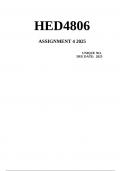
HED4806
ASSIGNMENT 2 2025

UNIQUE NO:
DUE DATE: 2025

, HED4806

Assignment 2 2025


Unique Number:

Due Date: 2025

International and Comparative Education

SECTION A: COMPULSORY SECTION

Question 1

1(a) Comparative education

1. Comparative and International Education can be defined as a field of study that
systematically examines educational systems, processes, and outcomes across
different countries and cultures. It aims to understand educational issues,
compare policies and practices, and apply findings to improve education globally.
2. Four historical phases in the evolution of Comparative and International
Education:

 Phase 1: Descriptive Stage (1800s–1900s) – Focused on describing
educational systems and structures in different countries without in-depth
analysis.
 Phase 2: Analytical Stage (1900s–1950s) – Began to analyze educational
practices using scientific methods.
 Phase 3: Social Science Integration (1960s–1980s) – Incorporated disciplines
like sociology, political science, and economics to understand education
comparatively.
 Phase 4: Globalization and Policy Borrowing (1990s–present) – Emphasizes
global trends, policy transfer, and international assessments like PISA.


Reviews from verified buyers

Showing all reviews
6 months ago

3.0

1 reviews

5
0
4
0
3
1
2
0
1
0
Trustworthy reviews on Stuvia

All reviews are made by real Stuvia users after verified purchases.

Get to know the seller

Seller avatar
Reputation scores are based on the amount of documents a seller has sold for a fee and the reviews they have received for those documents. There are three levels: Bronze, Silver and Gold. The better the reputation, the more your can rely on the quality of the sellers work.
LIBRARYpro University of South Africa (Unisa)
Follow You need to be logged in order to follow users or courses
Sold
10509
Member since
2 year
Number of followers
4904
Documents
4813
Last sold
5 days ago
LIBRARY

On this page, you find all documents, Package Deals, and Flashcards offered by seller LIBRARYpro (LIBRARY). Knowledge is Power. #You already got my attention!

3.7

1453 reviews

5
680
4
234
3
243
2
78
1
218

Recently viewed by you

Why students choose Stuvia

Created by fellow students, verified by reviews

Quality you can trust: written by students who passed their tests and reviewed by others who've used these notes.

Didn't get what you expected? Choose another document

No worries! You can instantly pick a different document that better fits what you're looking for.

Pay as you like, start learning right away

No subscription, no commitments. Pay the way you're used to via credit card and download your PDF document instantly.

Student with book image

“Bought, downloaded, and aced it. It really can be that simple.”

Alisha Student

Frequently asked questions