1 | Page
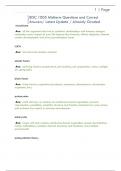
BISC 1005 Midterm Questions and Correct
Answers/ Latest Update / Already Graded
microbiome
Ans: all the organisms that live in symbiotic relationships with humans; changes
constantly; every aspect of your life impacts the diversity; affects digestion, immune
system, development, and stress/psychological issues
LUCA
Ans: last universal common ancestor
abiotic factor
Ans: nonliving factors; temperature, pH (acidity), soil composition, water, sunlight,
air, geography
biotic factor
Ans: living factors; organisms (producers, consumers, decomposers, microscopic
organisms, etc.)
prokaryotes
Ans: small cell size; no nucleus; no membrane-bound organelles; asexual
reproduction; unicellular; simplistic structure and function; bacteria live everywhere
and archaea live mainly in extreme environments
eukaryotes
Ans: larger cell size; nucleus; membrane-bound organelles; sexual reproduction;
mostly multicellular; complex internal structures and functions; more limited
environments
endosymbiotic theory
, 2 | Page
Ans: a large eukaryotic cell engulfed (ate) a smaller prokaryote
organization of life
Ans: cell → tissue → organ → organ system → organism
water
Ans: polarity of water allows for both adhesion (one substance attracted to
another substance) and cohesion (the same molecules attracted to each other)
competition
Ans: -/- interaction; both species are harmed
exploitation
Ans: +/- interaction; one species benefits while the other is harmed
commensalism
Ans: +/0 interaction; where one species benefits at no cost to the other
mutualism
Ans: +/+ interaction; where both species benefit increasing the survival and
reproduction of both the interacting species
Calorie v. calorie
Ans: big C means 1000Xs (this is the energy level you operate at)
ecosystem
BISC 1005 Midterm Questions and Correct
Answers/ Latest Update / Already Graded
microbiome
Ans: all the organisms that live in symbiotic relationships with humans; changes
constantly; every aspect of your life impacts the diversity; affects digestion, immune
system, development, and stress/psychological issues
LUCA
Ans: last universal common ancestor
abiotic factor
Ans: nonliving factors; temperature, pH (acidity), soil composition, water, sunlight,
air, geography
biotic factor
Ans: living factors; organisms (producers, consumers, decomposers, microscopic
organisms, etc.)
prokaryotes
Ans: small cell size; no nucleus; no membrane-bound organelles; asexual
reproduction; unicellular; simplistic structure and function; bacteria live everywhere
and archaea live mainly in extreme environments
eukaryotes
Ans: larger cell size; nucleus; membrane-bound organelles; sexual reproduction;
mostly multicellular; complex internal structures and functions; more limited
environments
endosymbiotic theory
, 2 | Page
Ans: a large eukaryotic cell engulfed (ate) a smaller prokaryote
organization of life
Ans: cell → tissue → organ → organ system → organism
water
Ans: polarity of water allows for both adhesion (one substance attracted to
another substance) and cohesion (the same molecules attracted to each other)
competition
Ans: -/- interaction; both species are harmed
exploitation
Ans: +/- interaction; one species benefits while the other is harmed
commensalism
Ans: +/0 interaction; where one species benefits at no cost to the other
mutualism
Ans: +/+ interaction; where both species benefit increasing the survival and
reproduction of both the interacting species
Calorie v. calorie
Ans: big C means 1000Xs (this is the energy level you operate at)
ecosystem