
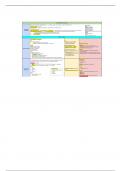
Peripheral Nervous Disorders
Damage or dysfunction of peripheral nerves → numbness, tingling, muscle weakness, & pain in the affected area
Mononeuropathy: one nerve
Polyneuropathy: simultaneous malfunction of many peripheral nn throughout the body
Peripheral Electrodiagnostic studies:
neuropathy Axonal neuropathies → d/t loss of axons or their cell bodies → reduced amplitude of the compound motor or sensory nerve action potentials
Demyelinating neuropathies: d/t loss or destruction of myelin → slowed conduction velocities & prolonged distal latencies.
- May also see dispersion of evoked compound action potentials (CAP)
- Conduction block → MAJOR decrease in amplitude of the muscle CAP
d/t: → “DANG THERAPIST”
Mononeuropathy
ENTRAPMENT neuropathies
D/T: PE:
- Individual n injured - Focal motor or sensory deficit
- Compressed, angulated, or stretched nerve - Deficit is in the territory of an
Meds: Corticosteroids
- Entrapment → where a nerve goes through a narrow space INDIVIDUAL peripheral n
Surgery if:
Types: Electromyography & nerve
- Progressive increasing of neurologic deficit
Pronator Teres Syndrome conduction studies → accurate
- Electrodiagnostic studies show evidence of PARTIAL
Sciatic & fibular n palsies localization of the focal lesion
DENERVATION in weak muscles
Mononeuropathy Tarsal tunnel syndrome
Facial neuropathy Distinguished from entrapment
Therapy:
Peripheral n tumors neuropathy vs peripheral n tumor only
- Occupation adjustment or job retraining w/ repetitive
by:
mechanical trauma
Ssx: - Noting the presence of a mass along - Chronic compressive or entrapment neuropathies: avoid
- May be asymptomatic the course of the nerve
aggravating factor & correct underlying systemic conditions
- Resolve rapidly & spontaneously - Demonstrating the precise site of the
- Pain DISTAL to the lesion lesion w/ appropriate
- Progressively more disabling & distressing electrophysiologic studies
- Deficit depends on the nerve involved
- Percussion of n at the site of lesion may lead to paresthesia in its DISTAL distribution
Non-invasive:
Compression of median n within carpal tunnel linked to occupational repetitive movements
(wrist flexion/extension, awkward wrist position, or strong gripping of objects) - Ibuprofen
- Bracing at night
MEDIAN N innervates - RICE
- Motor: ½ of FDP, FDS, FCR, PL, PT, PQ, & FPL + Hand (thenar & 1-2 lumbricals) - Ergonomic adjustments & take breaks
- Sensory: palmar skin, dorsal fingertips of digits 1-3 & ½ of digit 4 Refer to:
D/T: - OT
- DM - Yoga
Carpal Tunnel - Wt gain
Compressed by:
Longitudinal sonogram: US w/ linear - Nutritionist & wt loss
- Pregnancy probe
Syndrome - Synovitis of tendon sheaths - Flattening or tapering of median n Invasive
- RA
- Fractures - Surgery → release transverse carpal lig → open or
- HyperPTH
- Tumors endoscopic
SSx: - Steroid inj
- Numbness/tingling in hand
- Congenital - Refer: surgery
- Dull aching pain - If ssx persist > 3 months of conservative therapy
,- Weak grip - Contra in pregnancy
- Atrophy of thenar eminence Reassurance → may take 3-4 months & up to 1 year for
Ssx improve by changes in hand posture or shaking hand
FULL recovery
, compression/excessive stretching of ULNAR N within cubital tunnel
→ Propping or extensive elbow flexion d/t congenital, degenerative, or traumatic
Ulnar n innervates: MRI: Accessory muscle - anconeus
epitrochlearis muscle - not all people have Non-invasive if sensory ssx:
- Motor:
o Forearm: FCU & ½ of FDP but those who do more likely to get cubital - Pt education: avoidance of propping/excessive flexion
tunnel b/c further compresses nerve - Elbow protection: brace, towel roll, or arm in pillow case
o Hand: dorsal & palmar interossei, 3-4 lumbricals, pinky, & ½ of ring finger
Cubital Tunnel - Sensory: skin of medial palmar & dorsal hand Invasive if sensory AND motor:
Syndrome
SSx:
- Surgical transposition of ulnar n
- Numbness of medial two fingers & medial palm - Refer to EMG & surgery
- + Froment’s sign
- Weak grip
- More constant than carpal tunnel syndrome
- +/- elbow discomfort
“Saturday night Palsy” → occurs in intoxicated pts
Compression of RADIAL N Non-invasive:
Risk Factors:
Active and passive - Pain meds
- External pressure around proximal humerus extension movements - - splint/cast
Radial n Palsy - Night of heavy sleep scale from 1-5 (ex: - TENS to reduce pain
- DM unable to perform = 0)
SSx:
- Refer to PT
“wrist drop” Invasive: Surgical removal of cyst, tumor, broken bone
- Waking up w/ intense paresthesia on dorsal hand pressing on the n or repair n itself
- Wrist & finger extensor weakness: unable to extend fingers or open hand
Compression of the TIBIAL n within tunnel
Risk factors: Xray: bilateral hypertrophy of the Non-invasive:
- Flat feet sustentaculum tali - RICE
- High arch - OTC pain meds
- DM - Braces, cast, splint
Tarsal Tunnel
- Arthritis - Orthotic
Syndrome SSx: - Refer to PT & Podiatry
- Plantar foot pain & paresthesia worse when UPRIGHT (standing) Invasive:
- Shooting sensations in toes or heels - Steroid inj
- Occasionally diff wiggling toes - Surgery if ssx persist
- Swelling over medial malleolus
Prolonged compression of the COMMON FIBULAR N b/t an external object & fibular head
Risk factors: Non-invasive:
- M/C DM - Carbon ankle-foot orthotic → provide toe dorsiflexion
- Wt loss during the swing phase, medial or lateral stability at the
Fibular
- Excessive squatting, kneeling, crossed legs, or high boots ankle during stance
Neuropathy
SSx: - Refer to PT
- Numbness/tingling lateral leg & dorsal foot Invasive: Surgery if rapidly deteriorating lesion w/ NO signs
- Foot drop of improvement or open injuries w/ suspected n laceration
- Stumbling, catching toe
Compression of the LATERAL FEMORAL CUTANEOUS N (L2-L3) at the INGUINAL ligament → SENSORY N COMPRESSION
Risk factors:
- m/c DM Non-Invasive:
- Wear LOOSE clothes
- pregnancy
- OTC pain meds
Meralgia - obesity
- Refer: nutritionist & wt loss

