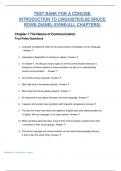
Test Bank For
A Concise Introduction to Linguistics
Author: Bruce M. Rowe
6thEdition
Information Classification: General
, TABLE OF CONTENT
1.Introduction: The Nature of Communication
2 Phonetics: The Sounds Used in Languages
3 Phonology: The Sound Patterns Used in Languages
4 Morphology: Words and How they are Formed
5 Syntax: The Larger Patterns of Language
6 Semantics: The Study of Meaning
7 Pragmatics: How Language is Used and The Effect of Context on Meaning
8 Sociolinguistics: Language and Society
9 Linguistic Anthropology: Language and Culture
10 Language Acquisition: How Children (and others) Learn Language
11 Sign Language: The Language of the Deaf Community
12 Writing Systems: The Graphic Representation of Language
13 Nonverbal Communication: Communicating Without Words
14 Historical Linguistics: The History of Languages
Information Classification: General
, Chapter 1 The Nature Of Communication
True/False Questions
1. Linguistic Competence Refers To The Subconscious Knowledge Of One’s
Language. Answer: T
2. Language Is Dependent On Hearing Or Speech. Answer: F
3. In Chapter 1, We Discuss Various Types Of Animal Communication
Because Comparison Of Those Systems Of Communication Can Aid Us In
Understanding Human Communication. Answer: T
4. All Animals Have A Language. Answer: F
5. Bird Calls Tend To Be Species Specific. Answer: F
6. Bird Songs Tend To Be Species Specific. Answer: T
7. All Researchers Now Agree That Apes Can Learn Language. Answer: F
8. A Person Who Stutters Has A Problem With Linguistic Competence. Answer: F
9. The Fact That Many New Words Are Added To English Each Year Demonstrates
That English, Like Any Language, Is An Open System. Answer: T
10. Birds And Bees Generally Learn Most Of Their Communication Systems From
Other Members Of Their Social Groups. Answer: F
11. The Terms Language And Communication Can Be Used Interchangeably
Because They Mean The Same Thing. Answer: F
Information Classification: General
, 12. One Difference Between Apes’ Use Of Sign “Language” And A Human’s Use Of
Language, Is That Apes Seldom Initiate Communication Whereas Humans,
Including Young Children, Frequently Initiate Communication With Others.
Answer: T
13. Humans Communicate In Both Verbal And Nonverbal Ways. Answer: T
14. Redundancy In A Message Helps Overcome “Static”. Answer: T
15. Bird Songs Are Generally More Elaborate Than Birdcalls. Answer: T
16. The Characteristic Of Languages That Allow People To Coin New Words As
Needed Is Called Discreteness. Answer: F
17. Linguistic Forms, Such As Words Or Sentences, Have An Arbitrary
Relationship To Their Meaning. Answer: T
18. Compared To Nonhuman Communication, Human Linguistic Communication
Tends To Be Stimulus-Bound. Answer: F
19. The Fact That A Person Can Talk About The Past Or Anticipate The Future
Illustrates The Characteristic Of Language Called Displacement. Answer: T
20. Some Researchers Believe That Kanzi Processes A Basic Understanding Of
Simple Grammar. Answer: T
21. Alex The Parrot, As Well As The Apes That Have Been Used In Language
Experiments, Have Been Able To Learn Language At The Level Of About A Five-
Year-Old Human.
Answer: F
22. Culture Shock Occurs When A Person Interacts With A Person Or People From A
Foreign Culture And Disorientation And Anxiety Occurs When Social Expectations
Are Not Met Because Of A Lack Of Knowledge Of The Norms Of The Other’s
Culture. Answer: T
Information Classification: General
A Concise Introduction to Linguistics
Author: Bruce M. Rowe
6thEdition
Information Classification: General
, TABLE OF CONTENT
1.Introduction: The Nature of Communication
2 Phonetics: The Sounds Used in Languages
3 Phonology: The Sound Patterns Used in Languages
4 Morphology: Words and How they are Formed
5 Syntax: The Larger Patterns of Language
6 Semantics: The Study of Meaning
7 Pragmatics: How Language is Used and The Effect of Context on Meaning
8 Sociolinguistics: Language and Society
9 Linguistic Anthropology: Language and Culture
10 Language Acquisition: How Children (and others) Learn Language
11 Sign Language: The Language of the Deaf Community
12 Writing Systems: The Graphic Representation of Language
13 Nonverbal Communication: Communicating Without Words
14 Historical Linguistics: The History of Languages
Information Classification: General
, Chapter 1 The Nature Of Communication
True/False Questions
1. Linguistic Competence Refers To The Subconscious Knowledge Of One’s
Language. Answer: T
2. Language Is Dependent On Hearing Or Speech. Answer: F
3. In Chapter 1, We Discuss Various Types Of Animal Communication
Because Comparison Of Those Systems Of Communication Can Aid Us In
Understanding Human Communication. Answer: T
4. All Animals Have A Language. Answer: F
5. Bird Calls Tend To Be Species Specific. Answer: F
6. Bird Songs Tend To Be Species Specific. Answer: T
7. All Researchers Now Agree That Apes Can Learn Language. Answer: F
8. A Person Who Stutters Has A Problem With Linguistic Competence. Answer: F
9. The Fact That Many New Words Are Added To English Each Year Demonstrates
That English, Like Any Language, Is An Open System. Answer: T
10. Birds And Bees Generally Learn Most Of Their Communication Systems From
Other Members Of Their Social Groups. Answer: F
11. The Terms Language And Communication Can Be Used Interchangeably
Because They Mean The Same Thing. Answer: F
Information Classification: General
, 12. One Difference Between Apes’ Use Of Sign “Language” And A Human’s Use Of
Language, Is That Apes Seldom Initiate Communication Whereas Humans,
Including Young Children, Frequently Initiate Communication With Others.
Answer: T
13. Humans Communicate In Both Verbal And Nonverbal Ways. Answer: T
14. Redundancy In A Message Helps Overcome “Static”. Answer: T
15. Bird Songs Are Generally More Elaborate Than Birdcalls. Answer: T
16. The Characteristic Of Languages That Allow People To Coin New Words As
Needed Is Called Discreteness. Answer: F
17. Linguistic Forms, Such As Words Or Sentences, Have An Arbitrary
Relationship To Their Meaning. Answer: T
18. Compared To Nonhuman Communication, Human Linguistic Communication
Tends To Be Stimulus-Bound. Answer: F
19. The Fact That A Person Can Talk About The Past Or Anticipate The Future
Illustrates The Characteristic Of Language Called Displacement. Answer: T
20. Some Researchers Believe That Kanzi Processes A Basic Understanding Of
Simple Grammar. Answer: T
21. Alex The Parrot, As Well As The Apes That Have Been Used In Language
Experiments, Have Been Able To Learn Language At The Level Of About A Five-
Year-Old Human.
Answer: F
22. Culture Shock Occurs When A Person Interacts With A Person Or People From A
Foreign Culture And Disorientation And Anxiety Occurs When Social Expectations
Are Not Met Because Of A Lack Of Knowledge Of The Norms Of The Other’s
Culture. Answer: T
Information Classification: General