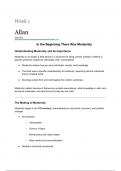
Week 1
Allan
(Allan, 2011)
https://www.sagepub.com/sites/default/files/upm-binaries/36028_1.pdf
In the Beginning There Was Modernity
Understanding Modernity and Its Importance
Modernity is not simply a time period or a synonym for being current. Instead, it reflects a
specific worldview shaped by rationality, order, and progress.
● Modernity shapes how we view individuals, society, and knowledge.
● The book uses a specific understanding of modernity: assuming rational individuals
and an ordered world.
● Sociology arises from and interrogates this modern worldview.
Modernity matters because it frames key societal assumptions: what knowledge is valid, who
we are as individuals, and what kind of society we can build.
The Making of Modernity
Modernity began in the 17th century, characterized by vast social, economic, and political
changes.
● Key features:
○ Urbanization
○ Division of labor
○ Bureaucracy and nation-states
○ Mass media and commodification
● Rooted in historical movements:
, ○ The Enlightenment
○ The Renaissance, Reformation, and Industrial Revolution
At its core, modernity introduced a new way of knowing, rooted in Enlightenment ideals like
reason, empiricism, and progress. This worldview challenged religious and traditional
authority, focusing instead on the power of human observation and rational inquiry.
Enlightenment and the Rise of Positivism
Modern knowledge depends on empirical testing rather than faith or tradition.
● Enlightenment thinkers emphasized:
○ Progress: belief that society can improve over time.
○ Empiricism: the world is knowable through observation and reason.
● Positivism: the belief that valid knowledge is based on observable, testable facts, not
metaphysics or theology.
● Science became the model of knowledge—cumulative, law-governed, and predictive.
This epistemological shift empowered individuals to investigate the world, understand it, and
seek to control it for human benefit.
Modernity’s Two Projects: Technical and Social
Modernity had two parallel projects:
● Technical Project (science):
○ Uses rational knowledge to control nature via technology.
● Social Project (democracy):
○ Aims to organize society based on rational individuals and equality.
The democratic state is the institutional foundation for the social project, built on the idea of
natural rights. These rights are not granted by the state but are inherent by birth, requiring
governance through consent.
,From Subject to Citizen
Feudal societies centered on loyalty to monarchs, with individuals seen as subjects.
● Modern democracy introduced the citizen, capable of rational thought and
responsible for self-governance.
● Enlightenment ideals made democracy both possible and necessary: only rational
individuals can be governed through consent.
Thus, modernity recast individuals as active participants in shaping both knowledge and
governance.
Early Sociologists and the American Experiment
The United States became a testing ground for democratic ideals, attracting observers and
early sociologists.
● Key figures:
○ Alexis de Tocqueville – Democracy in America analyzed the moral and
political foundations of U.S. democracy.
○ Harriet Martineau – translated Comte and wrote How to Observe Morals and
Manners, an early sociological methods book.
○ Jane Addams – Nobel Peace Prize winner who linked democracy with ethics
and social responsibility.
These thinkers saw sociology as a critical tool for assessing whether democracy lived up to
its ethical promises.
Martineau’s Ethical Method
Martineau argued that observing society required both discipline and rigor.
● Method: Compare morals (ideals) with manners (practices).
● Emphasis on ethics: Democratic claims must be assessed against actual behavior.
, ● Warned against casual or biased observations.
Martineau believed the study of society was the most difficult of sciences, requiring
objectivity, humility, and careful method.
Addams and the Ethical Foundations of Democracy
Jane Addams emphasized that democracy must be an ethical way of life, not just a political
structure.
● Democracy is:
○ A rule of living
○ A test of faith in human dignity and equality
● Ethics arise from social interaction and diversity, not from individual moral codes.
Addams linked democracy with emergent ethics—practices that arise from dynamic, diverse
communities engaging each other.
The Collective Moral Project
Tocqueville and Addams viewed democracy as a moral enterprise, rooted in collective
deliberation and diversity of thought.
● Modern morality is:
○ Public and emergent, not fixed.
○ Created through ongoing interaction among diverse individuals.
● Democratic practices like free speech and press are essential to ethical growth.
● Addams insisted that democratic citizens must engage with those unlike themselves
to fulfill the promise of democracy.
As Tocqueville put it, true wisdom and morality arise when "more brains" come
together—equality applied to minds, not just laws.
Democratic Institutions in Modernity
Allan
(Allan, 2011)
https://www.sagepub.com/sites/default/files/upm-binaries/36028_1.pdf
In the Beginning There Was Modernity
Understanding Modernity and Its Importance
Modernity is not simply a time period or a synonym for being current. Instead, it reflects a
specific worldview shaped by rationality, order, and progress.
● Modernity shapes how we view individuals, society, and knowledge.
● The book uses a specific understanding of modernity: assuming rational individuals
and an ordered world.
● Sociology arises from and interrogates this modern worldview.
Modernity matters because it frames key societal assumptions: what knowledge is valid, who
we are as individuals, and what kind of society we can build.
The Making of Modernity
Modernity began in the 17th century, characterized by vast social, economic, and political
changes.
● Key features:
○ Urbanization
○ Division of labor
○ Bureaucracy and nation-states
○ Mass media and commodification
● Rooted in historical movements:
, ○ The Enlightenment
○ The Renaissance, Reformation, and Industrial Revolution
At its core, modernity introduced a new way of knowing, rooted in Enlightenment ideals like
reason, empiricism, and progress. This worldview challenged religious and traditional
authority, focusing instead on the power of human observation and rational inquiry.
Enlightenment and the Rise of Positivism
Modern knowledge depends on empirical testing rather than faith or tradition.
● Enlightenment thinkers emphasized:
○ Progress: belief that society can improve over time.
○ Empiricism: the world is knowable through observation and reason.
● Positivism: the belief that valid knowledge is based on observable, testable facts, not
metaphysics or theology.
● Science became the model of knowledge—cumulative, law-governed, and predictive.
This epistemological shift empowered individuals to investigate the world, understand it, and
seek to control it for human benefit.
Modernity’s Two Projects: Technical and Social
Modernity had two parallel projects:
● Technical Project (science):
○ Uses rational knowledge to control nature via technology.
● Social Project (democracy):
○ Aims to organize society based on rational individuals and equality.
The democratic state is the institutional foundation for the social project, built on the idea of
natural rights. These rights are not granted by the state but are inherent by birth, requiring
governance through consent.
,From Subject to Citizen
Feudal societies centered on loyalty to monarchs, with individuals seen as subjects.
● Modern democracy introduced the citizen, capable of rational thought and
responsible for self-governance.
● Enlightenment ideals made democracy both possible and necessary: only rational
individuals can be governed through consent.
Thus, modernity recast individuals as active participants in shaping both knowledge and
governance.
Early Sociologists and the American Experiment
The United States became a testing ground for democratic ideals, attracting observers and
early sociologists.
● Key figures:
○ Alexis de Tocqueville – Democracy in America analyzed the moral and
political foundations of U.S. democracy.
○ Harriet Martineau – translated Comte and wrote How to Observe Morals and
Manners, an early sociological methods book.
○ Jane Addams – Nobel Peace Prize winner who linked democracy with ethics
and social responsibility.
These thinkers saw sociology as a critical tool for assessing whether democracy lived up to
its ethical promises.
Martineau’s Ethical Method
Martineau argued that observing society required both discipline and rigor.
● Method: Compare morals (ideals) with manners (practices).
● Emphasis on ethics: Democratic claims must be assessed against actual behavior.
, ● Warned against casual or biased observations.
Martineau believed the study of society was the most difficult of sciences, requiring
objectivity, humility, and careful method.
Addams and the Ethical Foundations of Democracy
Jane Addams emphasized that democracy must be an ethical way of life, not just a political
structure.
● Democracy is:
○ A rule of living
○ A test of faith in human dignity and equality
● Ethics arise from social interaction and diversity, not from individual moral codes.
Addams linked democracy with emergent ethics—practices that arise from dynamic, diverse
communities engaging each other.
The Collective Moral Project
Tocqueville and Addams viewed democracy as a moral enterprise, rooted in collective
deliberation and diversity of thought.
● Modern morality is:
○ Public and emergent, not fixed.
○ Created through ongoing interaction among diverse individuals.
● Democratic practices like free speech and press are essential to ethical growth.
● Addams insisted that democratic citizens must engage with those unlike themselves
to fulfill the promise of democracy.
As Tocqueville put it, true wisdom and morality arise when "more brains" come
together—equality applied to minds, not just laws.
Democratic Institutions in Modernity