

100% de satisfacción garantizada Inmediatamente disponible después del pago Tanto en línea como en PDF No estas atado a nada 4.2 TrustPilot
logo-home
Examen

HC3B Exam 2 | Questions and Answers (Complete Solutions)

Puntuación
-
Vendido
-
Páginas
34
Grado
A
Subido en
18-04-2025
Escrito en
2024/2025

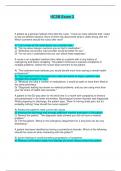
HC3B Exam 2 | Questions and Answers (Complete Solutions) A patient at a general medical clinic tells the nurse, "I have so many ailments that I need to see six different doctors. None of them has discovered what is really wrong with me." Which comment should the nurse offer next? A) "Let's review all the medications you currently take." B) "Tell me about allergic reactions you've had to medication." C) "Selecting one primary care provider would be better for you." D) "I'm not sure I understand how you can afford these expenses." A nurse in an outpatient medical clinic talks to a patient with a long history of malingering and doctor-shopping. The patient continues to express complaints of multiple problems. Select the nurse's best comment to the patient. A) "The treatment team believes you would benefit more from seeing a mental health professional." B) "The treatment team discussed your case and wants to begin a special case management program for you." C) "Because you take a number of medications, it would be safer to have them filled at the same pharmacy." D) "Diagnostic testing has shown no medical problems, and you are using more than your fair share of health care services." A patient in the ED was seen for the third time in a month with complaints of tremors and parasthesia in the lower extremities. Neurological function disorder was diagnosed. While preparing for discharge, the patient says, "Now I'm having chest pain, but it's probably nothing" How should the nurse respond? A) Assess the patient's most current lab values B) Interrupt the discharge and arrange additional medical evaluation of the patient C) Remind the patient, "The diagnostic tests showed you did not have a medical problem." D) Tell the patient, "Being in the emergency department for a long time can be very distressing." A patient has been identified as having a somatoform disorder. Which of the following should the nurse do when interacting with the patient? A) Ignore feelings to avoid promoting progression of symptoms B) Redirect conversation away from feelings but show interest toward the patient C) Encourage the use of benzodiazepines on a consistent basis to reduce anxiety D) Suggest the patient direct all questions to the nurse and not the medical provider Which disorder would the nurse suspect when a person takes their child from doctor to doctor and from hospital to hospital with a variety of intentionally induced symptoms? A) Illness anxiety disorder B) Functional neurological disorder C) Factitious disorder imposed by another D) Rumination disorder A 28-year-old second-grade teacher is diagnosed with major depressive disorder. She grew up in Texas but moved to Alaska 10 years ago to separate from an abusive mother. Her father died by suicide when she was 12 years old. Which combination of factors in this scenario best demonstrates the stress-diathesis model? A) Cold climate coupled with a history of abuse B) Current age of 28 coupled with a family history of depression C) Family history of mental illness coupled with a history of abuse D) Female gender coupled with the stressful profession of teaching A patient tells the nurse, "No matter what I do, I feel like there's always a dark cloud following me." Select the nurse's initial action. A) Assess the patient's current sleep and eating patterns B) Explain to the patient, "Everyone feels down from time to time." C) Suggest alternative activities for times when the patient feels depressed D) Say to the patient, "Tell me more about what you mean by 'a dark cloud.'" A patient experiencing depression says to the nurse, "My health care provider said I need 'talk' therapy, but I think I need a prescription for an antidepressant medication. What should I do?" Select the nurse's best response. A) "Which antidepressant medication do you think would be helpful?" B) "There are different types of talk therapy. Most patients find it beneficial." C) "Let's consider some ways to address your concerns with your health care provider." D) "Are you willing to give 'talk therapy' a try before starting an antidepressant medication?" The nurse cares for a hospitalized adolescent diagnosed with major depressive disorder. The health care provider prescribes a low-dose antidepressant. In consideration of published warnings about the use of antidepressant medications in younger patients, which action(s) should the nurse employ? SATA. A) Notify the facility's patient advocate about the new prescription B) Teach the adolescent about Black Box warnings associated with antidepressant medications C) Monitor the adolescent closely for evidence of adverse effects, particularly suicidal thinking or behavior D) Remind the health care provider about warnings associated with the use of antidepressants in children and adolescents Over the past 2 months, a patient made eight suicide attempts with increasing lethality. The health care provider informs the patient and family that electroconvulsive therapy (ECT) is needed. The family whispers to the nurse, "Isn't this a dangerous treatment?" How should the nurse reply? A) "Our facility has an excellent record of safety associated with the use of electroconvulsive therapy." B) "Your family member will eventually be successful with suicide if aggressive measures are not promptly taken." C) "Yes, there are hazards with electroconvulsive therapy. You should discuss these concerns with the health care provider." D) "Electroconvulsive therapy is very effective when urgent help is needed. Your family member was carefully evaluated for possible risks." A patient has a long history of bipolar disorder with frequent episodes of mania secondary to stopping prescribed medications. The patient says, "I will use my whole check next month to buy lottery tickets. Winning will solve all my money problems." Select the nurse's best action. A) Educate the patient about the low odds of winning the lottery B) Present reality by saying to the patient, "That is not a good use of your money." C) Confer with the treatment team about appointing a legal guardian for the patient D) Tell the patient, "If you buy lottery tickets, your money will run out before the end of the month." Which comment by a patient diagnosed with bipolar disorder best indicates the patient is experiencing mania? A) "I have been sleeping about 6 hours each night." B) "Yesterday I made 487 posts on my social network page." C) "I am having dreams about my father's death 8 years ago." D) "My appetite is so robust that I've gained 4 pounds in the past 2 weeks." A community mental health nurse counsels a group of patients about the upcoming flu season. What instruction does the nurse provide for patients who are prescribed lithium? A) "Call the clinic if you have nausea, vomiting and/or diarrhea or are unable to stay well hydrated." B) "Remember that lithium reduces your immunity, so you are more vulnerable to catching the flu." C) "The flu is contagious. Isolate yourself if you get the flu so that you avoid exposing others to it." D) "Because you take lithium, you may have flu symptoms that are not typically experienced by others." A patient was diagnosed with bipolar disorder many years ago. The patient tells the nurse, "When I have a manic episode, there's always a feeling of gloom behind it, and I know soon I will be totally depressed." What is the nurse's best response? A) "Most patient's diagnosed with bipolar disorder report the same types of feelings." B) "Feelings of gloom associated with depression result from serotonin dysregulation." C) "If you take your medication as it is prescribed, you will not have those experiences." D) "Your comment indicates you have an understanding of and insight about your disorder." A patient diagnosed with bipolar disorder lives in the community and is showing early signs of mania. The patient says, "I need to go visit my daughter, but she lives across the country. I put some requests on the Internet to get a ride. I'm sure someone will take me." What is the nurse's most therapeutic response? A) "I'm concerned about your safety when meeting or riding with strangers." B) "Have you asked friends and family to donate money for your airfare?" C) "You are not likely to get a ride. Let's consider some other strategies." D) "Have you asked your daughter if she wants you to come for a visit?" A patient smiles broadly at the nurse and says, "Look at my clean teeth. I brushed them with scouring powder because the label said, 'It brightens and whitens everything.'" Which term should the nurse include when documenting the encounter? A) Circumstantiality B) Concrete thinking C) Poverty of speech D) Associative looseness A patient diagnosed with schizophrenia says, "I hear the voices every day. They always say bad things about me." Which action by the nurse has the highest priority? A) Assess the patient for suicidal thinking and plans B) Review the patient's medication regimen and adherence C) Educate the patient about symptoms associated with schizophrenia D) Suggest distracters for the patient to use when auditory hallucinations occur Three days after beginning a new regime of haloperidol (Haldol), the nurse observes that a hospitalized patient is drooling, has stiff and extended extremities, and has skin that is damp and hot to the touch. The patient has difficulty responding verbally to the nurse. What is the nurse's correct analysis and action in this situation? A) A seizure is occurring; place the patient in a lateral recumbent position and monitor B) Serotonin syndrome has developed; place an intravenous line and rapidly infuse D5 1/2 normal saline (NS) C) Neuroleptic malignant syndrome has developed; prepare the patient for immediate transfer to a medical unit D) An acute dystonic reaction is occurring; promptly administer an IM injection of diphenhydramine (Benadryl) The parent tells the nurse about the death of a child 2 years ago. Which comment by this parent warrants the nurse's priority attention? A) "I still have some of my child's toys and clothes." B) "A parent should never live longer than their child." C) "I never returned to church again after the death of my child." D) "My child has been dead a long time, but it seems like only yesterday." A patient diagnosed with major depressive disorder was hospitalized for 2 weeks on an acute psychiatric unit. One day after discharge, the patient completed suicide. Recognizing likely reactions among staff, which action should the nursing supervisor implement first? A) Assess each staff member individually for suicidal intent and/or plans B) Provide a private setting for staff members to talk about feelings associated with the event C) Remind staff members that suicide is a risk for the patient population and that they are not at fault D) Invited a guest speaker to conduct an educational session for staff members about suicide risk factors On the sixth anniversary of her spouse's death, a widow says, "Sometimes life does not seem worth living anymore. I wish I could go to sleep and never wake up." Which response by the nurse has priority? A) "Are you considering suicide?" B) "You still have so much to live for." C) "Grief can sometimes last for many years." D) "Why do you continue to grieve something from long ago?" A patient who had a stroke 3 days ago tearfully tells the nurse, "What's the use in living? I'm no good to anybody like this." Which action should the nurse employ first when caring for a patient demonstrating hopelessness? A) Implement the institutional protocol for suicide risk B) Support the patient to clarify and express feelings of grief C) Educate the patient about the success of stroke rehabilitation D) Offer the patient an opportunity to confer with the pastoral counselor A single adult says to the nurse, "Both of my parents died several years ago, and my only sibling committed suicide 2 weeks ago. I feel so alone." After determining that the adult has no suicidal ideation, the nurse should: A) Explore the adult's feelings of survivor's guilt B) Assess the adult's cultural beliefs and spirituality C) Refer the adult for cognitive behavioral therapy (CBT) D) Refer the adult to a self-help group for suicide survivors Which term would the nurse use to describe a client with schizophrenia who is vacillating between being happy and sad about going home? A) Double bind B) Ambivalence C) Loose association D) Inappropriate affect Which factor would the nurse identify as likely related to the sleeplessness of a schizophrenic client who was transferred from a private room to a room with a roommate 3 days ago? A) Fear of the other client B) Concern about family at home C) Watching for an opportunity to escape D) Trying to work out emotional problems Which strategy would the nurse use to help a depressed, withdrawn client who exhibits sadness through nonverbal behavior? A) Increase structured physical activity B) Cope with painful feelings by sharing them C) Decide with unit activities the client can perform D) Improve the ability to communicate with significant others Which intervention would provide the greatest safety for a client admitted to a mental health unit because of suicidal ideation? A) Seclusion room B) Four-point restraints C) Continual one-on-one supervision D) Removal of unsafe objects from the environment Which side effect would the nurse monitor for when administering a selective serotonin reuptake inhibitor (SSRI)? SATA. A) Anxiety B) Nausea C) Sedation D) Restlessness E) Suicidal ideation F) Increased energy level Which response would the nurse make to a client with schizophrenia who claims to be Joan of Arc about to be burned at the stake? A) "Tell me more about being Joan of Arc." B) "We both know that you're not Joan of Arc." C) "It seems like the world is a pretty scary place for you." D) "You're safe here, because we won't let you be burned." Which statement describes the psychodynamics of a client calling the ED during the very act of a suicide attempt? A) A need for attention B) A need to punish others C) Ambivalence about dying D) An inability to stick to a decision Which feeling would be difficult for a client with major depression to express? A) Need for comforting B) Anger towards others C) Remorse for past behaviors D) Feelings of low self-esteem Which characteristic would be a concern for the nurse when caring for a client with schizophrenia in the early phase of treatment? A) Continual pacing B) Suspicious feelings C) Inability to socialize with others D) Disturbed relationship with the family Which long-term outcome would the nurse add to the plan of care for a client experiencing a major depressive episode? A) Will talk openly about the depressed feelings B) Will identify and use new defense mechanisms C) Will discuss the unconscious source of the anger D) Will verbalize realistic perceptions of self and others Which question would the nurse ask while assessing a Hispanic woman with depression for the risk of self-harm? A) "When did you last spend time with friends?" B) "How do you express yourself when you're angry?" C) "When did you first notice that you were depressed?" D) "Do you have interests outside your work and home?" Which signs and symptoms would the nurse observe in a client with bipolar disorder, depressed episode? A) Elated affect related to reaction formation B) Loose associations related to a thought disorder C) Physical exhaustion related to decreased physical activity D) Paucity of verbal expression related to slowed thought processes Which intervention would the nurse add to the plan of care for a moderately depressed client? A) Encouraging the client to determine leisure time activities B) Offering the client the opportunity to make some decisions C) Relieving the client of the responsibility of making any decisions D) Allowing the client time to be alone to decide in which activities to engage Which action would the nurse take when working with a client who is depressed? A) Accept what the client says B) Attempt to keep the client occupied C) Keep the client's surroundings cheery D) Try to prevent the client from talking too much Which response would the nurse make to help a depressed client who is crying? A) "Does crying help?" B) "I know that you're upset." C) "Tell me what you're feeling now." D) "Do you want to tell me why you're crying?" At which time would the nurse expect the hallucinations to be more frequent in a client with schizophrenia? A) Resting B) Playing sports C) Watching television D) Interacting with others Which initial behavior would the nurse help a client with major depressive disorder complete? A) Develop a rapport with the nurse B) Investigate new leisure activities C) Participate in small-group activities D) Initiate conversations about feelings Which approach would the nurse use for a client with major depression who refuses to participate in unit activities, claiming to be 'just too tired'? A) Planning 1 rest period during each activity B) Explaining why the staff believes that the activities are therapeutic C) Encouraging the client to express negative feelings about the activities D) Accepting the client's feelings about activities while calmly setting firm limits Which intervention would the nurse implement for a client prescribed haloperidol for schizophrenia? SATA. A) Using the gluteal site only B) Administering the medication every 3 months C) Shaking the medication vigorously before administering D) Using the Z-track method for all irritation medications E) When initiating, giving the first two injections using the deltoid site F) Monitoring the client for excess sedation for 3 hours postinjection Which symptoms indicates a possible drug interaction in a client taking monoamine oxidase inhibitors (MAOIs) for depression? SATA. A) Diarrhea B) Dystonia C) Dry mouth D) Dyskinesia E) Hypotension F) Constricted pupils Which approach would the nurse use to evaluate a newly admitted depressed client's potential for suicide? A) Questioning the client about plans for the future B) Inquiring whether the client is now considering suicide C) Discussing suicide with other clients while the client is in the group D) Asking family members whether the client has ever attempted suicide Which response would the nurse make to a depressed client who says, "Go talk to someone else. Other people need you more," when the nurse states that they will be spending time together? A) "Why do you want me to go?" B) "I'll go, but I'll be back tomorrow." C) "Don't you think that you're important too?" D) "I'll be spending the next half hour with you." Which statement from the client would alert the nurse the client is experiencing a hallucination? A) "I'm going to save world because I'm God." B) "My insides smell like they're going to just rot away." C) "Unless I gamble at least once a week, I feel extremely anxious." D) "It's crazy, but I keep thinking that something terrible will happen to my baby." Which action would the nurse take when the language of a client in the manic phase of a bipolar disorder becomes vulgar and profane? A) State, "We don't like that kind of talk around here." B) Ignore it because the client is using it to gain attention C) Recognize that the behavior is part of the illness, but set limits on it D) Responds, "We'll talk with you when you can speak in an acceptable way." Which response would the ED nurse say when assessing the adolescent's suicide potential after a drug overdose? A) "Did you take pills because you wanted to kill yourself?" B) "Do you know how much harm you can cause by taking these pills?" C) "Lots of adolescents take too many pills because they want people to pay attention to them." D) "A few pills aren't very much, but you seem to be asking for someone to pay attention to you." A client is heard saying, "I like eggs, fried by Meg, served on a keg, kicked in the leg, and don't want her to hoopanize them ever again." Which documentation entry would the nurse use to record this finding? A) "Demonstrating word salad and echolalia speech patterns." B) "Exhibiting clang association and neologism speech patterns." C) "Speech appears to be nonsensical and sing-song in tempo." D) "Speech has deteriorated to incoherent jabbering with loose associations." Which response would the nurse make to a client with schizophrenia who says,"I know they're spying on me in here, too. I'm not safe anywhere"? A) "Nobody's spying on you in here." B) "Why do you feel they'd want to follow you here?" C) "You don't feel safe anywhere, not even in the hospital?" D) "You're safe in the hospital; nothing can happen to you here." Which conclusion would the nurse make about a client who confides, "I've been thinking about suicide lately"? A) This statement is intended to frighten the nurse B) The client wants attention from the staff C) This statement indicates a feeling of safety with the nurse D) The client is seeking protection from the impulses/thoughts Which conclusion would the nurse make about a depressed, suicidal client who greets the nurse cheerfully and states, "Everything is looking up. I'm not going to have problems for very long."? A) Increased risk for suicide B) Elevated level of anxiety C) Positive response to treatment D) Resolution of suicidal ideation Which activity would the nurse suggest for a client with bipolar disorder who as accelerating manic behavior? A) Involving the client in a video game B) Encouraging the client to join in group activities C) Isolating the client away from others until the agitation lessens D) Engaging the client in conversation while walking slowly in the hall Which statement by the client who has major depressive disorder would alert the nurse to the possibility of a suicide attempt? A) "I don't feel too good today." B) "I feel much better today; today is a lovely day." C) "I am a little better, but it probably won't last." D) "I'm really tired today, so I'll take things a little slower." Which approach would the nurse use for a client with schizophrenia who refuses to eat meals? A) Directing the client repeated to eat the food B) Explaining to the client the importance of eating C) Allowing the client to eat whenever the client is ready D) Having a staff member sit with the client in quiet area during mealtimes Which assessment would be a priority for a client with schizophrenia who has paranoia? A) Continuous pacing B) Suspicious feelings C) Lack of love for parents D) Disregard for the feelings of others Which interpretation would the nurse make about a depressed client with mild suicidal ideation who has no plan, but has adequate family support and attends church regularly? A) Should be at no risk for suicide B) Warrants one-on-one observation C) Warrants placement in a seclusion room D) Should be reassessed at intervals regarding suicidal intent To increase involvement in unit activities, which response would the nurse make to a withdrawn client with schizophrenia who has auditory hallucinations? A) "You'll get a reward if you go to the gym." B) "Would you like to participate in the group walk today?" C) "Those voices you hear would like it if you did a little exercise." D) "There's a positive relationship between exercise and good mental health." Which side effect would the nurse monitor for in a severely depressed client who received electroconvulsive therapy (ECT)? A) Loss of appetite B) Postural hypotension C) Total memory loss D) Confusion immediately after the treatment Which condition would be a contraindication to electroconvulsive therapy (ECT)? A) Brain tumor B) Type 1 diabetes C) Hypothyroid disorder D) UTI Which assessment finding would the nurse observe in a client with bipolar disorder, manic phase? A) Constant singing B) Ritualistic behavior C) Flat affect D) Apathetic demeanor Which action by the nurse would be priority for a male client with a history of schizophrenia who comes to the ED accompanied by his spouse? A) Observing and evaluating his behavior B) Writing a plan of care for the mental health team C) Obtaining a copy of the client's past medical records D) Meeting separately with is wife and exploring why he came to the hospital Which action would the nurse take to help a female, bipolar client in the manic episode meet personal hygiene needs? A) Suggest that she wear hospital clothing B) Guide her to dress appropriately in her own clothing C) Allow her to apply makeup in whatever manner she chooses D) Keep makeup away from her because she will apply it too freely Which prescribed treatment would a nurse anticipate for a client with severe, persistent, intractable depression and suicidal ideation? A) Electroconvulsive therapy B) Short-term psychoanalysis C) Nondirective psychotherapy D) High doses of anxiolytic medications Which action would the nurse take when caring for a severely depressed client? A) Play a game of chess with the client B) Allow the client to make personal decisions C) Sit down next to the client at frequent intervals D) Provide the client with frequent periods of time for reflection Which clinical manifestations would best indicate to the nurse that the mental status of a client with schizophrenia and paranoid delusions is improving? A) Absence of mild to moderate anxiety B) Development of insight into the problem C) Decreased need to use defense mechanisms D) Ability to function effectively in activities of daily living Which feeling would the nurse anticipate a manic client with bipolar 1 disorder is likely experiencing? A) Guilt B) Grandeur C) Worthlessness D) Self-deprecation Which response would the nurse make to a depressed, crying client on the evening of admission? A) "You're crying. Let's talk about it." B) "Let me get a cup of coffee; then we can talk." C) "Visitors will be here soon; you'd better get ready." D) "You'll feel better soon. Come to the sitting room with me." Which response would the nurse make while speaking to a client with schizophrenia who keeps interjecting sentences that have nothing to with the main thoughts being expressed? A) "You aren't making any sense; let's talk about something else." B) "You're so confused; I can't understand what you're saying to me." C) "Why don't you take a rest? We can talk again later this afternoon." D) "I'd like to understand what you're saying, but I'm having difficulty following you." Which action would the nurse take for a client with schizophrenia who needs self-esteem increased? A) Reward healthy behaviors B) Explain the treatment plan C) Identify various means of coping D) Encourage participation in community meetings In which type of room would the nurse tell the admissions clerk to place a client with bipolar 1 disorder, manic phase? A) Private B) Isolation C) Semi-private D) Negative-airflow Which action would the nurse take for a client with major depression who is tearful and refuses to eat dinner after a visit with a friend? A) Allow the client to skip the meal B) Offer an opportunity to discuss the visit C) Reinforce the importance of adequate nutrition D) Provide the client with adequate quiet thinking time Which response would the nurse make to a client who has been attending a day treatment facility for 1 month with depressive disorder and is to be discharged in a week? A) "We have just a few sessions left. I'm really pleased at your progress." B) "Your discharge date has been set for next week. That's wonderful news." C) "There are 5 sessions remaining. We need to start making plans to end our sessions." D) "I understand that your discharge is set for next week. I'm wondering how you feel about that?" Which intervention would the nurse include when developing a plan of care for a client in the manic phase of bipolar disorder? A) Focus on the client's interest in reminiscing B) Encourage the client to talk as much as needed C) Persuade the client to complete any task that has been started D) Redirect the client's excess energy to more constructive activities Which action would the nurse take before a severely depressed client receives electroconvulsive therapy (ECT)? A) Have the client speak with other clients undergoing ECT B) Give a detailed explanation of what to expect after the procedure C) Limit the client's intake to a light breakfast on the days of the treatment D) Provide emotional support while presenting a simple explanation of the ECT procedure Which response would the nurse make to a depressed client who asks, "Do you think they'll ever let me out of here?" A) "We should ask your primary health care provider." B) "Everyone says you're doing fine." C) "Do you think you're ready to leave?" D) "How do you feel about leaving here?" Which approach would the nurse take for a client with schizophrenia who refuses to get out bed and becomes upset? A) Requiring the client to get out of bed at once B) Allowing the client to stay in bed for awhile C) Staying at the bedside until the client calms down D) Giving the prescribed as-needed tranquilizer to the client Which action by the school nurse would be most important when monitoring an adolescent who has just returned to high school after a suicide attempt? A) Observe the adolescent interacting with friends B) Request that teachers and friends report any changes in the client's behavior C) Speak with the adolescent regarding feelings about returning to school D) Tell the teachers what happened and ask them whether there are any problems In light of a nurse hearing a depressed client telling another client, "I'll be feeling better soon," which initial parameter would the nurse assess for in the depressed client? A) Ability to sleep B) Suicidal thinking C) Current feelings of depression D) Subjective ideas about treatment progress On the day after admission, which response would the nurse make to a suicidal client who asks, "Why am I being watched around the clock, and why can't I walk around the whole unit?" A) "Why do you think we're observing you?" B) "What makes you think we're observing you?" C) "We're concerned that you might try to harm yourself." D) "We're following orders, so there must be a reason." Which guideline would the nurse consider when caring for clients who are at risk for suicide? A) A client who fails in a suicide attempt will probably not try again B) Formal suicide plans increase the likelihood that a client will attempt suicide C) It is best not to talk to clients about suicide, because it may give them the idea D) Clients who talk about suicide are not planning it; they are using the threat to gain attention Which response would the nurse make to a client scheduled for electroconvulsive therapy (ECT) who says, "I'm scared that I'll lose my memory forever after the treatment"? A) "Your memory loss may be permanent, but usually it's just temporary." B) "You won't experience a permanent memory loss, so there's no need to be frightened." C) "You'll experience a temporary loss of memory, and feeling frightened about it is expected." D) "Your memory loss will be temporary, and it will help block out many of your painful past experiences." Which immediate action would the nurse take for an adolescent boy with schizophrenia who exposes his genitals to a nurse? A) Ignore the client at this time B) State that this behavior is unacceptable C) Move him to his room for a short time-out D) Tell the client to come to the office later to discuss the behavior Which action would the nurse take for a newly admitted client with schizophrenia who refuses to remove dirty clothing? A) Allow the client to undress when ready to help maintain identity B) Provide two outfits and help the client decide which one to wear C) Explain that clean clothes will look more attractive and increase self-esteem D) Get assistance to remove the clothing to meet the client's basic hygiene needs Which nursing objective would be essential for a client who is demonstrating manic-type behavior by being demanding and hyperactive? A) To ease the client's feelings of guilt B) To maintain a supportive, structured environment C) To point out reality through continued communication D) To broaden the client's contacts with other people on the unit Which legal ramification would be indicated when a newly admitted male client with bipolar disorder who has a history of hyperactivity and combativeness is found later in the evening beating another client? A) The client would have been placed in restraints on admission B) Keeping the client sedated is necessary for a client who is known to be combative C) A client with bipolar disorder who is in contact with reality does not require supervision D) Because it was known that the client was frequently combative, close observation by the nursing staff was indicated Which would be placed in the medical record before implementing the use of restraints? A) A prescription from the health care provider B) Approval of the department of mental health C) Documentation that the client is not alert and oriented D) Pharmacological efforts to control the client have failed The nurse is working with a group of clients in a mental health facility. The nurse would assess risk for suicide in clients with which conditions? SATA. A) Anxiety B) Alcohol abuse C) Schizophrenia D) Bipolar disorder E) Attention deficit disorder Which behaviors would the nurse include in a teaching plan to educate a relative of a client with schizophrenia about the early signs of relapse? SATA. A) Appearing disheveled B) Socializing with peers C) Staying alone in the house D) Joining a local church singing group E) Exhibiting indifference to family activities Which response from the nurse would demonstrate an understanding of hallucinating behavior by a client? A) Asking, "What are the voices telling you to do?" B) Calmly noting that the "rat on the floor" is really a stuffed toy C) Allowing the family to bring prepackaged foods from the store D) Explaining to the family that the behavior will worsen during the night Which explanation would the nurse manager give about using group therapy for a client with schizophrenia who has paranoid delusions? A) Individuals with this disorder respond well to small therapeutic groups B) Therapeutic group work tends to be threatening to individuals who are suspicious C) Compliance with unit rules and medication regimens increases as therapeutic group involvement increases D) Involvement in small therapeutic groups may decrease the regression and dependency associated with institutionalization Which condition would be treated with electroconvulsive therapy (ECT)? A) Severe clinical depression B) Substance abuse disorders C) Antisocial personality disorder D) Psychosis occurring in schizophrenia Which thought process would the nurse document the mental health client is experiencing after the client says, "The FBI us out to kill me."? A) Hallucinations B) Error in judgment C) Delusion of persecution D) Self-accusatory delusion Which signs and symptoms would the nurse observe in a client with schizophrenia?

Mostrar más Leer menos
Institución
HC3B
Grado
HC3B


Ups! No podemos cargar tu documento ahora. Inténtalo de nuevo o contacta con soporte.

Escuela, estudio y materia

Institución
HC3B
Grado
HC3B

Información del documento

Subido en
18 de abril de 2025
Número de páginas
34
Escrito en
2024/2025
Tipo
Examen
Contiene
Preguntas y respuestas

Temas

  • hc3b exam 2
  • hc3b

Vista previa del contenido

HC3B Exam 2


A patient at a general medical clinic tells the nurse, "I have so many ailments that I need
to see six different doctors. None of them has discovered what is really wrong with me."
Which comment should the nurse offer next?

A) "Let's review all the medications you currently take."
B) "Tell me about allergic reactions you've had to medication."
C) "Selecting one primary care provider would be better for you."
D) "I'm not sure I understand how you can afford these expenses."

A nurse in an outpatient medical clinic talks to a patient with a long history of
malingering and doctor-shopping. The patient continues to express complaints of
multiple problems. Select the nurse's best comment to the patient.

A) "The treatment team believes you would benefit more from seeing a mental health
professional."
B) "The treatment team discussed your case and wants to begin a special case
management program for you."
C) "Because you take a number of medications, it would be safer to have them filled at
the same pharmacy."
D) "Diagnostic testing has shown no medical problems, and you are using more than
your fair share of health care services."

A patient in the ED was seen for the third time in a month with complaints of tremors
and parasthesia in the lower extremities. Neurological function disorder was diagnosed.
While preparing for discharge, the patient says, "Now I'm having chest pain, but it's
probably nothing" How should the nurse respond?

A) Assess the patient's most current lab values
B) Interrupt the discharge and arrange additional medical evaluation of the patient
C) Remind the patient, "The diagnostic tests showed you did not have a medical
problem."
D) Tell the patient, "Being in the emergency department for a long time can be very
distressing."

A patient has been identified as having a somatoform disorder. Which of the following
should the nurse do when interacting with the patient?

A) Ignore feelings to avoid promoting progression of symptoms
B) Redirect conversation away from feelings but show interest toward the patient

,C) Encourage the use of benzodiazepines on a consistent basis to reduce anxiety
D) Suggest the patient direct all questions to the nurse and not the medical provider

Which disorder would the nurse suspect when a person takes their child from doctor to
doctor and from hospital to hospital with a variety of intentionally induced symptoms?

A) Illness anxiety disorder
B) Functional neurological disorder
C) Factitious disorder imposed by another
D) Rumination disorder

A 28-year-old second-grade teacher is diagnosed with major depressive disorder. She
grew up in Texas but moved to Alaska 10 years ago to separate from an abusive
mother. Her father died by suicide when she was 12 years old. Which combination of
factors in this scenario best demonstrates the stress-diathesis model?

A) Cold climate coupled with a history of abuse
B) Current age of 28 coupled with a family history of depression
C) Family history of mental illness coupled with a history of abuse
D) Female gender coupled with the stressful profession of teaching

A patient tells the nurse, "No matter what I do, I feel like there's always a dark cloud
following me." Select the nurse's initial action.

A) Assess the patient's current sleep and eating patterns
B) Explain to the patient, "Everyone feels down from time to time."
C) Suggest alternative activities for times when the patient feels depressed
D) Say to the patient, "Tell me more about what you mean by 'a dark cloud.'"

A patient experiencing depression says to the nurse, "My health care provider said I
need 'talk' therapy, but I think I need a prescription for an antidepressant medication.
What should I do?" Select the nurse's best response.

A) "Which antidepressant medication do you think would be helpful?"
B) "There are different types of talk therapy. Most patients find it beneficial."
C) "Let's consider some ways to address your concerns with your health care provider."
D) "Are you willing to give 'talk therapy' a try before starting an antidepressant
medication?"

The nurse cares for a hospitalized adolescent diagnosed with major depressive
disorder. The health care provider prescribes a low-dose antidepressant. In
consideration of published warnings about the use of antidepressant medications in
younger patients, which action(s) should the nurse employ? SATA.

A) Notify the facility's patient advocate about the new prescription

,B) Teach the adolescent about Black Box warnings associated with antidepressant
medications
C) Monitor the adolescent closely for evidence of adverse effects, particularly suicidal
thinking or behavior
D) Remind the health care provider about warnings associated with the use of
antidepressants in children and adolescents

Over the past 2 months, a patient made eight suicide attempts with increasing lethality.
The health care provider informs the patient and family that electroconvulsive therapy
(ECT) is needed. The family whispers to the nurse, "Isn't this a dangerous treatment?"
How should the nurse reply?

A) "Our facility has an excellent record of safety associated with the use of
electroconvulsive therapy."
B) "Your family member will eventually be successful with suicide if aggressive
measures are not promptly taken."
C) "Yes, there are hazards with electroconvulsive therapy. You should discuss these
concerns with the health care provider."
D) "Electroconvulsive therapy is very effective when urgent help is needed. Your family
member was carefully evaluated for possible risks."

A patient has a long history of bipolar disorder with frequent episodes of mania
secondary to stopping prescribed medications. The patient says, "I will use my whole
check next month to buy lottery tickets. Winning will solve all my money problems."
Select the nurse's best action.

A) Educate the patient about the low odds of winning the lottery
B) Present reality by saying to the patient, "That is not a good use of your money."
C) Confer with the treatment team about appointing a legal guardian for the patient
D) Tell the patient, "If you buy lottery tickets, your money will run out before the end of
the month."

Which comment by a patient diagnosed with bipolar disorder best indicates the patient
is experiencing mania?

A) "I have been sleeping about 6 hours each night."
B) "Yesterday I made 487 posts on my social network page."
C) "I am having dreams about my father's death 8 years ago."
D) "My appetite is so robust that I've gained 4 pounds in the past 2 weeks."

A community mental health nurse counsels a group of patients about the upcoming flu
season. What instruction does the nurse provide for patients who are prescribed
lithium?

A) "Call the clinic if you have nausea, vomiting and/or diarrhea or are unable to stay well
hydrated."

, B) "Remember that lithium reduces your immunity, so you are more vulnerable to
catching the flu."
C) "The flu is contagious. Isolate yourself if you get the flu so that you avoid exposing
others to it."
D) "Because you take lithium, you may have flu symptoms that are not typically
experienced by others."

A patient was diagnosed with bipolar disorder many years ago. The patient tells the
nurse, "When I have a manic episode, there's always a feeling of gloom behind it, and I
know soon I will be totally depressed." What is the nurse's best response?

A) "Most patient's diagnosed with bipolar disorder report the same types of feelings."
B) "Feelings of gloom associated with depression result from serotonin dysregulation."
C) "If you take your medication as it is prescribed, you will not have those experiences."
D) "Your comment indicates you have an understanding of and insight about your
disorder."

A patient diagnosed with bipolar disorder lives in the community and is showing early
signs of mania. The patient says, "I need to go visit my daughter, but she lives across
the country. I put some requests on the Internet to get a ride. I'm sure someone will take
me." What is the nurse's most therapeutic response?

A) "I'm concerned about your safety when meeting or riding with strangers."
B) "Have you asked friends and family to donate money for your airfare?"
C) "You are not likely to get a ride. Let's consider some other strategies."
D) "Have you asked your daughter if she wants you to come for a visit?"

A patient smiles broadly at the nurse and says, "Look at my clean teeth. I brushed them
with scouring powder because the label said, 'It brightens and whitens everything.'"
Which term should the nurse include when documenting the encounter?

A) Circumstantiality
B) Concrete thinking
C) Poverty of speech
D) Associative looseness

A patient diagnosed with schizophrenia says, "I hear the voices every day. They always
say bad things about me." Which action by the nurse has the highest priority?

A) Assess the patient for suicidal thinking and plans
B) Review the patient's medication regimen and adherence
C) Educate the patient about symptoms associated with schizophrenia
D) Suggest distracters for the patient to use when auditory hallucinations occur

Three days after beginning a new regime of haloperidol (Haldol), the nurse observes
that a hospitalized patient is drooling, has stiff and extended extremities, and has skin

$27.49
Accede al documento completo:

100% de satisfacción garantizada
Inmediatamente disponible después del pago
Tanto en línea como en PDF
No estas atado a nada


Documento también disponible en un lote

Thumbnail
Package deal
HC3B EXAM 1-4 PACKAGE
-
4 2025
$ 100.46 Más información

Conoce al vendedor

Seller avatar
Los indicadores de reputación están sujetos a la cantidad de artículos vendidos por una tarifa y las reseñas que ha recibido por esos documentos. Hay tres niveles: Bronce, Plata y Oro. Cuanto mayor reputación, más podrás confiar en la calidad del trabajo del vendedor.
Jumuja Liberty University
Ver perfil
Seguir Necesitas iniciar sesión para seguir a otros usuarios o asignaturas
Vendido
548
Miembro desde
4 año
Número de seguidores
415
Documentos
2654
Última venta
1 semana hace

3.9

115 reseñas

5
60
4
15
3
20
2
4
1
16

Recientemente visto por ti

Por qué los estudiantes eligen Stuvia

Creado por compañeros estudiantes, verificado por reseñas

Calidad en la que puedes confiar: escrito por estudiantes que aprobaron y evaluado por otros que han usado estos resúmenes.

¿No estás satisfecho? Elige otro documento

¡No te preocupes! Puedes elegir directamente otro documento que se ajuste mejor a lo que buscas.

Paga como quieras, empieza a estudiar al instante

Sin suscripción, sin compromisos. Paga como estés acostumbrado con tarjeta de crédito y descarga tu documento PDF inmediatamente.

Student with book image

“Comprado, descargado y aprobado. Así de fácil puede ser.”

Alisha Student

Preguntas frecuentes

