

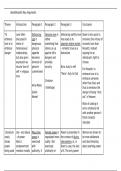
Ibsen/Rossetti Key Arguments
Theme Introduction Paragraph 1 Paragraph 2 Paragraph 3 Conclusion
‘To Love often Embracing Genuine love is Embracing earthly love Ibsen is less quick to
embrace discussed in lust is rather may lead us to renounce the virtues of
love is to terms of dangerous - something that abandon higher duties romantic love than
embrace heterosexual physical shores us up - romantic love as a Rossetti, instead
danger’ relationships, appetite against life’s distraction arguing for an
but also given becomes dangers and individual’s right to
expression as divorced of provides choose
secular love of genuine security Nora: duty to self
For Rossetti, to
self + religious commitment
‘Twice’: duty to God embrace love is to
love
embrace someone
Christine
other than God, and
Anne-Marie
‘A Birthday’ thus to embrace the
Goblin danger of being “shut
Market’ out” of Heaven
Risks of casting in
one’s emotional lot
with another person’s
fickle romantic
impulses
‘Literature Use - and abuse Masculine Female power is Power is presented in Women are shown to
rarely - of power. power is negotiated more the context of divine be more deliberate
shows Nora’s exercised subtly. Not intervention; or, in and discriminating
power empowerment with exercised Ibsen’s case, the lack about exerting power
being used remains morally authority, if arbitrarily or of it. The only power
, Ibsen/Rossetti Key Arguments
well’ ambiguous, not brutality, unjustly, but as that is truly well- While Ibsen’s Nora
while MC’s while female a matter of employed is that demonstrates defiance
agency power is preserving the wielded by God - of expectation, of
precipitates negotiated integrity of the gender roles and of
discomfort for more subtly. self against religion - in her
those she Patriarchal forces that seek Nora: “no religion”, empowerment, the
“scorn[s]”. Less power is to impose “infallible guide” majority of Rossetti’s
conflicted on oppressive unwarranted speakers seem to wait
‘Good Friday’
God’s power, and open to control on God’s better
justly wielded; abuse. judgement before
Ib. devoid Corrosivenes acting
s of ‘No Thank You,
For Rossetti, human
unchallenged John’
power could never be
masculine
‘Winter: My better directed than
authority in
Secret’ towards the higher
19th century
purposes ascribed by
‘Maude Clare’
God, while for Ibsen,
Nora abuses of power - such
Torvald:
as trapping women in
verbal
unhappy marriages -
‘Goblin were very often carried
Market’: out in the name of “so-
physical called religion”
‘Experienc Female Sexual Female Experienc Questionin Experience is always
e all too disillusionment experience disillusionment e leads to g of faith, followed by
often leads is foregrounded. leads to as a result of enlighten disillusion consequence: cause-
, Ibsen/Rossetti Key Arguments
to Alternative - regret for disappointing ment and ment with and-effect logic of the
disillusion experience those who male conduct, thus the experience well-made play,
ment’ leads to seek it out of which includes - imperativ . Mortal religious doctrine,
enlightenment wedlock, but is not e to act to experience Christian catechism
and the impetus such was the exclusive to - improve disappointi
Although these
to improve importance sexual relations. one’s ng
experiences are
one’s fortunes. placed on Naive fortunes compared
sometimes positive,
Experience as chastity. expectation is to heaven
more often they
satisfying - Reminder of briskly deflated
represent a character’s
post-Darwinian the by the reality of Nora
loss of innocence, as
world lacked disillusionme Torvald’s Torvald
‘Twice’ they become
meaning, only nt that selfishness.
and ‘From the disabused of notions
true fulfilment inevitably
‘Goblin Antique’ they held about
to be found in follows
Market’ society, a construction
Heaven pursuing
such as marriage, or
sexual
The failure of another person
gratification
the “miracle of
and the Characters such as
miracles”
vulnerability Nora and Rossetti’s
women open ‘Maude Clare’ - speaker of ‘Twice’ may
themselves refusal to be try to make the best of
up to by bought it, but this doesn’t
doing so. discount the fact that
the ideals they once
wholeheartedly
Anne-Marie believed in have been
irreparably shattered
‘Soeur
, Ibsen/Rossetti Key Arguments
Louise’
Pride goes Relationship to Pride is Ibsen, who Pride, when derived Both writers agree that
before a masculinity, associated surrounded from self-sacrifice, can pride follows a fall, but
fall. The relationships with himself with be justified. Whereas only to an extent. For
greater the and femininity. stereotypicall strong proto- Ibsen’s focus is on the Ibsen, the kind of self-
pride, the Pride (over- y masculine feminist individual’, Rossetti’s deluding, spiritually
greater the estimation of figures. thinkers such as religious upbringing in blind pride exhibited
fall our worth, Torvald his wife and the coterie of her by Torvald is always
arrogance). derives a Camilla Collett, Anglo-Catholic family destined to be
Devalued as a sense of self- seems to required her to eschew deflated, but individual
trait. Merits of importance advocate for a most notions of the pride and vanity are
taking pride in from “ample woman’s right prideful ‘self’ and not damaging per se,
the ability to income”. to take pride in emphasise the especially if they
help others. Professional herself; humility associated empower us to take
Female pride is vulnerability something that with belonging to a the necessary steps to
punished in R’s and personal Rossetti collective personal freedom.
poetry and fallibility. arguably
Christine For Rossetti, pride is
more explicitly Captain disagreed with.
too much associated
encouraged in I Skene’s Warning against ‘Up-Hill’, ‘Goblin
with valuing oneself
execution is pride of seeking Market’, ‘Good Friday’
over God, whom she
a cautionary to establish a
believed our first
tale against sexual identity
allegiance should be
deriving before
to. While pride is
pride from marriage
inevitably associated
one’s
with Ibsen’s humanist
position in a
emphasis on
hierarchy - Christine versus
Theme Introduction Paragraph 1 Paragraph 2 Paragraph 3 Conclusion
‘To Love often Embracing Genuine love is Embracing earthly love Ibsen is less quick to
embrace discussed in lust is rather may lead us to renounce the virtues of
love is to terms of dangerous - something that abandon higher duties romantic love than
embrace heterosexual physical shores us up - romantic love as a Rossetti, instead
danger’ relationships, appetite against life’s distraction arguing for an
but also given becomes dangers and individual’s right to
expression as divorced of provides choose
secular love of genuine security Nora: duty to self
For Rossetti, to
self + religious commitment
‘Twice’: duty to God embrace love is to
love
embrace someone
Christine
other than God, and
Anne-Marie
‘A Birthday’ thus to embrace the
Goblin danger of being “shut
Market’ out” of Heaven
Risks of casting in
one’s emotional lot
with another person’s
fickle romantic
impulses
‘Literature Use - and abuse Masculine Female power is Power is presented in Women are shown to
rarely - of power. power is negotiated more the context of divine be more deliberate
shows Nora’s exercised subtly. Not intervention; or, in and discriminating
power empowerment with exercised Ibsen’s case, the lack about exerting power
being used remains morally authority, if arbitrarily or of it. The only power
, Ibsen/Rossetti Key Arguments
well’ ambiguous, not brutality, unjustly, but as that is truly well- While Ibsen’s Nora
while MC’s while female a matter of employed is that demonstrates defiance
agency power is preserving the wielded by God - of expectation, of
precipitates negotiated integrity of the gender roles and of
discomfort for more subtly. self against religion - in her
those she Patriarchal forces that seek Nora: “no religion”, empowerment, the
“scorn[s]”. Less power is to impose “infallible guide” majority of Rossetti’s
conflicted on oppressive unwarranted speakers seem to wait
‘Good Friday’
God’s power, and open to control on God’s better
justly wielded; abuse. judgement before
Ib. devoid Corrosivenes acting
s of ‘No Thank You,
For Rossetti, human
unchallenged John’
power could never be
masculine
‘Winter: My better directed than
authority in
Secret’ towards the higher
19th century
purposes ascribed by
‘Maude Clare’
God, while for Ibsen,
Nora abuses of power - such
Torvald:
as trapping women in
verbal
unhappy marriages -
‘Goblin were very often carried
Market’: out in the name of “so-
physical called religion”
‘Experienc Female Sexual Female Experienc Questionin Experience is always
e all too disillusionment experience disillusionment e leads to g of faith, followed by
often leads is foregrounded. leads to as a result of enlighten disillusion consequence: cause-
, Ibsen/Rossetti Key Arguments
to Alternative - regret for disappointing ment and ment with and-effect logic of the
disillusion experience those who male conduct, thus the experience well-made play,
ment’ leads to seek it out of which includes - imperativ . Mortal religious doctrine,
enlightenment wedlock, but is not e to act to experience Christian catechism
and the impetus such was the exclusive to - improve disappointi
Although these
to improve importance sexual relations. one’s ng
experiences are
one’s fortunes. placed on Naive fortunes compared
sometimes positive,
Experience as chastity. expectation is to heaven
more often they
satisfying - Reminder of briskly deflated
represent a character’s
post-Darwinian the by the reality of Nora
loss of innocence, as
world lacked disillusionme Torvald’s Torvald
‘Twice’ they become
meaning, only nt that selfishness.
and ‘From the disabused of notions
true fulfilment inevitably
‘Goblin Antique’ they held about
to be found in follows
Market’ society, a construction
Heaven pursuing
such as marriage, or
sexual
The failure of another person
gratification
the “miracle of
and the Characters such as
miracles”
vulnerability Nora and Rossetti’s
women open ‘Maude Clare’ - speaker of ‘Twice’ may
themselves refusal to be try to make the best of
up to by bought it, but this doesn’t
doing so. discount the fact that
the ideals they once
wholeheartedly
Anne-Marie believed in have been
irreparably shattered
‘Soeur
, Ibsen/Rossetti Key Arguments
Louise’
Pride goes Relationship to Pride is Ibsen, who Pride, when derived Both writers agree that
before a masculinity, associated surrounded from self-sacrifice, can pride follows a fall, but
fall. The relationships with himself with be justified. Whereas only to an extent. For
greater the and femininity. stereotypicall strong proto- Ibsen’s focus is on the Ibsen, the kind of self-
pride, the Pride (over- y masculine feminist individual’, Rossetti’s deluding, spiritually
greater the estimation of figures. thinkers such as religious upbringing in blind pride exhibited
fall our worth, Torvald his wife and the coterie of her by Torvald is always
arrogance). derives a Camilla Collett, Anglo-Catholic family destined to be
Devalued as a sense of self- seems to required her to eschew deflated, but individual
trait. Merits of importance advocate for a most notions of the pride and vanity are
taking pride in from “ample woman’s right prideful ‘self’ and not damaging per se,
the ability to income”. to take pride in emphasise the especially if they
help others. Professional herself; humility associated empower us to take
Female pride is vulnerability something that with belonging to a the necessary steps to
punished in R’s and personal Rossetti collective personal freedom.
poetry and fallibility. arguably
Christine For Rossetti, pride is
more explicitly Captain disagreed with.
too much associated
encouraged in I Skene’s Warning against ‘Up-Hill’, ‘Goblin
with valuing oneself
execution is pride of seeking Market’, ‘Good Friday’
over God, whom she
a cautionary to establish a
believed our first
tale against sexual identity
allegiance should be
deriving before
to. While pride is
pride from marriage
inevitably associated
one’s
with Ibsen’s humanist
position in a
emphasis on
hierarchy - Christine versus


