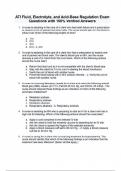
ATI Fluid, Electrolyte, and Acid-Base Regulation Exam Questions with 100% Verified Answers
1. A nurse is assisting in the care of a client who has heart failure and a prescription to receive a unit of packed red blood cells. The nurse should plan for the blood to infuse over which of the following lengths of time? a. 1 hr b. 2 hr c. 4 hr d. 6 hr - c. 4 hr 2. A nurse is assisting in the care of a client who has a prescription to receive one unit of packed red blood cells. The client's blood type is AB+, and the nurse receives a unit of A- blood from the blood bank. Which of the following actions should the nurse take? a. Return the blood unit as it is not compatible with the client's blood type. b. Stay with the client for 15 min prior to starting the blood transfusion. c. Verify the unit of blood with another nurse. d. Prime the blood tubing with 0.45% sodium chloride. - c. Verify the unit of blood with another nurse. 3. A nurse is reviewing laboratory results for a client and notes the following arterial blood gas (ABG) values: pH 7.31, PaCO2 49 mm Hg, and HCO3- 25 mEq/L. The nurse should interpret these findings as an indication of which of the following acid-base imbalances? a. Metabolic acidosis b. Respiratory acidosis c. Metabolic alkalosis d. Respiratory alkalosis - b. Respiratory acidosis 4. A nurse is assisting an RN who is preparing to start an IV for a client who has a high risk for bleeding. Which of the following actions should the nurse take? a. Apply a cold compress to the selected IV site. b. Ask the client to hold the extremity up prior to searching for an IV site. c. Ask the client to spread the fingers of the selected extremity. d. Apply a blood pressure cuff set to 30 mm Hg. - d. Apply a blood pressure cuff set to 30 mm Hg. 5. A nurse is caring for a client who is receiving treatment for hyponatremia. The nurse should identify that which of the following findings is an indication that the treatment has been effective? (Select all that apply.) The client states their muscle spasms are absent. The client reports a headache. The client denies being confused. The client reports being nauseated. The client reports feeling tired. - The client states their muscle spasms are absent. The client denies being confused. 6. A nurse is assisting in the care of a client who has an acid-base imbalance and is experiencing hypoxia. Which of the following actions should the nurse take first? a. Initiate continuous cardiac monitoring. b. Elevate the head of the client's bed. c. Instruct the client to deep breathe and cough. d. Initiate continuous SpO2 monitoring. - b. Elevate the head of the client's bed. 7. A nurse is collecting data on a client who has been receiving IV therapy for several days and notes that the client's daily weight has increased. The nurse should identify that the client is at increased risk for developing which of the following IV-related complications? a. Phlebitis b. Extravasation c. Air embolism d. Circulatory overload - d. Circulatory overload 8. A nurse is caring for a client who is experiencing respiratory alkalosis. Which of the following actions should be the goal of treatment for the client? a. Increase the carbon dioxide level. b. Increase the respiratory rate. c. Increase the bicarbonate level. d. Increase the pH level. - a. Increase the carbon dioxide level. 9. A charge nurse is observing a newly licensed nurse who is preparing to administer a blood transfusion to a client. For which of the following actions by the newly licensed nurse should the charge nurse intervene? a. The nurse selects 0.45% sodium chloride to use to prime the tubing. b. The nurse asks another nurse to check the blood unit label and client identification prior to beginning the transfusion. c. The nurse uses tubing with a filter for the blood transfusion. d. The nurse discards the tubing after the first unit of blood is completed. - a. The nurse selects 0.45% sodium chloride to use to prime the tubing. 10. A nurse is caring for a client who has a peripherally inserted central catheter (PICC). For which of the following complications should the nurse monitor? a. The need for multiple IV sticks b. Infection at the access site c. Dehydration d. Infiltration - b. Infection at the access site
Información del documento
- Subido en
- 11 de abril de 2025
- Número de páginas
- 7
- Escrito en
- 2024/2025
- Tipo
- Examen
- Contiene
- Preguntas y respuestas