

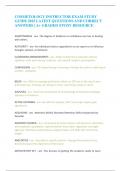
COSMETOLOGY INSTRUCTOR EXAM STUDY
GUIDE 2025 LATEST QUESTIONS AND CORRECT
ANSWERS | A+ GRADED STUDY RESOURCE
.
ASSERTIVENESS - ans -The degree of boldness or confidence one has in dealing
with others.
AUTHORITY - ans -An individual cited or appealed to as an expert or to influence
thought, opinion, or behavior.
CLASSROOM ARRANGEMENTS - ans -Helps to determine educator control,
sightlines with and among students, and overall student participation.
COMPASSION - ans -The deep feeling of sharing or feeling the pain or suffering of
another, sympathy.
80/20 - ans -80% are average performers where as 20% are in the top of your
profession by; showing up, being on time, and being ready to work.
AACS/CEA - ans -American Association of Cosmetology Schools/Cosmetology
Educators of America
ACTIVE LISTENING - ans -Be with the speaker, don't interrupt, repeat, gain
agreement.
ADD/ADHD - ans -Attention Deficit Disorder/Attention Deficit Hyperactivity
Disorder
ADVISORY COUNCIL - ans -Composed of school owners and directors, educators
and employers, graduates, representatives from state, regulatory oversight
agencies. Identifies and prioritizes subject matter and skills that need to be
taught.
ANECDOTES - ans -Describes a specific point to help get the learners focus
directed toward the objectives of the lesson.
ANTICIPATORY SET - ans -The process of getting the students ready to learn
, CURRICULUM DEVELOPMENT - ans -The process of developing a set of courses
constituting an area of specialization as prescribed by the state regulatory agency.
DEDUCTIVE REASONING - ans -The process of reaching a probable conclusion by
employing logical reasoning.
DEMOGRAPHICS - ans -Average income, cost of services, age, ethnicity, etc. within
a specified area.
DEMONSTRATION - ans -Perform at an appropriate speed ensuring the students
do not miss any key points or steps.
DEPT. OF EDUCATION - ans -Sets forth specific regulations governing student
hours and financial aid disbursement.
DISABLED LEARNER - ans -Is responsible for providing documentation of their
disability and making a formal request for accommodations.
DYSLEXIA - ans -A specific learning disability that is an impairment in the brain's
ability to translate written images received by the eyes into meaningful language.
CONFERENCES - ans -Private, nonthreatening, face to face talk to bring about
change, not to intimidate or control behavior.
CONSISTENCY - ans -Behaving the same way on repeated occasions when the
circumstances are the same or similar.
COURSE OBJECTIVE - ans -AKA: Program objective - specifies the learning
outcomes of the program of study.
COURSE OF STUDY - ans -AKA: Program of study - Properly developed program
will result in an orderly and systematic process of education.
CRITICISM - ans -Be open to constructive criticism, be humble, put yourself in the
other person's shoes, apologize if necessary and don't whine, cry, or blame
others.
GUIDE 2025 LATEST QUESTIONS AND CORRECT
ANSWERS | A+ GRADED STUDY RESOURCE
.
ASSERTIVENESS - ans -The degree of boldness or confidence one has in dealing
with others.
AUTHORITY - ans -An individual cited or appealed to as an expert or to influence
thought, opinion, or behavior.
CLASSROOM ARRANGEMENTS - ans -Helps to determine educator control,
sightlines with and among students, and overall student participation.
COMPASSION - ans -The deep feeling of sharing or feeling the pain or suffering of
another, sympathy.
80/20 - ans -80% are average performers where as 20% are in the top of your
profession by; showing up, being on time, and being ready to work.
AACS/CEA - ans -American Association of Cosmetology Schools/Cosmetology
Educators of America
ACTIVE LISTENING - ans -Be with the speaker, don't interrupt, repeat, gain
agreement.
ADD/ADHD - ans -Attention Deficit Disorder/Attention Deficit Hyperactivity
Disorder
ADVISORY COUNCIL - ans -Composed of school owners and directors, educators
and employers, graduates, representatives from state, regulatory oversight
agencies. Identifies and prioritizes subject matter and skills that need to be
taught.
ANECDOTES - ans -Describes a specific point to help get the learners focus
directed toward the objectives of the lesson.
ANTICIPATORY SET - ans -The process of getting the students ready to learn
, CURRICULUM DEVELOPMENT - ans -The process of developing a set of courses
constituting an area of specialization as prescribed by the state regulatory agency.
DEDUCTIVE REASONING - ans -The process of reaching a probable conclusion by
employing logical reasoning.
DEMOGRAPHICS - ans -Average income, cost of services, age, ethnicity, etc. within
a specified area.
DEMONSTRATION - ans -Perform at an appropriate speed ensuring the students
do not miss any key points or steps.
DEPT. OF EDUCATION - ans -Sets forth specific regulations governing student
hours and financial aid disbursement.
DISABLED LEARNER - ans -Is responsible for providing documentation of their
disability and making a formal request for accommodations.
DYSLEXIA - ans -A specific learning disability that is an impairment in the brain's
ability to translate written images received by the eyes into meaningful language.
CONFERENCES - ans -Private, nonthreatening, face to face talk to bring about
change, not to intimidate or control behavior.
CONSISTENCY - ans -Behaving the same way on repeated occasions when the
circumstances are the same or similar.
COURSE OBJECTIVE - ans -AKA: Program objective - specifies the learning
outcomes of the program of study.
COURSE OF STUDY - ans -AKA: Program of study - Properly developed program
will result in an orderly and systematic process of education.
CRITICISM - ans -Be open to constructive criticism, be humble, put yourself in the
other person's shoes, apologize if necessary and don't whine, cry, or blame
others.

