
EXAM 4, May 1, 2024 NAME:
Question 1 (10 points):
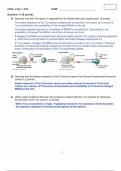
A. Describe how the Trp-operon is regulated by the leader-attenuator sequences? (6 points)
The leader sequence of the Trp-operon encodes two consecutive Trp codons as a sensor of
Trp concentration and availability of Trp-charged tRNAs in the cell.
The leader-peptide sequence is translated as RNAP is transcribing it. Depending on the
availability of charged Trp-tRNAs, one of two structures can form.
If charged Trp-tRNAs are present then ribosome reads past the Trp codons, covering sequence
2, which favors the formation of a transcription terminator between sequences 3-4.
If Trp is absent, charged Trp-tRNAs are low and ribosome stalls on the Trp codons. This favor
formation of a structure between sequence 2-3 which forms an antitermination structure that
favors continuation of transcription of the Trp biosynthetic genes.
High tryptophan Low tryptophan o
Leader T Antiterminator ( o
peptide . “Terminated” polymerase
2 25 trp operon mRN;
PR N + RNA polymerase - v
trpL mRNA A . et
Ribosome transcribing iy DNA encoding
the leader peptide mRNA attandem Trp codons trp operon
[————— PR ———
B. Describe why the leader sequence of the Threonine operon has several consecutive threonine
codons? (2 points)
leader sequence of the Threonine operon encodes several consecutive Threonine
codons as a sensor of Threonine concentration and availability of Threonine-charged
tRNAs in the cell.
C. Under what conditions does the Trp repressor protein binds the Trp operator to represses
transcription of the Trp operon? (2 points)
When Trp concentration is high, Tryptophan binds the Trp repressor which the binds
the operator sequence to prevent transcription of the operon.
, EXAM 4, May 1, 2024 NAME:
Question 2 (10 points) One of your classmates invented a Star-Trek Next-Generation microscope
that lets you see into cells and observe biological molecules directly. You are looking at Eukaryotic
cells and are fascinated by the “circular” appearance of the mRNA.
A. Explain why the mRNA appears circular. (2 points)
Eukaryotic mRNA appears circular because the 5’-end cap is bound by elF4E (part of
elF4F) and the 3’-end polyA tail is bound by PABP, which then interacts with the cap-
binding complex (elF4F) via interactions with the elF4G scaffold.
The next day your friend from the Dream-Team brings you a mutant cell and wants to examine it
under your microscope. You both see that the mRNA in this mutant cell is not “circular”. You also
notice that the lengths and sizes of mMRNAs are not different and their polyA tails are unchanged.
B. Explain what mutations could cause mRNAs in this cell to be “linear” (no longer appear
circular). (One example is sufficient). (4 points)
Based on answer to part A, | was looking for answers that mention mutations affecting
interaction between elF4G-PABP such that the mRNA can’t circularize.
An elF4G mutation that affects PABP interaction will cause this phenotype.
Or a PABP mutation that does not interact with 4G will give the same phenotype.
C. Briefly explain whether these “linear” mRNAs would be translated as efficiently as “circular”
mRNAs. (2 points)
The likely outcome of the elF4G mutation would be reduced translation efficiency
because both initiation and termination might be adversely affected by such mutations.
D. Based on your answer in part C, how would you show/confirm your conclusion and
determine where the mutation is? (2 points)
Depends on your answer in part A. If you said elF4G mutation, then you would
sequence 4G and determine the nature of the mutation or you would isolate 4G from the
mutant cells and test its ability to interact PABP.

