

Escrito por estudiantes que aprobaron Inmediatamente disponible después del pago Leer en línea o como PDF ¿Documento equivocado? Cámbialo gratis 4,6 TrustPilot
logo-home
Document preview thumbnail
Vista previa 2 fuera de 6 páginas
Examen

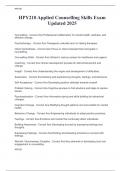
HPY210 Applied Counselling Skills Exam Updated 2025

Document preview thumbnail
Vista previa 2 fuera de 6 páginas

Counselling - Correct Ans-Professional collaboration for mental health, wellness, and effective change. Psychotherapy - Correct Ans-Therapeutic umbrella term for talking therapies. Client Centredness - Correct Ans-Focus on client empowerment and goals in counselling. Counselling Skills - Correct Ans-Utilized in various careers for healthcare and support. Coaching - Correct Ans-Human development process for skill enhancement and change. Insight - Correct Ans-Understanding the origins and development of difficulties. Awareness - Correct Ans-Noticing and experiencing thoughts, feelings, and behaviors. Self-Acceptance - Correct Ans-Developing positive attitudes towards oneself. Problem Solving - Correct Ans-Cognitive process to find solutions and steps to resolve issues. Psychoeducation - Correct Ans-Information-giving and skills-building for behavioral changes. Cognitive Change - Correct Ans-Modifying thought patterns and core beliefs for mental health. Behaviour Change - Correct Ans-Empowering individuals to adopt positive practices. Feelings - Correct Ans-Emotions and moods that continually affect individuals. Building Awareness - Correct Ans-Decreasing arousal by expressing feelings and thoughts. Expressing Feelings - Correct Ans-Eliciting and tolerating emotions to connect with feelings. Warmth, Genuineness, Empathy - Correct Ans-Key elements in developing trust and engagement in counselling. SMART Goals - Correct Ans-Specific, Measurable, Achievable, Relevant, Time-bound objectives. Outcome Based Research - Correct Ans-Evaluating counselling effectiveness through quantitative methods. Experienced Focused Research - Correct Ans-Understanding counselling experiences through qualitative analysis. Empathy - Correct Ans-Understanding clients' thoughts and feelings from their perspective. Alliance - Correct Ans-Positive emotional bond and agreement on counselling goals. Goal consensus and collaboration - Correct Ans-Mutually-agreed therapeutic goal cooperation between counsellor and client. Positive regard and affirmations - Correct Ans-Displaying warmth, care, and affirmation towards the client. Collecting feedback - Correct Ans-Monitoring progress and checking in with the client. First Meeting - Correct Ans-Initial session setup, greeting, observation, and confidentiality discussion. The invitation to talk - Correct Ans-Opening prompt to encourage client dialogue and session direction. Listening - Correct Ans-Accurately understanding and interpreting client communication. Encourages and minimal responses - Correct Ans-Brief cues and nonverbal gestures to encourage client expression. Paraphrasing - Correct Ans-Reflecting back the essence of the client's statements accurately. Empathetic of feelings - Correct Ans-Reflecting the emotional state perceived from the client. Open questions - Correct Ans-Queries encouraging detailed responses for deeper exploration. Closed questions - Correct Ans-Specific questions often answered with yes or no. Summarising - Correct Ans-Concise review and reflection of client statements. Theoretical Model of Behaviour Change - Correct Ans-Integrative approach to intentional behavior change stages. Precontemplation stage - Correct Ans-No intention for future change. Contemplation stage - Correct Ans-Considering behavior change. Preparation stage - Correct Ans-Decision made to change behavior. Action stage - Correct Ans-Behavior change initiation. Maintenance stage - Correct Ans-Establishing behavior change as the new norm. Lapse - Correct Ans-Brief return to old behavior. Relapse - Correct Ans-Complete return to old behavior. Theory of Planned Behaviour - Correct Ans-Intention as the main behavior predictor. Motivation - Correct Ans-Internal drive guiding action and engagement. Intrinsic motivation - Correct Ans-Engagement for inherent satisfaction. Extrinsic motivation - Correct Ans-Activity engagement for separable outcomes. Welcoming the Client - Correct Ans-Initial impression considerations and client reception. Getting Personal and contextual information - Correct Ans-Collecting client details and history before sessions. Self-instruction - Correct Ans-Guiding one's thoughts and actions Schunk (1996) - Correct Ans-Studied goal setting and self-evaluation in self-regulated learning Self-evaluative judgments - Correct Ans-Linked to causal attributions Reactive students - Correct Ans-Struggle due to poor goal setting Cyclical model - Correct Ans-Guides interventions with at-risk students in goal setting Australian Psychological Society code of ethics - Correct Ans-Includes respect, propriety, and integrity Ethical Decision Making - Correct Ans-Involves a framework for working through ethical dilemmas Codes of ethics - Correct Ans-Define honorable behavior in a field or organization Ethical principles - Correct Ans-Include do not harm, duty of care, know your limits Confidentiality - Correct Ans-Information shared only when required by law or for imminent risk Dual Relationships - Correct Ans-Occurs when CC and client have non-professional connections Reading - Ethics in Psychology - Correct Ans-Basic rules governing professional behavior Prosperity - Correct Ans-Incorporates beneficence, non-maleficence, competence Integrity - Correct Ans-Emphasizes good character, trust, and professional conduct impact Psychologists' responsibilities - Correct Ans-Respect clients' rights, provide culturally appropriate services Continuing professional development - Correct Ans-Ensures psychologists maintain competence Adequate records - Correct Ans-Kept for a minimum of 7 years Limits to confidentiality - Correct Ans-Made clear in professional relationships Authorship of scholarship - Correct Ans-Assigned honestly and accurately Ethical concerns - Correct Ans-Addressed promptly as they arise Grey areas in counselling - Correct Ans-Arise from conflicting ethical standards or complex situations Professional ethics vs legally mandated ethics - Correct Ans-Psychologists follow ethical codes and state/federal laws Competing ethical codes - Correct Ans-May require applying ethical judgment to resolve Steps in ethical decision-making - Correct Ans-Involve anticipating impacts, reviewing standards, and consulting Ethical Judgment - Correct Ans-Consideration of personal biases affecting decision-making. Consultation - Correct Ans-Seeking advice from others for decision-making. Alternative Courses of Action - Correct Ans-Various options to address a situation ethically. Perspective Adoption - Correct Ans-Understanding viewpoints of those affected by decisions. Personal Responsibility - Correct Ans-Accepting consequences of decisions made. Documentation - Correct Ans-Recording the decision-making process and outcomes. Risk Assessment - Correct Ans-Evaluating potential harm factors in a situation. Suicidal Risk Factors - Correct Ans-Indicators like substance abuse, loss, and access to lethal means. Client Factors - Correct Ans-Traits like impulsivity and hopelessness increasing suicide risk. Psychological Conditions - Correct Ans-Disorders like depression elevating the risk of harm. Serious Harm to Others - Correct Ans-Ethical considerations when clients pose risks to others. Safety Planning - Correct Ans-Strategies to prevent harm and ensure client safety. Warning Signs - Correct Ans-Indicators of escalating risk in a client. Internal Coping Skills - Correct Ans-Individual strategies to manage stress and emotions. Social Supports - Correct Ans-Involving friends and family for client assistance. Safety Plan Steps - Correct Ans-Structured actions to address client safety concerns. Confidentiality Statement - Correct Ans-Reassuring clients of privacy and safety measures. Ethical Decision Making Steps - Correct Ans-Sequential process including consultation and responsibility. Approaches in Counselling - Correct Ans-Structured systems to aid clients in problem-solving. Assessment in Counselling - Correct Ans-Collecting data to understand and address client issues. Termination in Therapy - Correct Ans-Concluding therapy responsibly and ethically. Client Termination Criteria - Correct Ans-Determining when a client no longer needs therapy. Therapeutic Relationship Review - Correct Ans-Reflecting on client progress and unmet goals. Grief Discussion - Correct Ans-Addressing emotions related to therapy conclusion. Micro Skills Recap - Correct Ans-Summarizing techniques like active listening in counselling.

Vista previa del contenido

HPY210


HPY210 Applied Counselling Skills Exam
Updated 2025

Counselling - Correct Ans-Professional collaboration for mental health, wellness, and
effective change.

Psychotherapy - Correct Ans-Therapeutic umbrella term for talking therapies.

Client Centredness - Correct Ans-Focus on client empowerment and goals in
counselling.

Counselling Skills - Correct Ans-Utilized in various careers for healthcare and support.

Coaching - Correct Ans-Human development process for skill enhancement and
change.

Insight - Correct Ans-Understanding the origins and development of difficulties.

Awareness - Correct Ans-Noticing and experiencing thoughts, feelings, and behaviors.

Self-Acceptance - Correct Ans-Developing positive attitudes towards oneself.

Problem Solving - Correct Ans-Cognitive process to find solutions and steps to resolve
issues.

Psychoeducation - Correct Ans-Information-giving and skills-building for behavioral
changes.

Cognitive Change - Correct Ans-Modifying thought patterns and core beliefs for mental
health.

Behaviour Change - Correct Ans-Empowering individuals to adopt positive practices.

Feelings - Correct Ans-Emotions and moods that continually affect individuals.

Building Awareness - Correct Ans-Decreasing arousal by expressing feelings and
thoughts.

Expressing Feelings - Correct Ans-Eliciting and tolerating emotions to connect with
feelings.

Warmth, Genuineness, Empathy - Correct Ans-Key elements in developing trust and
engagement in counselling.

HPY210

, HPY210


SMART Goals - Correct Ans-Specific, Measurable, Achievable, Relevant, Time-bound
objectives.

Outcome Based Research - Correct Ans-Evaluating counselling effectiveness through
quantitative methods.

Experienced Focused Research - Correct Ans-Understanding counselling experiences
through qualitative analysis.

Empathy - Correct Ans-Understanding clients' thoughts and feelings from their
perspective.

Alliance - Correct Ans-Positive emotional bond and agreement on counselling goals.

Goal consensus and collaboration - Correct Ans-Mutually-agreed therapeutic goal
cooperation between counsellor and client.

Positive regard and affirmations - Correct Ans-Displaying warmth, care, and affirmation
towards the client.

Collecting feedback - Correct Ans-Monitoring progress and checking in with the client.

First Meeting - Correct Ans-Initial session setup, greeting, observation, and
confidentiality discussion.

The invitation to talk - Correct Ans-Opening prompt to encourage client dialogue and
session direction.

Listening - Correct Ans-Accurately understanding and interpreting client communication.

Encourages and minimal responses - Correct Ans-Brief cues and nonverbal gestures to
encourage client expression.

Paraphrasing - Correct Ans-Reflecting back the essence of the client's statements
accurately.

Empathetic of feelings - Correct Ans-Reflecting the emotional state perceived from the
client.

Open questions - Correct Ans-Queries encouraging detailed responses for deeper
exploration.

Closed questions - Correct Ans-Specific questions often answered with yes or no.

Summarising - Correct Ans-Concise review and reflection of client statements.

HPY210

Información del documento

Subido en
7 de abril de 2025
Número de páginas
6
Escrito en
2024/2025
Tipo
Examen
Contiene
Preguntas y respuestas
$8.09

¿Documento equivocado? Cámbialo gratis Dentro de los 14 días posteriores a la compra y antes de descargarlo, puedes elegir otro documento. Puedes gastar el importe de nuevo.
Escrito por estudiantes que aprobaron
Inmediatamente disponible después del pago
Leer en línea o como PDF

Seller avatar
Los indicadores de reputación están sujetos a la cantidad de artículos vendidos por una tarifa y las reseñas que ha recibido por esos documentos. Hay tres niveles: Bronce, Plata y Oro. Cuanto mayor reputación, más podrás confiar en la calidad del trabajo del vendedor.
AlexScorer
2.5
(2)
Vendido
11
Seguidores
0
Artículos
1800
Última venta
2 semanas hace


Por qué los estudiantes eligen Stuvia

Creado por compañeros estudiantes, verificado por reseñas

Calidad en la que puedes confiar: escrito por estudiantes que aprobaron y evaluado por otros que han usado estos resúmenes.

¿No estás satisfecho? Elige otro documento

¡No te preocupes! Puedes elegir directamente otro documento que se ajuste mejor a lo que buscas.

Paga como quieras, empieza a estudiar al instante

Sin suscripción, sin compromisos. Paga como estés acostumbrado con tarjeta de crédito y descarga tu documento PDF inmediatamente.

Student with book image

“Comprado, descargado y aprobado. Así de fácil puede ser.”

Alisha Student

Preguntas frecuentes
