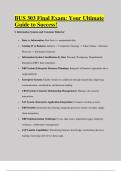
BUS 303 Final Exam: Your Ultimate
Guide to Success!
I. Information Systems and Consumer Behavior
Data vs. Information: Raw facts vs. manipulated data.
Linking IT to Business: Industry -> Competitive Strategy -> Value Chains -> Business
Processes -> Information Systems.
Information System Classification by Size: Personal, Workgroup, Departmental,
Enterprise (ERP), Inter-enterprise.
ERP System (Enterprise Resource Planning): Integrates all business operations into a
single platform.
Enterprise Systems: Enable workers to collaborate through shared data, improving
communication, coordination, and decision-making.
CRM System (Customer Relationship Management): Manages all customer
interactions.
EAI System (Enterprise Application Integration): Connects existing systems.
ERP Benefits: Real-time data sharing, integrated processes, better oversight, supply
chain integration.
ERP Implementation Challenges: Costs, data issues, requirement gaps, employee
resistance, collaborative management.
SAP Lumira Capabilities: Maximizing business knowledge, accelerating decision-
making, increasing self-service data usage.
, Consumer Behavior: Activities related to purchase, use, and disposal of goods/services,
including psychological responses.
Consumer Decision-Making Process:
1. Problem Recognition/Motivation: Identifying a need or want. Marketers can
trigger this.
2. Information Search/Perception: Gathering information to solve the problem.
Selective Exposure, Attention, Comprehension, Retention: How
consumers process information.
3. Alternative Evaluation/Attitude Formation: Evaluating options.
Central Route to Persuasion: High involvement, focus on message
content.
Peripheral Route to Persuasion: Low involvement, focus on peripheral
cues.
4. Purchase Decision/Integration: Making the purchase.
Decision Rules: Deliberate attribute evaluation or heuristics (shortcuts).
5. Post-Purchase Evaluation/Learning: Assessing satisfaction.
Market Research:
o Secondary: Data collected by others.
o Primary: Data collected yourself.
o Qualitative: In-depth, exploratory (interviews, focus groups, ethnography).
o Quantitative: Statistically valid (surveys, experiments).
Sampling: Using a small group to represent the population. Must be representative and
generalizable.
Guide to Success!
I. Information Systems and Consumer Behavior
Data vs. Information: Raw facts vs. manipulated data.
Linking IT to Business: Industry -> Competitive Strategy -> Value Chains -> Business
Processes -> Information Systems.
Information System Classification by Size: Personal, Workgroup, Departmental,
Enterprise (ERP), Inter-enterprise.
ERP System (Enterprise Resource Planning): Integrates all business operations into a
single platform.
Enterprise Systems: Enable workers to collaborate through shared data, improving
communication, coordination, and decision-making.
CRM System (Customer Relationship Management): Manages all customer
interactions.
EAI System (Enterprise Application Integration): Connects existing systems.
ERP Benefits: Real-time data sharing, integrated processes, better oversight, supply
chain integration.
ERP Implementation Challenges: Costs, data issues, requirement gaps, employee
resistance, collaborative management.
SAP Lumira Capabilities: Maximizing business knowledge, accelerating decision-
making, increasing self-service data usage.
, Consumer Behavior: Activities related to purchase, use, and disposal of goods/services,
including psychological responses.
Consumer Decision-Making Process:
1. Problem Recognition/Motivation: Identifying a need or want. Marketers can
trigger this.
2. Information Search/Perception: Gathering information to solve the problem.
Selective Exposure, Attention, Comprehension, Retention: How
consumers process information.
3. Alternative Evaluation/Attitude Formation: Evaluating options.
Central Route to Persuasion: High involvement, focus on message
content.
Peripheral Route to Persuasion: Low involvement, focus on peripheral
cues.
4. Purchase Decision/Integration: Making the purchase.
Decision Rules: Deliberate attribute evaluation or heuristics (shortcuts).
5. Post-Purchase Evaluation/Learning: Assessing satisfaction.
Market Research:
o Secondary: Data collected by others.
o Primary: Data collected yourself.
o Qualitative: In-depth, exploratory (interviews, focus groups, ethnography).
o Quantitative: Statistically valid (surveys, experiments).
Sampling: Using a small group to represent the population. Must be representative and
generalizable.