NURS 6640 Week 6 Midterm Exam
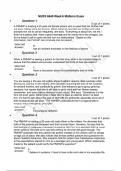
• Question 1 0 out of 1 points lOMoARcPSD| • Question 6 1 out of 1 points • Question 7 1 out of 1 points If a task must be completed, I will often complete it myself versus depending on someone else.” The PMHNP is working with a patient who experiences anxiety around her parents that later leads to poor impulse control. What will the PMHNP do to employ psychodynamic psychotherapy properly for this patient? Selected Answer: B. Focus on expressions of emotion The PMHNP has been treating a 15-year-old patient with a history of abuse and neglect. Thirty minutes into their therapy session the patient jumps up and begins to pace around the room. Utilizing Socratic dialogue (SD) the PMHNP’s best action would be to: Selected Answer: C. Say, “I noticed a change. Can you tell me what happened?” During cognitive behavioral therapy (CBT), a 64-year-old male patient states, “I get so frustrated sometimes and I just blow up at everybody!” Which response by the PMHNP demonstrates translation of Socratic dialogue (SD)? Selected Answer: B. “When you say blow up, what exactly does blow up mean and how • Question 5 0 out of 1 points lOMoARcPSD| • Question 9 1 out of 1 points • Question 10 1 out of 1 points • Question 11 0 out of 1 points • Question 12 1 out of 1 points does it feel to you?” The PMHNP understands that anxiety and depression are two disorders in which their symptoms may overlap. When discussing this, you explain that the autonomic nervous system is activated and further helps distinguish anxiety symptoms by making the following points: Selected Answer: B. “You may experience fear, sweating, and muscle tension.” The PMHNP meets with an adolescent patient who has depression and often presents with resistance when discussing his parent’s divorce. For the past couple of sessions, the patient has been quiet, sometimes refusing to speak. To further support the therapeutic relationship, the PMNHP: Selected Answer: A. Observes and points out the behavior The PMHNP is working with a patient who experiences abreactions when discussing repressed feelings of his sexual abuse as a child. What can the PMHNP do to manage the patient’s intense emotional reactions? Selected Answer: C. Suggest a relaxation technique, such as yoga or meditation A 35-year-old patient seeks treatment for depression and anxiety after an abusive relationship. To help empower the patient, the PMHNP wants to teach the safe-place exercise to create a feeling of calm. In order to walk the patient through the exercise, the PMHNP first says: Selected Answer: D. “Picture a beautiful beach and describe to me what you see.” True or false: A PMHNP may ask his patient to describe her relationship with her father, both as a child and now, in order to assess interpersonal style. Selected Answer: Fals e • Question 13 • Question 8 1 out of 1 points lOMoARcPSD| • Question 14 1 out of 1 points • Question 15 0 out of 1 points • Question 16 1 out of 1 points • Question 17 1 out of 1 points An initial evaluation reveals that an 11-year-old patient has moved to a new school after her parents’ recent divorce, and is having trouble making friends. The patient has normal mental status and exhibits appropriate behavior. What is the most appropriate scale for the PMHNP to use to get more information? Selected Answer: D. Impact of Event Scale A 62-year-old patient has been diagnosed with borderline personality disorder. Upon assessment, the PMHNP learns that he participates in spending sprees and occasional binge eating, accompanied by rapid changes in self-image. Which evidence-based psychotherapeutic model does the PMHNP identify as effective and beneficial? Selected Answer: C. Dialectical behavior therapy The PMHNP is working with an adult patient who has somatic complaints caused by a history of childhood abuse. As part of the therapeutic process, what does the PMHNP do to assess and organize a trauma history? Selected Answer: D. Debrief with the patient The PMHNP is working with a veteran who has posttraumatic stress disorder (PTSD). The PMHNP believes that dual awareness will be beneficial in allowing the patient to focus on the here and now. What strategies can the PMHNP use to develop dual awareness in the patient? Selected Answer: D. All of the above A PMHNP is treating a 50-year-old patient who suffers from depression. When he was growing up, he was often responsible for taking care of his three younger siblings. Since then, the patient puts other people’s needs before his own. Based on this information, the PMHNP would conclude that his interpersonal style is . Selected Answer: A. overly nurturing 1 out of 1 points lOMoARcPSD| • Question 19 0 out of 1 points • Question 20 1 out of 1 points • Question 21 1 out of 1 points The PMHNP is working with a patient who is living in poverty and abusing substances. According to the treatment hierarchy framework, what needs does the PMHNP need to attend to first? Selected Answer: A. Provide safety through case management strategies During a session, the PMHNP asks a patient with a history of sexual abuse to recall the relationship she had as a child with her parents. The patient responds by saying she has a headache and her stomach hurts, and starts talking about her physical ailments. What is the appropriate response by the PMHNP? Selected Answer: C. Tell the patient that she may not get better if she does not face her fears The PMHNP is mentoring a student. After working with a patient during a session, the student laments about all the things she should have, or could have, said to the patient. “I feel guilty that I didn’t speak up more about the patient’s concern toward her son,” says the student. The PMHNP understands that the student is exhibiting signs of which therapeutic concept? Selected Answer: A. Countertransfer ence
Document information
- Uploaded on
- March 31, 2025
- Number of pages
- 17
- Written in
- 2024/2025
- Type
- Exam (elaborations)
- Contains
- Questions & answers