

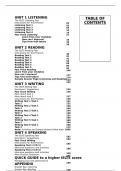
UNIT 1 LISTENING TABLE OF
The IELTS Listening Test
Instructions for Test Practice 02 CONTENTS
Listening Test 1 03
Listening Test 2 04
Listening Test 3 10
Listening Test 4 19
Fast Track Listening 27
Learn from your mistakes
How can I improve? 35
Tips from test-takers 36
38
UNIT 2 READING
The IELTS Reading Test
Instructions for Test Practice 40
Reading Test 1 41
Reading Test 2 42
Reading Test 3 56
Reading Test 4 68
Reading Test 5 80
Reading Test 6 92
Fast Track Reading 104
Learn from your mistakes
How can I improve? 117
Tips from test-takers 119
Sample Answer Page (Listening and Reading)120
122
UNIT 3 WRITING
The IELTS Writing Test
Examiners’ Suggestions 124
Fast Track Writing 126
More about task 1
More about task 2 127
Instructions for Test Practice 128
Writing Test 1 Task 1 131
Task 2 132
Writing Test 2 Task 1 136
Task 2 140
Writing Test 3 Task 1 144
Task 2 148
Writing Test 4 Task 1 152
Task 2 156
Writing Test 5 Task 1 160
Task 2 164
Writing Test 6 Task 1 168
Task 2 172
Note: Activities and Sample Answer follow each Task
176
UNIT 4 SPEAKING
The IELTS Speaking Test
182
Examiners’ Suggestions
184
Fast Track Writing
Instructions for Test Practice
185
Speaking Test 1 (CD 1)
Interview questions and activities
186
Speaking Test 2 (CD 2)
Interview questions and activities
190
More Practice Questions
195
QUICK GUIDE to a higher IELTS score
Managing your test performance
199
APPENDIX
Answer Key: Listening
Answer Key: Reading 210
,written for candidates who are preparing for the IELTS Test (Academic) in order to
enter an academic course in an English-speaking institution. It is designed both
for independent study and for use as a classroom textbook, especially for courses
with a focus on writing and speaking skills. IELTS on Track is not an official IELTS
publication and, like most other practice and preparation books, is not endorsed
officially by IELTS. The IELTS on Track series has its own website –
www.IELTSonTrack.com which has other helpful test preparation materials.
WHAT IS THE IELTS TEST?
IELTS (International English Language Testing System) is a widely used and
recognized international Test of English administered by Cambridge English
Language Assessment, formerly Cambridge ESOL, the British Council, and IDP
Education Australia. There are two versions: Academic (for students wishing to
study in an English-speaking university for college) and General training (for entry
for vocational programs, schools or for immigration).
IELTS test four performance areas: Listening, Reading, Writing and Speaking. All
candidates receive a test score between 1 (lowest) and 9(highest) Academic
Institution set their own IELTS entry scores
The IELTS test is taken in this sequence:
Listening 40 questions -30 minutes (+ 10 minutes to transfer
answer)
Academic Reading 40 questions based on three texts- 60 minutes
Academic Writing 2 essays task- 60 minutes
Speaking a standard interview in 3 parts lasting 11-14
The current IELTS material for test applicants, which is available at all times centers
worldwide gives further information about the test. The official website: www.ielts.org also
gives up-to-date information and test data.
INSIDE THE BOOK
IELTS on Track is divided into four units- Listening, Reading, Writing and Speaking.
Each unit contains IELTS practices test and a Fast Track section
,The CD recordings offer a wide variety of English accents- British, American, Australian,
Canadian and Scottish. This is consistent with the international nature of the IELTS test and
the need for candidates to accommodate varieties of English spoken at a nature speed.
6 COMPLETE READING TEST
Topics that are interesting, durable and even controversial have been favored
for inclusion. The aim has been to encourage critical thinking and discussion
in IELTS preparation classrooms. All six tests are at a level comparable to the
actual IELTS but the later test pose a slightly higher level of challenge than
the earlier ones.
6 COMPLETE WRITING TEST
The Writing Test Task 1 material covers a wide range of test task type. The
Writing Test Task 2 prompts are usually short and clear. The aim has been to
enable users of this book to focus on their own writing needs.
2 COMPLETE SPEAKING TESTS
The two sample IELTS Speaking test on CD 1 and CD 2 involve nonnative
speakers- one from Taiwan and other from Hungary.
1 QUICK GUIDE to a higher IELTS score
This new section offers detailed guidance for managing test performance
professionally and improving upon your IELTS score in each of the four
subtests.
, The FOUR Fast Track sections offer easy to follow strategies, activities and
support.
LISTENING and READING
Immediately following both Listening and Reading test sections you will find the Fast
Track sections. Refer to these pages to help you to analyze your mistakes and
develop strategies for listening to and reading IELTS test material. Also check the
student comment and language tips.
WRITING
The first part of this section explores the requirement of the IELTS Academic Writing
Test and targets problem areas with hints for improvement. Each of the twelve
Writing task has planning assistance plus a Sample Answer, which generate
language building activities. ‘Notes’ following the answers provides additional
discourse pointers. Our belief is that IELTS candidates will become better attuned to
the type of writing required for the test if they work analytically and interactively
with whole sample answers. This consistent with an inductive approach
SPEAKING
Two recorded speaking test on CDs are accompanied by listening activities so you
can ‘track ’in an active way the interview format and content. There are also
teacher comments for the two candidates, examiner’s suggestions, plus extra test
practice topics and questions.
HOW TO USE THIS BOOK
Of course, if you are working alone you will choose how the best to use this book,
but we would remind you two principles that we hope may influence you.
Learn by reviewing performance
Our approach is based on an inductive view of learning. This means that we believe
that it is better to learn by doing IELTS test and then reviewing the strengths and
weaknesses of your performance. Repeating the test helps to reinforce corrections
and build confidence and speed. Your progress will be more efficient working this
way than just doing one test after another.
‘Use it or lose it’
Again we strongly encourage you to try the same test several times to make sure
you can build on what you have learnt about your performance, monitoring and
then demonstrate improvement. This is why we say ‘Use it or lose it ‘GOOD LUCK!
The IELTS Listening Test
Instructions for Test Practice 02 CONTENTS
Listening Test 1 03
Listening Test 2 04
Listening Test 3 10
Listening Test 4 19
Fast Track Listening 27
Learn from your mistakes
How can I improve? 35
Tips from test-takers 36
38
UNIT 2 READING
The IELTS Reading Test
Instructions for Test Practice 40
Reading Test 1 41
Reading Test 2 42
Reading Test 3 56
Reading Test 4 68
Reading Test 5 80
Reading Test 6 92
Fast Track Reading 104
Learn from your mistakes
How can I improve? 117
Tips from test-takers 119
Sample Answer Page (Listening and Reading)120
122
UNIT 3 WRITING
The IELTS Writing Test
Examiners’ Suggestions 124
Fast Track Writing 126
More about task 1
More about task 2 127
Instructions for Test Practice 128
Writing Test 1 Task 1 131
Task 2 132
Writing Test 2 Task 1 136
Task 2 140
Writing Test 3 Task 1 144
Task 2 148
Writing Test 4 Task 1 152
Task 2 156
Writing Test 5 Task 1 160
Task 2 164
Writing Test 6 Task 1 168
Task 2 172
Note: Activities and Sample Answer follow each Task
176
UNIT 4 SPEAKING
The IELTS Speaking Test
182
Examiners’ Suggestions
184
Fast Track Writing
Instructions for Test Practice
185
Speaking Test 1 (CD 1)
Interview questions and activities
186
Speaking Test 2 (CD 2)
Interview questions and activities
190
More Practice Questions
195
QUICK GUIDE to a higher IELTS score
Managing your test performance
199
APPENDIX
Answer Key: Listening
Answer Key: Reading 210
,written for candidates who are preparing for the IELTS Test (Academic) in order to
enter an academic course in an English-speaking institution. It is designed both
for independent study and for use as a classroom textbook, especially for courses
with a focus on writing and speaking skills. IELTS on Track is not an official IELTS
publication and, like most other practice and preparation books, is not endorsed
officially by IELTS. The IELTS on Track series has its own website –
www.IELTSonTrack.com which has other helpful test preparation materials.
WHAT IS THE IELTS TEST?
IELTS (International English Language Testing System) is a widely used and
recognized international Test of English administered by Cambridge English
Language Assessment, formerly Cambridge ESOL, the British Council, and IDP
Education Australia. There are two versions: Academic (for students wishing to
study in an English-speaking university for college) and General training (for entry
for vocational programs, schools or for immigration).
IELTS test four performance areas: Listening, Reading, Writing and Speaking. All
candidates receive a test score between 1 (lowest) and 9(highest) Academic
Institution set their own IELTS entry scores
The IELTS test is taken in this sequence:
Listening 40 questions -30 minutes (+ 10 minutes to transfer
answer)
Academic Reading 40 questions based on three texts- 60 minutes
Academic Writing 2 essays task- 60 minutes
Speaking a standard interview in 3 parts lasting 11-14
The current IELTS material for test applicants, which is available at all times centers
worldwide gives further information about the test. The official website: www.ielts.org also
gives up-to-date information and test data.
INSIDE THE BOOK
IELTS on Track is divided into four units- Listening, Reading, Writing and Speaking.
Each unit contains IELTS practices test and a Fast Track section
,The CD recordings offer a wide variety of English accents- British, American, Australian,
Canadian and Scottish. This is consistent with the international nature of the IELTS test and
the need for candidates to accommodate varieties of English spoken at a nature speed.
6 COMPLETE READING TEST
Topics that are interesting, durable and even controversial have been favored
for inclusion. The aim has been to encourage critical thinking and discussion
in IELTS preparation classrooms. All six tests are at a level comparable to the
actual IELTS but the later test pose a slightly higher level of challenge than
the earlier ones.
6 COMPLETE WRITING TEST
The Writing Test Task 1 material covers a wide range of test task type. The
Writing Test Task 2 prompts are usually short and clear. The aim has been to
enable users of this book to focus on their own writing needs.
2 COMPLETE SPEAKING TESTS
The two sample IELTS Speaking test on CD 1 and CD 2 involve nonnative
speakers- one from Taiwan and other from Hungary.
1 QUICK GUIDE to a higher IELTS score
This new section offers detailed guidance for managing test performance
professionally and improving upon your IELTS score in each of the four
subtests.
, The FOUR Fast Track sections offer easy to follow strategies, activities and
support.
LISTENING and READING
Immediately following both Listening and Reading test sections you will find the Fast
Track sections. Refer to these pages to help you to analyze your mistakes and
develop strategies for listening to and reading IELTS test material. Also check the
student comment and language tips.
WRITING
The first part of this section explores the requirement of the IELTS Academic Writing
Test and targets problem areas with hints for improvement. Each of the twelve
Writing task has planning assistance plus a Sample Answer, which generate
language building activities. ‘Notes’ following the answers provides additional
discourse pointers. Our belief is that IELTS candidates will become better attuned to
the type of writing required for the test if they work analytically and interactively
with whole sample answers. This consistent with an inductive approach
SPEAKING
Two recorded speaking test on CDs are accompanied by listening activities so you
can ‘track ’in an active way the interview format and content. There are also
teacher comments for the two candidates, examiner’s suggestions, plus extra test
practice topics and questions.
HOW TO USE THIS BOOK
Of course, if you are working alone you will choose how the best to use this book,
but we would remind you two principles that we hope may influence you.
Learn by reviewing performance
Our approach is based on an inductive view of learning. This means that we believe
that it is better to learn by doing IELTS test and then reviewing the strengths and
weaknesses of your performance. Repeating the test helps to reinforce corrections
and build confidence and speed. Your progress will be more efficient working this
way than just doing one test after another.
‘Use it or lose it’
Again we strongly encourage you to try the same test several times to make sure
you can build on what you have learnt about your performance, monitoring and
then demonstrate improvement. This is why we say ‘Use it or lose it ‘GOOD LUCK!

