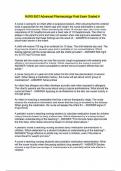
NURS 6521 Advanced Pharmacology Final Exam Graded A
A nurse is caring for an infant after a surgical procedure. After ensuring that the ordered dose is appropriate for the infant's age and weight, the nurse administers a narcotic analgesic intravenously. When assessing the infant 15 minutes later, the nurse notes respirations of 22 breaths/minute and a heart rate of 110 beats/minute. The infant is asleep in the parent's arms and does not awaken when vital signs are assessed. The nurse understands that these findings are the result of: - ANSWER immaturity of the blood-brain barrier in the infant. A child will receive 750 mg of an antibiotic for 10 days. The child attends day care. The drug may be dosed in several ways and is available in two concentrations. Which dosing regimen will the nurse discuss with the child's provider? - ANSWER 500 mg/5 mL to 375 mg PO twice daily Parents ask the nurse why an over-the-counter cough suppressant with sedative side effects is not recommended for infants. Which response by the nurse is correct? - ANSWER "Infants are more susceptible to central nervous system effects than are adults." A nurse caring for a 5-year-old child notes that the child has discoloration of several teeth. When taking a medication history, the nurse will ask about which group of medications? - ANSWER Tetracyclines An infant has allergies and often develops a pruritic rash when exposed to allergens. The infant's parents ask the nurse about using a topical antihistamine. What should the nurse tell them? - ANSWER Applying an antihistamine to the skin can cause toxicity in this age group. An infant is receiving a medication that has a narrow therapeutic range. The nurse reviews the medication information and learns that the drug is excreted by the kidneys. When giving the medication, the nurse will assess the infant for: - ANSWER signs of drug toxicity. A pediatric nurse is teaching nursing students to calculate medication doses for children using a formula based on body surface area. Which statement by a nursing student indicates understanding of the teaching? - ANSWER "This formula helps approximate the first dose; other doses should be based on clinical observations." A pediatric nurse is teaching nursing students about medication administration in children. Which statement by a student indicates an understanding of the teaching? - ANSWER "Drugs effective in adults may not work in children, even if the dose is proportional for weight and size." A nurse is teaching nursing students about pediatric medication administration. What will the nurse include when discussing pediatric drug research? - ANSWER Studies showed a significant percentage of unanticipated and potentially lethal side effects in children. A prescriber has ordered medication for a newborn. The medication is eliminated primarily by hepatic metabolism. The nurse expects the prescriber to: - ANSWER order a dose that is lower than an adult dose. The parents of a child with asthma ask the nurse why their child can not use oral corticosteroids more often, because they are so effective. The nurse will offer which information that is true for children? - ANSWER Chronic steroid use can inhibit growth. A patient with schizophrenia receives a dose of risperidone [Risperdal Consta] IM. The nurse teaching this patient about this medication will make which statement? - ANSWER "You will need to take an oral antipsychotic drug for 3 weeks." A patient with schizophrenia shows suicidal behaviors, and the provider orders clozapine [Clozaril]. The nurse teaches the family about the medication and its side effects. Which statement by a family member indicates a need for further teaching about this drug? - ANSWER "If the ANC is less than 3000, the drug will be discontinued permanently." A patient in whom drug therapy has failed several times in the past is readmitted to a hospital to begin therapy for schizophrenia. What will the nurse do to help improve adherence? - ANSWER Teach the patient about drug side effects and how to manage them. A nurse provides teaching for a patient about to begin taking an FGA drug for schizophrenia. Which statement by the patient indicates a need for further teaching about side effects of these drugs? - ANSWER "Dry mouth and constipation are uncommon with this medication." A patient taking an FGA medication develops severe parkinsonism and is treated with amantadine [Symmetrel]. The amantadine is withdrawn 2 months later, and the parkinsonism returns. The nurse will expect the provider to: - ANSWER try a secondgeneration antipsychotic (SGA). What are negative symptoms of schizophrenia? Select all that apply. - ANSWER Poor judgment Poor self-care Poverty of speech A patient is taking an FGA for schizophrenia. The nurse notes that the patient has trouble speaking and chewing and observes slow, wormlike-movements of the patient's tongue. The nurse recognizes which adverse effect in this patient? - ANSWER Tardive dyskinesia A nurse and a nursing student are discussing the plan of care for a patient with schizophrenia. The patient, who has been taking a high-potency FGA for 2 months, has become restless and constantly needs to be in motion. Which statement by the student indicates a need for further education? - ANSWER "Because this may be an exacerbation of psychosis, the provider may increase the dose of the FGA." A patient who is taking a first-generation antipsychotic (FGA) drug for schizophrenia comes to the clinic for evaluation. The nurse observes that the patient has a shuffling gait and mild tremors. The nurse will ask the patient's provider about which course of action? - ANSWER Giving an anticholinergic medication A patient with schizophrenia has been taking an oral FGA for 1 week. The patient has been taking the drug daily in two divided doses. The individual complains of daytime drowsiness. The patient's family reports a decrease in the person's hostility and anxiety but states that the patient remains antisocial with disordered thinking. What will the nurse tell the patient and the family? - ANSWER Some symptoms take months to improve. A patient with schizophrenia has been taking an antipsychotic drug for several days. The nurse enters the patient's room to administer a dose of haloperidol [Haldol] and finds the patient having facial spasms. The patient's head is thrust back, and the patient is unable to speak. What will the nurse do? - ANSWER Request an order to give diphenhydramine. A parent reports being afraid that a child may have schizophrenia because of disorganized speech and asocial behaviors. The nurse will tell this parent that which of the following must also be present to make a diagnosis? Select all that apply. - ANSWER A decrease in self-care, job, or school function A 1-month duration of active phase symptoms Continuous signs of disturbance for longer than 6 months Which side effects are more common in second-generation antipsychotic medications than in first-generation antipsychotic medications? Select all that apply. - ANSWER Agranulocytosis Anticholinergic effects Metabolism by CYP3A4 A nurse in a mental health hospital finds a patient with schizophrenia who takes haloperidol [Haldol] lying rigid in bed with a temperature of 41.3°C. A cardiac monitor shows cardiac dysrhythmias. What will be included in the treatment of this patient? Select all that apply. - ANSWER Dantrolene Intravenous fluids Withdrawal of haloperidol A patient who has diabetes mellitus is diagnosed with schizophrenia and the provider orders thioridazine. The patient asks the nurse why the provider has not ordered olanzapine [Zyprexa], which the patient has seen advertised on television. Which response by the nurse is the most important reason that this patient is not receiving olanzapine? - ANSWER "Olanzapine causes more metabolic side effects than thioridazine." A patient who has been taking a monoamine oxidase inhibitor (MAOI) for depression for several months tells the provider that the medication has not helped with symptoms. The provider plans to switch the patient to an SSRI. The nurse will teach this patient to: - ANSWER stop taking the MAOI 2 weeks before starting the SSRI. A young adult patient has been taking an antidepressant medication for several weeks and reports having increased thoughts of suicide. The nurse questions further and learns that the patient has attempted suicide more than once in the past. The patient identifies a concrete plan for committing suicide. The nurse will contact the provider to discuss: - ANSWER hospitalizing the patient for closer monitoring. An older adult patient who is to begin taking imipramine [Tofranil] asks the nurse when the drug should be taken. The nurse will instruct the patient to: - ANSWER divide the daily dose into two equal doses 12 hours apart. A patient has been taking an SSRI antidepressant for major depression and reports having headaches and jaw pain. What will the nurse tell the patient? - ANSWER Discuss these symptoms with a dentist. A neonate is born to a patient who reports taking venlafaxine [Effexor XR]. The nurse caring for the infant will observe the infant for: - ANSWER irritability, tremor, and respiratory distress. A patient is brought to the emergency department after taking a handful of TCA pills. The nurse will expect to provide what when caring for this patient? Select all that apply. - ANSWER Cardiac monitoring Cholinesterase inhibitors Gastric lavage and activated charcoal A patient is diagnosed with major depression with severe symptoms and begins taking an antidepressant medication. Three weeks after beginning therapy, the patient tells the nurse that the drug is not working. The nurse will counsel this patient to ask the provider about: - ANSWER using nondrug therapies to augment the medication. Which patients are candidates for MAOIs? Select all that apply. - ANSWER Patients who have not responded to SSRIs and TCAs Patients with atypical depression Patients with bulimia nervosa A patient whose spouse has died recently reports feeling down most of every day for the past 2 months. On further questioning, the nurse learns that the patient has quit participating in church and social activities, has difficulty falling asleep, and has lost 5 pounds. The patient reports feeling tired and confused all the time but does not have suicidal thoughts. What does the nurse suspect? - ANSWER Major depression A patient taking an MAOI is seen in the clinic with a blood pressure of 170/96 mm Hg. What will the nurse ask this patient? - ANSWER To list all foods eaten that day A patient taking fluoxetine [Prozac] complains of decreased sexual interest. A prescriber orders a "drug holiday." What teaching by the nurse would best describe a drug holiday? - ANSWER "Don't take the medication on Friday and Saturday." A patient with bipolar disorder who wants to minimize the need for drug therapy asks the nurse what else can be done to treat the disorder. The nurse will recommend which measures? Select all that apply. - ANSWER Psychotherapy Regular sleep and exercise Using a chart to monitor mood changes A patient with bipolar disorder who is taking divalproex sodium [Valproate] has just been admitted to the hospital. During the admission assessment, the patient tells the nurse about recent suicidal ideation. The nurse observes several areas of bruising over soft tissue areas and notes a weight gain of 10 pounds since the last admission 1 year ago. What will the nurse do? - ANSWER Contact the provider to report these findings. A patient with bipolar disorder takes lamotrigine [Lamictal]. Which statement by the patient would prompt the nurse to hold the drug and notify the prescriber for further assessment? - ANSWER "I've broken out in a rash on my chest and back." A patient who has recently begun taking carbamazepine [Equetro] for bipolar disorder reports having vertigo and headaches. Which action by the nurse is appropriate? - ANSWER Reassure the patient that these effects occur early in treatment and will resolve over time. A patient is admitted to a hospital for treatment for first-time symptoms of mania and is exhibiting euphoric mania. Which medication will the provider order? - ANSWER Lithium [Lithobid] A patient with bipolar disorder has been taking lithium [Lithobid] for several years. The patient has developed a goiter, and serum tests reveal hypothyroidism. What will the nurse expect the provider to order for this patient? - ANSWER Administration of levothyroxine A nurse is preparing to administer medications to a hospitalized patient who has been taking lithium [Lithobid] for 3 days. The patient is complaining of mild nausea and abdominal bloating. The patient's lithium level is 0.8 mEq/L. What will the nurse do? - ANSWER Administer the dose and tell the patient that the side effects are temporary. A patient recently was diagnosed with bipolar disorder. The patient, who has a history of seasonal allergies, is an athlete who participates in track. The nurse is teaching the patient about lithium [Lithobid], which the prescriber has just ordered. Which statement by the patient indicates the need for further teaching? - ANSWER "I can continue to use ibuprofen as needed for muscle pain." A patient with bipolar disorder is admitted to the hospital. The patient has been taking lithium [Lithobid] for several years and has not been evaluated by a provider for over a year. Besides obtaining a lithium level, the nurse caring for this patient will anticipate orders for which laboratory tests? Select all that apply. - ANSWER Calcium level Renal function tests Thyroid function tests The spouse of a patient with bipolar disorder (BPD) tells the nurse that the patient will not stay on the lithium ordered by the provider longer than 1 or 2 months at a time. The nurse understands that adherence to medication regimens in patients with BPD is problematic and will tell the spouse: - ANSWER "During manic episodes, many patients don't see the benefit of prophylactic medications." A patient with bipolar disorder has frequent manic episodes alternating with depressive episodes. The prescriber orders risperidone [Risperdal] in addition to the lithium [Lithobid] that the patient is already taking. The patient asks the nurse why another drug is needed. The nurse will tell the patient that the risperidone is used to: - ANSWER help control symptoms during manic episodes. A patient with a new-onset seizure disorder receives a prescription for phenobarbital. The patient reports being concerned about the sedative side effects of this drug. Which response by the nurse is correct? - ANSWER "Phenobarbital doses for seizures are nonsedating." A patient who travels frequently for business reports occasional instances of being unable to fall asleep. The patient tells the nurse that job demands require staying up late and then getting up early for meetings. The nurse expects that the provider will prescribe which medication for this patient? - ANSWER Zaleplon [Sonata] A patient who is experiencing alcohol withdrawal is given a benzodiazepine. The nurse understands that this drug is effective because: - ANSWER the patient has a crossdependence to the benzodiazepine. A patient in the emergency department is given intravenous diazepam [Valium] for seizures. When the seizures stop, the nurse notes that the patient is lethargic and confused and has a respiratory rate of 10 breaths/minute. The nurse will expect to administer which of the following? - ANSWER Respiratory support A patient who has been using secobarbital for several months to treat insomnia tells the nurse that the prescriber has said the prescription will be changed to temazepam [Restoril] because it is safer. The patient asks why this agent is safer. The nurse is correct in telling the patient that temazepam: - ANSWER potentiates endogenous gamma-aminobutyric acid (GABA) producing a finite CNS depression. A hospitalized patient who is given one dose of flurazepam continues to show drowsiness the next day. A nursing student asks the nurse the reason for this, because the drug's half-life is only 2 to 3 hours. Which response by the nurse is correct? - ANSWER "When this drug is metabolized, the resulting compound has longer-lasting effects." A patient takes temazepam [Restoril] for insomnia. The patient tells the nurse that a recent telephone bill lists several calls to friends that the patient does not remember making. What will the nurse do? - ANSWER Ask the patient about any alcohol consumption in conjunction with the benzodiazepine. A nurse is discussing the use of benzodiazepines as sedative-hypnotic agents with a group of nursing students. A student asks about the actions of these drugs in the central nervous system. The nurse makes which correct statement? - ANSWER "Benzodiazepines affect the hippocampus and the cerebral cortex to cause anterograde amnesia." A patient who has been taking alprazolam [Xanax] to treat generalized anxiety disorder (GAD) reports recently stopping the medication after symptoms have improved but reports having feelings of panic and paranoia. Which initial action by the nurse is correct? - ANSWER Ask the patient if the medication was stopped abruptly. A patient is diagnosed with anxiety after describing symptoms of tension, poor concentration, and difficulty sleeping that have persisted for over 6 months. Which medication will the nurse expect the provider to order for this patient? - ANSWER Buspirone [Buspar] A nurse is preparing a patient who will stop taking lorazepam [Ativan] for anxiety and begin taking buspirone [Buspar]. Which statement by the patient indicates a need for further teaching? - ANSWER "I should stop taking the Ativan when I start taking the Buspar." A patient reports having occasional periods of tremors, palpitations, nausea, and a sense of fear, which usually dissipate within 30 minutes. To treat this condition, the nurse anticipates the provider will prescribe a drug in which drug class? - ANSWER Selective serotonin reuptake inhibitors Selective serotonin reuptake inhibitors are known to be effective for which disorders? Select all that apply. - ANSWER Generalized anxiety disorder (GAD) Obsessive-compulsive disorder Panic disorder Social anxiety disorder uring an admission history, a patient reports a frequent need to return to a room multiple times to make sure an iron or other appliance is unplugged. What does the nurse understand about this patient's behavior? - ANSWER It helps the patient reduce anxiety about causing a fire. A patient describes feelings of anxiety and fear when speaking in front of an audience and is having difficulty at work because of an inability to present information at meetings three or four times each year. The patient is reluctant to take long-term medications. The nurse will expect the provider to order which treatment? - ANSWER Alprazolam [Xanax] as needed A patient who has obsessive-compulsive disorder (OCD) has been undergoing behavioral therapy but continues to exhibit symptoms that interfere with daily life. Which intervention will the nurse expect the provider to order for this patient? - ANSWER Fluoxetine [Paxil] A nurse is performing an admission assessment on a patient. The patient reports taking alprazolam [Xanax] for "nerves." The nurse knows that this patient is most likely being treated for which condition? - ANSWER Generalized anxiety disorder An agitated, extremely anxious patient is brought to the emergency department. The prescriber orders a benzodiazepine. The nurse understands that benzodiazepines are used in this clinical situation based on which principle? - ANSWER Benzodiazepines have a rapid onset of action. A child will begin taking methylphenidate [Ritalin] for attention-deficit/hyperactivity disorder. Important baseline information about this patient will include: - ANSWER height and weight. A child has been taking SD methylphenidate [Ritalin], 10 mg at 0800 and 1200 and 5 mg at 1600, for 2 months. The parents tell the nurse that the child sometimes misses the noon dose while at school. The child's appetite is normal. The teacher has reported a slight improvement in hyperactivity and impulsivity. What will the nurse do? - ANSWER Ask the prescriber whether this child could be given methylphenidate [Concerta]. An adult patient will begin taking atomoxetine [Strattera] for attentiondeficit/ hyperactivity disorder. What will the nurse teach this patient? - ANSWER Therapeutic effects may not be felt for 1 to 3 weeks after beginning therapy. A child is diagnosed with attention-deficit/hyperactivity disorder (ADHD). The prescriber orders a central nervous system stimulant. Which statement by the child's parent indicates a need for further teaching? - ANSWER "This drug will make him less impulsive while he's at school." A university student who is agitated and restless and has tremors is brought to the emergency department. The patient's heart rate is 110 beats/minute, the respiratory rate is 18 breaths/minute, and the blood pressure is 160/95 mm Hg. The patient reports using concentrated energy drinks to stay awake during finals. This patient is at risk of having: - ANSWER Seizures A patient who is morbidly obese is admitted for treatment. The prescriber orders lisdexamfetamine [Vyvanse]. The nurse will be concerned if this patient shows signs of: - ANSWER dyspnea. 234. A nurse is providing education to a group of patients regarding amphetamines. To evaluate the group's understanding, the nurse asks a participant what effects amphetamines would have on her. The participant shows that she understands the effects of these drugs if she gives which answers? Select all that apply. - ANSWER "Amphetamines suppress the perception of pain." "Amphetamines increase the heart rate." "Amphetamines elevate mood." A nurse working the night shift begins taking modafinil [Alertec]. The nurse is telling a coworker about the medication. Which statement is correct? - ANSWER "It will not interfere with my normal sleep." A nurse is teaching the parents of a child who has attention-deficit/hyperactivity disorder about methylphenidate [Concerta]. Which statement by the child's parents indicates understanding of the teaching? - ANSWER "The tablet needs to be swallowed whole, not crushed or chewed." A young adult begins taking clonidine [Kapvay] to treat ADHD symptoms after suffering anorexia with methylphenidate [Ritalin]. What will the nurse include when teaching this patient about taking clonidine? - ANSWER "Avoid consuming alcohol while taking this medication." A parent thinks a school-aged child has ADHD. The nurse asks the parent to describe the child's behaviors. Which behaviors are characteristic of ADHD? Select all that apply. - ANSWER Hyperactivity Inattention Impulsivity A patient has been receiving heparin while in the hospital to treat deep vein thromboses and will be discharged home with a prescription for enoxaparin [Lovenox]. The nurse provides teaching for the nursing student who asks about the advantages of enoxaparin over heparin. Which statement by the student indicates a need for further teaching? - ANSWER "Enoxaparin is more cost-effective than heparin." A patient is receiving heparin postoperatively to prevent deep vein thrombosis. The nurse notes that the patient has a blood pressure of 90/50 mm Hg and a heart rate of 98 beats/minute. The patient's most recent aPTT is greater than 90 seconds. The patient reports lumbar pain. The nurse will request an order for: - ANSWER protamine sulfate. A nursing student who is preparing to care for a postoperative patient with deep vein thrombosis asks the nurse why the patient must take heparin rather than warfarin. Which response by the nurse is correct? - ANSWER "The onset of warfarin is delayed." A postoperative patient reports pain in the left lower extremity. The nurse notes swelling in the lower leg, which feels warm to the touch. The nurse will anticipate giving which medication? - ANSWER Enoxaparin [Lovenox] A patient who is taking warfarin [Coumadin] has just vomited blood. The nurse notifies the provider, who orders laboratory work revealing a PT of 42 seconds and an INR of 3.5. The nurse will expect to administer: - ANSWER phytonadione (vitamin K1) 1 mg IV over 1 hour. A patient is admitted to the emergency department with chest pain. An electrocardiogram shows changes consistent with an evolving myocardial infarction. The patient's cardiac enzymes are pending. The nurse caring for this patient will expect to: - ANSWER give alteplase [Activase] within 2 hours. A patient who takes warfarin for atrial fibrillation undergoes hip replacement surgery. On the second postoperative day, the nurse assesses the patient and notes an oxygen saturation of 83%, pleuritic chest pain, shortness of breath, and hemoptysis. The nurse will contact the provider to report possible and request an order for - ANSWER pulmonary embolism; heparin A patient with atrial fibrillation is receiving warfarin [Coumadin]. The nurse notes that the patient's INR is 2.7. Before giving the next dose of warfarin, the nurse will notify the provider and: - ANSWER administer the dose as ordered. A postoperative patient will begin anticoagulant therapy with rivaroxaban [Xarelto] after knee replacement surgery. The nurse performs a history and learns that the patient is taking erythromycin. The patient's creatinine clearance is 50 mL/minute. The nurse will: - ANSWER notify the provider to discuss changing the patient's antibiotic. A patient who is taking clopidogrel [Plavix] calls the nurse to report black, tarry stools and coffee-ground emesis. The nurse will tell the patient to: - ANSWER continue taking the clopidogrel until talking to the provider. A patient has been taking warfarin [Coumadin] for atrial fibrillation. The provider has ordered dabigatran etexilate [Pradaxa] to replace the warfarin. The nurse teaches the patient about the change in drug regimen. Which statement by the patient indicates understanding of the teaching? - ANSWER "I will stop taking the warfarin and will start taking the dabigatran when my INR is less than 2." A 50-year-old female patient asks a nurse about taking aspirin to prevent heart disease. The patient does not have a history of myocardial infarction. Her cholesterol and blood pressure are normal, and she does not smoke. What will the nurse tell the patient? - ANSWER There is most likely no protective benefit for patients her age. A patient who takes warfarin [Coumadin] is brought to the emergency department after accidentally taking too much warfarin. The patient's heart rate is 78 beats/minute and the blood pressure is 120/80 mm Hg. A dipstick urinalysis is normal. The patient does not have any obvious hematoma or petechiae and does not complain of pain. The nurse will anticipate an order for: - ANSWER a PT and an INR. A nurse caring for a patient receiving heparin therapy notes that the patient has a heart rate of 98 beats/minute and a blood pressure of 110/72 mm Hg. The patient's fingertips are purplish in color. A stat CBC shows a platelet count of less than 100,000 mm3. The nurse will: - ANSWER discontinue the heparin and notify the provider. A patient will begin taking dabigatran etexilate [Pradaxa] to prevent stroke. The nurse will include which statement when teaching this patient? - ANSWER It is important not to crush, chew, or open capsules of dabigatran. A patient is admitted to the hospital with unstable angina and will undergo a percutaneous coronary intervention. Which drug regimen will the nurse expect to administer to prevent thrombosis in this patient? - ANSWER Aspirin, heparin, abciximab [ReoPro] A patient who has taken warfarin [Coumadin] for a year begins taking carbamazepine. The nurse will anticipate an order to: - ANSWER increase the dose of warfarin. A nurse has just received an order for tenecteplase [TNKase] for a patient experiencing an acute myocardial infarction. The nurse should administer this drug: - ANSWER by bolus injection A nurse is taking a medication history on a newly admitted patient. The patient reports taking folic acid and vitamin B12. The nurse notifies the provider because of the concern that folic acid can: - ANSWER mask the signs of vitamin B12 deficiency. A nurse is caring for a patient after hip replacement surgery. The patient has been receiving iron replacement therapy for 2 days. The nurse notes that the patient's stools appear black. The patient is pale and complains of feeling tired. The patient's heart rate is 98 beats/minute, respirations are 20 breaths/minute, and the blood pressure is 100/50 mm Hg. The nurse will contact the provider to: - ANSWER request a hemoglobin and hematocrit (H&H). A 12-year-old female patient is admitted to the hospital before sinus surgery. The nurse preparing to care for this patient notes that the admission hemoglobin is 10.2 gm/dL, and the hematocrit is 32%. The nurse will ask the child's parents which question about their daughter? - ANSWER "Has she begun menstruating?" A patient with renal failure is undergoing chronic hemodialysis. The patient's hemoglobin is 10.6 gm/dL. The provider orders sodium-ferric gluconate complex (SFGC [Ferrlecit]). What will the nurse expect to do? - ANSWER Administer the drug intravenously with erythropoietin. A patient tells a nurse that she is thinking about getting pregnant and asks about nutritional supplements. What will the nurse recommend? - ANSWER 400 to 800 mg of folic acid per day A patient who has recently immigrated to the United States from an impoverished country appears malnourished. The patient's folic acid levels are low, and the vitamin B12 levels are normal. The nurse expects this patient's treatment to include: - ANSWER a diet high in folic acid. A patient is admitted to the hospital. The patient's initial laboratory results reveal megaloblastic anemia. The patient complains of tingling of the hands and appears confused. The nurse suspects what in this patient? - ANSWER Vitamin B12 deficiency A nurse is reviewing a patient's most recent blood count and notes that the patient has a hemoglobin of 9.6 gm/dL and a hematocrit of 33%. The nurse will notify the provider and will expect initial treatment to include: - ANSWER determining the cause of the anemia. What are the indications for administration of a parenteral iron preparation? Select all that apply. Blood loss of 750 mL/week - ANSWER Blood loss of 750 mL/week Celiac disease with anemia Intestinal disease impairing absorption A patient was given a 30-day supply of Feosol and has been taking the drug for 4 weeks for iron deficiency anemia. The patient's initial hemoglobin was 8.9 gm/dL. The nurse notes that the hemoglobin has risen to 9.7 gm/dL. What will the nurse ask the patient about? - ANSWER Whether the prescription needs to be refilled The patient with which of the following is most at risk for folic acid deficiency? - ANSWER Alcoholism A patient is receiving oral iron for iron deficiency anemia. Which antibiotic drug, taken concurrently with iron, would most concern the nurse? - ANSWER Tetracycline A patient with vitamin B12 deficiency is admitted with symptoms of hypoxia, anemia, numbness of hands and feet, and oral stomatitis. The nurse expects the prescriber to order which of the following therapies? - ANSWER IM cyanocobalamin and folic acid A patient who has been prescribed oral ferrous sulfate reports taking extra doses for the past few months. The patient's serum iron level is 560 mcg/dL. What will the nurse expect the provider to order for this patient? - ANSWER oral deferasirox [Exjade]Giving parenteral deferoxamine [Desferal] A patient is diagnosed with moderate vitamin B12 deficiency. The nurse reviews the laboratory work and notes that the plasma B12 is low; also, a Schilling test reveals B12 malabsorption. The provider orders oral cyanocobalamin 500 mcg/day. The nurse will contact the provider to: - ANSWER suggest an increased dose. A postmenopausal patient who has had a hysterectomy and who has a family history of coronary heart disease reports experiencing vaginal dryness and pain with intercourse but tells the nurse that she does not want to take hormones because she is afraid of adverse effects. The nurse will suggest that the woman ask her provider about: - ANSWER Premarin vaginal. A 50-year-old postmenopausal patient who has had a hysterectomy has moderate to severe vasomotor symptoms and is discussing estrogen therapy (ET) with the nurse. The patient is concerned about adverse effects of ET. The nurse will tell her that: - ANSWER transdermal preparations have fewer side effects. A patient who will begin combination estrogen/progestin therapy (EPT) for menopause asks the nurse why she cannot take an estrogen-only preparation. The patient has not had a hysterectomy, has a slightly increased risk of cardiovascular disease, and has mild osteopenia. The nurse will tell her that the progestin is necessary to: - ANSWER decrease her risk of endometrial cancer A nurse provides teaching to a patient who has had a hysterectomy and is about to begin hormone therapy to manage menopausal symptoms. Which statement by the patient indicates understanding of the teaching? - ANSWER "I should take the lowest effective dose for the shortest time needed." A patient with osteopenia asks a nurse about the benefits of hormone therapy in preventing osteoporosis. Which statement by the nurse is correct? - ANSWER "When hormone therapy is discontinued, bone mass is quickly lost." The nurse is providing patient education about the application of transdermal estrogen spray. Which statement made by the patient best demonstrates understanding of the application of this medication? "I should apply this medication to my: - ANSWER thighs and calves." A nurse provides teaching to a group of nursing students about the risks and benefits of hormone therapy (HT), including estrogen therapy (ET) and combination estrogen/progestin therapy (EPT). Which statement by a student indicates understanding of the teaching? - ANSWER "Principal benefits of ET are suppression of menopausal symptoms and prevention of bone loss."
Escuela, estudio y materia
- Institución
-
Walden University
- Grado
-
NURS 6521
Información del documento
- Subido en
- 25 de marzo de 2025
- Número de páginas
- 27
- Escrito en
- 2024/2025
- Tipo
- Examen
- Contiene
- Preguntas y respuestas
Temas
- nurs 6521
- advanced pharmacology
- pharmacology
-
advanced pharmacology final exam graded
-
nurs 6521 advanced pharmacology final exam graded

Documento también disponible en un lote